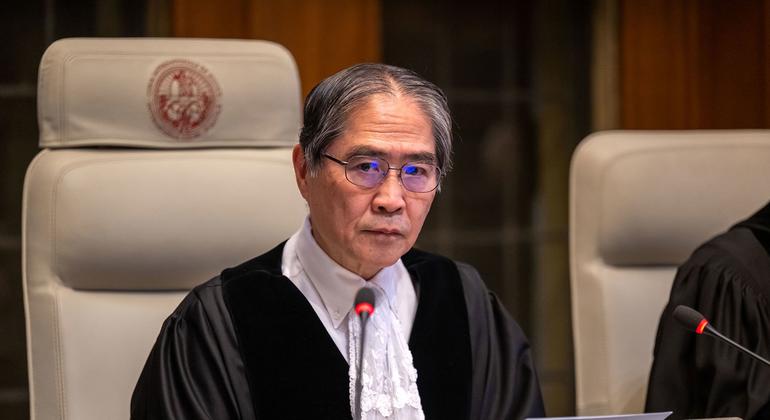
ICJ President Judge Iwasawa Yuji Addresses 80th UN General Assembly Session

Madam President, Excellencies, Distinguished Delegates,
It is an honour for me to address the General Assembly today. I am keenly aware of the importance of highlighting the contribution of the principal judicial organ of the United Nations to the objectives of the Organization as a whole. Key to this endeavour is the long-standing tradition of providing an annual platform to the President of the Court to present an overview of the judicial activities of the Court over the previous 12 months.
Before I begin my presentation, I would like to take this opportunity to congratulate Her Excellency Ms Annalena Baerbock on her election as President of the Eightieth Session of the General Assembly. Madam President, I wish you every success in this distinguished office.
Turning now to the work of the Court during the period under review, I shall commence with a brief summary and then explain in a little more depth the various rulings delivered since my predecessor addressed you last year. On 1 August 2024 the starting date of the period covered by the Court’s annual report there were 23 cases on the Court’s docket.
Over the course of the year, the number of cases has remained at a record high, with 24 cases currently pending, including 23 contentious proceedings and one advisory proceeding. The inter-State disputes cover a wide range of legal issues, such as land and maritime delimitation, human rights, environmental protection, economic relations, immunities, as well as the interpretation and application of treaties dealing with diverse subject matters. The request for an advisory opinion, which was submitted by the International Labour Organization (ILO), relates to the question of whether the right to strike of workers and their organizations is protected under ILO Convention No. 87.
Since my predecessor’s address to you last October, five new contentious cases have been brought before the Court, two of which have, however, been removed from the General List.
The first case was brought on 17th April 2025 by the Islamic Republic of Iran against Canada, Sweden, Ukraine and the United Kingdom and concerns an appeal relating to the jurisdiction of the ICAO Council under Article 84 of the Convention on International Civil Aviation.
The second case was filed on 16 May 2025 by France against the Islamic Republic of Iran with regard to a dispute over alleged violations by the latter of obligations under the Vienna Convention on Consular Relations in the context of the arrest, detention and trial of several French nationals in Iran. These proceedings were, however, subsequently withdrawn by France, and the Court issued an Order on 19 September 2025 placing on record the discontinuance by the Applicant and directing that the case be removed from the General List.
The third case was filed by Lithuania against Belarus on 19 May 2025, with reference to a dispute relating to alleged breaches by Belarus of its obligations under the Protocol against the Smuggling of Migrants by Land, Sea and Air, in relation to the alleged large-scale smuggling of irregular migrants from Belarus into Lithuania. Most recently, on 18th September 2025, the Russian Federation filed an Application against Australia and the Netherlands, constituting an appeal against a decision by the ICAO Council. In addition, on 5 March 2025, Sudan instituted a case against the United Arab Emirates alleging breaches by the latter of obligations under the Convention on the Prevention and Punishment of the Crime of Genocide in Sudan. For reasons I will explain later in my speech, that case was removed from the General List.
Madam President, since last summer, the Court has held hearings in six cases and has rendered one Judgment on the merits, two Judgments on preliminary objections and two Advisory Opinions, the second of which was delivered a week ago. In addition, it has issued three Orders on requests for the indication or modification of provisional measures, one on the suspension of proceedings, and one on the admissibility of declarations of intervention. The Court has also issued a number of Orders on time-limits. The Court is currently deliberating on the request for an advisory opinion submitted by the ILO.
As is customary, I shall now give a brief account of the judgments and advisory opinions delivered and the substantive orders made during the period under review. I should like to begin with the two advisory opinions requested by your Assembly.
I shall first give an overview of the Advisory Opinion on the Obligations of States in respect of Climate Change, which was rendered by the Court on 23 July 2025, in response to this Assembly’s request, as set out in resolution 77/276. These proceedings were followed closely by the international community and saw an unprecedented level of participation, with ninety-six States and eleven international organizations presenting their views during the oral hearings. The Opinion of the Court was adopted unanimously.
The General Assembly put two questions to the Court.
The first concerned the obligations of States under international law to ensure the protection of the climate system and other parts of the environment from anthropogenic emissions of greenhouse gases.
The second question concerned the legal consequences under these obligations for States where they, by their acts and omissions, have caused significant harm to the climate system and other parts of the environment.
In its Advisory Opinion, the Court noted that the consequences of climate change were severe and far-reaching, affecting both natural ecosystems and human populations, and posing an urgent and existential threat. In examining these consequences, the Court relied primarily on the reports of the IPCC, the Intergovernmental Panel on Climate Change, which participants agreed provide the best available scientific explanation on the causes, nature and effects of climate change.
With regard to the first question relating to the obligations of States in respect of climate change, the Court determined that the most directly relevant applicable law consists of the Charter of the United Nations, the three climate change treaties: namely the United Nations Framework Convention on Climate Change; the Kyoto Protocol and the Paris Agreement ¾ the United Nations Convention on the Law of the Sea, the Ozone Layer Convention, the Montreal Protocol, the Biodiversity Convention and the Desertification Convention.
The Court further determined that the customary duty of States to prevent significant harm to the environment and the duty to co-operate in the protection of the environment also form part of the most relevant applicable law. The Court moreover stated that the core human rights treaties, including the International Covenant on Economic, Social and Cultural Rights and the International Covenant on Civil and Political Rights, and human rights recognized under customary international law, form part of the most directly relevant applicable law.
Finally, the Court found that the principles of sustainable development, common but differentiated responsibilities and respective capabilities, equity, intergenerational equity and the precautionary approach or principle are applicable as guiding principles for the interpretation and application of the most directly relevant legal rules. The Court considered that the argument according to which the climate change treaties constitute lex specialis excluding the application of other rules of international law could not be upheld.
The Court explained that the climate change treaties set forth binding obligations for States parties to ensure the protection of the climate system and other parts of the environment from anthropogenic greenhouse gas emissions. It added that these obligations are stringent and notably include, under the Paris Agreement, an obligation to prepare, communicate and maintain successive and progressive nationally determined contributions which, inter alia, when taken together, are capable of achieving the temperature goal of limiting global warming to 1.5°C above pre-industrial levels.
Concerning the obligations of States under customary international law relating to climate change, the Court noted that States are under a duty to prevent significant harm to the environment and that, to this end, due diligence is the required standard of conduct. The Court further noted that the duty to co-operate for the protection of the environment has a customary character, and emphasized the importance of co-operation in the context of a resource shared by all States, such as the climate system. It added that co-operation between States is the very foundation of meaningful international efforts with respect to climate change.
The Court considered that the obligations arising from the climate change treaties and State practice in implementing them inform the general customary obligations, just as the general customary obligations provide guidance for the interpretation of the climate change treaties.
Examining the obligations of States under other relevant environmental treaties and UNCLOS, the Court considered that these instruments, the climate change treaties and the relevant obligations under customary international law inform each other. In particular, States have to take their obligations under environmental treaties and UNCLOS into account when implementing their obligations under the climate change treaties and under customary international law, just as they must take their obligations under the climate change treaties and under customary international law into account when implementing their obligations under environmental treaties and UNCLOS.
With respect to sea level rise, the Court considered that the provisions of UNCLOS do not require States parties to update their charts or lists of geographical co-ordinates that show the baselines and outer limit lines of their maritime zones once they have been duly established in conformity with the Convention. The Court also recalled that several participants had argued that sea level rise poses a significant threat to territorial integrity and thus to the very statehood of small island States. In this regard, the Court clarified that once a State is established, the disappearance of one of its constituent elements would not necessarily entail the loss of its statehood.
The Court then examined the obligations of States under international human rights law. Taking into account the adverse effects of climate change on the enjoyment of human rights, the Court considered that the full enjoyment of human rights cannot be ensured without the protection of the climate system. The Court then addressed the second question relating to the legal consequences arising from States’ acts and omissions that cause significant harm to the climate system. With respect to the determination of State responsibility, it underlined that responsibility for breaches of obligations
under the climate change treaties, and in relation to the loss and damage associated with the adverse effects of climate change, is to be determined by applying the well-established rules on State responsibility under customary international law.
With respect to the legal consequences arising from wrongful acts in the climate change context, it stressed that it could not, in the course of the advisory proceedings, specify precisely what consequences are entailed by the commission of an internationally wrongful act breaching obligations to protect the climate system from anthropogenic greenhouse gas emissions, since such consequences depend on the specific breach in question and on the nature of the particular harm.
As a general observation, the Court noted that breaches of States’ obligations under the first question put by the General Assembly might give rise to the entire panoply of legal consequences provided for under the law of State responsibility. These include obligations of cessation and non-repetition, which are consequences that apply irrespective of the existence of harm, as well as consequences requiring full reparation, including restitution, compensation and/or satisfaction. The Court also noted that breaches of States’ obligations do not affect the continued duty of the responsible State to perform the obligation breached.
In conclusion, the Court underlined that the questions posed by the General Assembly represent more than a legal problem: they concern an existential problem of planetary proportions. International law, whose authority had been invoked by the General Assembly, has an important but ultimately limited role in resolving this problem. A lasting and satisfactory solution requires human will and wisdom.
On 22nd October 2025, one week ago, the Court delivered its Advisory Opinion on the Obligations of Israel in relation to the Presence and Activities of the United Nations, Other International Organizations and Third States in and in relation to the Occupied Palestinian Territory. The question put to the Court was formulated in resolution 79/232 adopted on 19th December 2024, less than a year ago.
The Assembly asked the Court to determine “the obligations of Israel, as an occupying Power and as a member of the United Nations, in relation to the presence and activities of the United Nations, including its agencies and bodies, other international organizations and third States, in and in relation to the Occupied Palestinian Territory”.
In addressing the scope of the question, the Court stated that in addition to Israel’s obligations in the Occupied Palestinian Territory, the request also required consideration of Israeli activities undertaken on Israeli territory or elsewhere to the extent that they concerned the Occupied Palestinian Territory.
Given the circumstances on the ground, the Court paid particular attention to Israel’s obligations in the Gaza Strip. The Court noted that, while it based its legal analysis primarily on the facts as they stood at the closure of the oral proceedings, it had taken into account subsequent developments based on information presented to the Court, at its request, by the United Nations, Israel and the observer State of Palestine in September 2025.
The Court noted that Israel’s relevant obligations, as an occupying Power, flow from the 1949 Fourth Geneva Convention, to which Israel is a party. Israel also has obligations under customary international law, as notably reflected in the 1907 Hague Regulations and in certain provisions of 1977 Additional Protocol I to the Geneva Conventions.
The Court observed that, since 07th October 2023, Israel’s effective control over the Gaza Strip had increased significantly, as evidenced, inter alia, by Israel’s increased military control in large portions of the territory and Israel’s blocking of aid between 2 March and 18 May 2025. Therefore, the Court found that Israel’s obligations under the law of occupation had also increased significantly, commensurate with the increase in its effective control over the territory. The Court added that, when hostilities take place in an occupied territory, the law of occupation applies alongside other rules of international humanitarian law relating to the conduct of hostilities, and the occupying Power must comply with both sets of rules. However, the intensity of the hostilities could affect the implementation of certain obligations under the law of occupation.
The Court was conscious of Israel’s security concerns. It observed, however, that the protection of security interests is not a free-standing exception permitting a State to depart from the otherwise applicable rules of international humanitarian law. It noted that any limitations on Israel’s obligations under international humanitarian law based on its security concerns must be grounded in a specific rule. The Court underscored that reliance upon such concerns must be exercised in accordance with the principle of good faith, and that when States take measures to combat terrorism, they must comply with their obligations under international law.
Turning to the relevant framework under international humanitarian law, the Court observed that Articles 55 and 56 of the Fourth Geneva Convention oblige an occupying Power to ensure that the population of the occupied territory is supplied with the essentials of daily life, including food, water, shelter, medical supplies and medical care. Article 59 imposes additional obligations that come into play when the population is inadequately supplied. The Court found that the local population in the Gaza Strip has been inadequately supplied and that Israel, as the occupying Power, is under an obligation to facilitate relief schemes provided by the United Nations, including UNRWA.
The Court noted that there was no evidence that, as an entity, UNRWA had breached the principle of impartiality within the meaning of Article 59, as alleged by Israel. It further noted that, while neutrality is not a separate requirement under Article 59, it plays a role in assessing the impartiality of the activities of humanitarian organizations. The Court concluded that the information before it was not sufficient to establish UNRWA’s lack of neutrality for the purpose of assessing its impartiality under Article 59.
After considering how Article 59 applies in the particular context of the Gaza Strip and assessing Israel’s actions to replace UNRWA, the Court concluded that, under the present circumstances, the United Nations, acting through UNRWA, has been an indispensable provider of humanitarian relief in the Gaza Strip. Thus, having regard to Article 59, and in the circumstances, the Court considered that Israel is under an obligation to agree to and facilitate relief schemes provided by the United Nations and its entities, including UNRWA. Furthermore, under Article 59, Israel is also obliged to facilitate relief schemes provided by third States or impartial humanitarian organizations.
The Court further observed that Israel, as an occupying Power, is prohibited from restricting the presence and activities of the United Nations, other international organizations and third States to a degree that created conditions of life that would force the population to leave. Moreover, Israel is under an obligation under customary international law not to use starvation of the civilian population as a method of warfare.
Israel also has obligations under international human rights law to respect, protect and fulfil the human rights of the population of the Occupied Palestinian Territory. Restrictions on the provision of humanitarian aid that is indispensable for the well-being and dignity of the Palestinian population directly implicate these obligations. The Court confirmed that Israel is under a positive obligation to protect human rights, even in times of armed conflict. It observed that, to the extent that the local population has been capable of enjoying many of these human rights, this has been largely enabled and ensured through the work of the United Nations, particularly through UNRWA, supported by the activities of other international organizations and third States. Consequently, any diminution by Israel of the capacity of these entities to ensure these basic human rights meant that the obligations of Israel to protect these rights increase to a commensurate degree.
Turning next to the obligations of Israel as a Member State of the United Nations, the Court discussed first the obligation to co-operate with the United Nations. In realizing the purposes of the United Nations, Member States have a specific obligation to co-operate with the Organization under Article 2, paragraph 5, of the Charter, which provides that “all Members shall give the United Nations every assistance in any action it takes in accordance with the present Charter”. This provision must be read together with the provisions of the Charter relating to the powers of various organs of the United Nations. The obligation of Israel, and of all other Member States, to co-operate with the United Nations with respect to the question of Palestine is of paramount importance in addressing the critical situation on the ground since October 2023. In the view of the Court, Israel is not entitled to withhold its co-operation with the United Nations by unilaterally deciding on the presence and activities of United Nations entities in the Occupied Palestinian Territory. Within the territory of Israel, the presence and activities of the United Nations and its entities are subject to the consent of Israel.
With regard to the obligation to respect the privileges and immunities of the United Nations, the Court emphasized that the privileges and immunities accorded to the United Nations and its personnel by virtue of Article 105 of the Charter and the General Convention are functional in nature, and do not cease to operate in the context of armed conflict. The Court concluded that Israel must respect the privileges and immunities accorded to the United Nations, its personnel, premises, property and assets in the Occupied Palestinian Territory, and that it must address any concerns arising in this context within the legal framework of the United Nations.
In the last section of its Advisory Opinion, the Court discussed the presence and activities of the United Nations in support of the right of the Palestinian people to self-determination. It stated that respect for the right to self-determination of the Palestinian people required Israel not to prevent the fulfilment of the basic needs of the Palestinian people in the Gaza Strip, including by the United Nations, its entities, other international organizations and third States. Since October 2023, UNRWA had remained the principal means of all humanitarian response in the Gaza Strip. The Court concluded that Israel is under an obligation not to impede the operations of United Nations entities, other international organizations and third States, and to co-operate in good faith with the United Nations to ensure respect for the right of the Palestinian people to self-determination.
I shall now turn to the other rulings of the Court during the period under review. On 12 November 2024, the Court issued its Judgment on preliminary objections in the case concerning Application of the International Convention on the Elimination of All Forms of Racial Discrimination (Armenia v. Azerbaijan). Armenia instituted these proceedings on 16th September 2021, alleging racial
discrimination by the Respondent in violation of the aforementioned Convention, which I shall refer to as “CERD”. On 21st April 2023, Azerbaijan raised two preliminary objections to the jurisdiction of the Court.
Azerbaijan contended, first, that the Court lacked jurisdiction under Article 22 of CERD because the precondition of negotiation had not been satisfied. The Court considered that Armenia had made a genuine attempt to engage in discussions with Azerbaijan with a view to resolving the dispute. The Court concluded that the precondition of negotiation had been satisfied and accordingly rejected the first preliminary objection raised by Azerbaijan.
Second, Azerbaijan argued that claims relating to alleged murder, torture and inhuman treatment, and arbitrary detention and enforced disappearance fell outside of the scope of CERD, and were thus not within the Court’s jurisdiction ratione materiae. In particular, according to Azerbaijan, these claims, even if proven, would constitute violations of international humanitarian law and reflect the general animosity between nationals of two States involved in an armed conflict, rather than hostility based on the ethnic origin of the victims. On this point, the Court noted that the prohibition of racial discrimination, an essential part of international human rights law, is also a fundamental element of international humanitarian law.
It recalled its previous jurisprudence whereby it had acknowledged that allegedly discriminatory acts taking place in the context of armed conflict “appeared to be” capable of contravening rights provided for by CERD, even if certain of these alleged acts might also be covered by other rules of international law. It also recalled that the protection offered by human rights conventions does not cease in case of armed conflict, and thus, the protection against racial discrimination provided by CERD continued to apply.
The Court then considered whether the specific acts complained of by Armenia were capable of establishing discriminatory treatment against ethnic Armenians, in breach of their rights protected under CERD. The Court found that Armenia’s claims of alleged racially motivated murder, torture and inhuman treatment of ethnic Armenians fell within the scope of CERD, as did the acts alleged by Armenia in relation to the arbitrary detention and enforced disappearance of ethnic Armenian civilians. The Court thus concluded that Azerbaijan’s second preliminary objection to the Court’s jurisdiction must also be rejected. The proceedings on the merits of this case, which had been suspended following the filing of Azerbaijan’s preliminary objections, have now resumed.
On the same day, 12th November 2024, the Court also issued its Judgment on the preliminary objections in the case concerning Application of the International Convention on the Elimination of All Forms of Racial Discrimination (Azerbaijan v. Armenia), a case parallel to the one I have just described. This case was brought by Azerbaijan against Armenia on 23rd September 2021 and concerned alleged violations of CERD. On 21 April 2023, Armenia raised three preliminary objections to the jurisdiction of the Court and the admissibility of the Application.
Armenia submitted,
first, that the Court lacked jurisdiction ratione temporis with respect to Azerbaijan’s claims concerning events that transpired prior to the entry into force of CERD between the Parties on 15 September 1996, or that such claims were inadmissible. The Court observed that, during the interval period between 23 July 1993, when Armenia became bound by CERD, and 15 September 1996, there were no treaty relations between the Parties under CERD, since Azerbaijan was not yet a party to that instrument. The Court explained that if Azerbaijan were permitted to make claims against Armenia for alleged acts that had occurred during that interval period, while Armenia was not able to exercise such a right against Azerbaijan for its conduct during the same period because of its non-party status, there would be no reciprocity and equality between the Parties. For this reason, the Court upheld the first preliminary objection of Armenia.
Second, Armenia submitted that the Court lacked jurisdiction ratione materiae with respect to Azerbaijan’s claims concerning the alleged placement of landmines and booby traps. The Court considered that Azerbaijan had not requested the Court to find that the laying of landmines and booby traps in itself constituted a violation of Armenia’s obligations under CERD, but rather had contended that this activity was part of a policy of ethnic cleansing. The Court concluded that Armenia’s second preliminary objection was without object and must be rejected, observing that any submissions concerning alleged acts of ethnic cleansing should be raised at the merits stage.
Third, Armenia argued that the Court lacked jurisdiction ratione materiae with respect to Azerbaijan’s claims concerning alleged environmental harm targeted at Azerbaijanis on the basis of their national or ethnic origin. The Court recognized that conduct leading to harm to the environment may, in some cases, constitute an act of racial discrimination under CERD. However, in the Court’s view, Armenia’s alleged actions and omissions concerning deforestation and overexploitation of mineral resources were either commercially motivated or a result of neglect and mismanagement of the environment. Thus, even if established and attributable to Armenia, they would not constitute a differentiation of treatment based on a prohibited ground under CERD. The Court thus upheld the third preliminary objection of Armenia. The proceedings on the merits of this case, which had been suspended following the filing of Armenia’s preliminary objections, have now resumed.
I now turn to the Court’s Judgment on the merits of 19th May 2025 in the case concerning the Land and Maritime Delimitation and Sovereignty over Islands (Gabon/Equatorial Guinea). This case was introduced on 05th March 2021 by way of a Special Agreement signed in 2016 between Gabon and Equatorial Guinea, whereby the Parties requested that the Court determine whether certain legal titles, treaties and international conventions invoked by them have the force of law in their relations in so far as they concern the delimitation of their common maritime and land boundaries and sovereignty over certain maritime features in Corisco Bay.
In particular, while the Parties recognized as applicable to their dispute the 1900 Special Convention on the delimitation of French and Spanish possessions in West Africa, on the coasts of the Sahara and the Gulf of Guinea, referred to as the “1900 Convention”, they disagreed on the question whether the document entitled “Convention delimiting the land and maritime frontiers of Equatorial Guinea and Gabon” referred to as the “Bata Convention”, was a legal title having the force of law in the relations between the Parties with regard to the dispute. The Court found that this instrument does not constitute a legal title under the terms of the Special Agreement. In reaching this conclusion, the Court examined various factors to determine whether the Parties intended to be legally bound by this instrument, including the specific features thereof, the circumstances in which it was drawn up, and the subsequent conduct of the Parties, which the Court found particularly indicative of the fact that the Parties did not consider the document entitled “Bata Convention” to be a treaty constituting a legal title.
With regard to the delimitation of the common land boundary between Gabon and Equatorial Guinea, the Court found that the legal titles of relevance are the titles held on 17th August 1960 by France and on 12th October 1968 by Spain on the basis of the 1900 Convention, to which titles Gabon and Equatorial Guinea respectively succeeded.
Turning to the question of sovereignty over certain islands in Corisco Bay, the Court focused its attention on the question whether Spain, as the colonial Power, held title to these maritime features when Equatorial Guinea became independent. Having examined the evidence adduced, the Court concluded that, based on an intentional display of authority that was continuous and uncontested, this was indeed the case. Accordingly, the Court found that the title with the force of law in the relations between the Parties concerning sovereignty over three islands in Corisco Bay is the title held by Spain in 1968, to which Equatorial Guinea succeeded upon independence.
Finally, the Court turned to the legal titles, treaties and international conventions invoked by the Parties concerning the delimitation of their common maritime boundary. In the opinion of the Court, the 1900 Convention constitutes a source of the Parties’ rights to adjacent maritime areas, in so far as it establishes the land boundary terminus from which the maritime boundary started. It also concluded that UNCLOS is an international convention with the force of law in the relations between the Parties, in so far as that instrument concerns the delimitation of their maritime boundary.
Madam President,
I shall now move on to the various substantive orders issued by the Court during the period under review.
I start with the Order relating to provisional measures rendered on 01st May 2025 in the case concerning Arbitral Award of 3 October 1899 (Guyana v. Venezuela), which is at the merits phase. This case was brought on 29th March 2018 by Guyana against Venezuela with regard to a dispute concerning “the legal validity and binding effect of the Award regarding the Boundary between the Colony of British Guiana and the United States of Venezuela, of 03rd October 1899”.
To provide some context, let me recall that, by an Order of 1 December 2023, the Court, in response to a Request for the indication of provisional measures filed by Guyana, directed Venezuela to refrain from taking any action that would modify the situation that currently prevailed in the territory in dispute. On 06th March 2025, Guyana filed a second Request for the indication of provisional measures. In its Order of 1 May 2025, the Court explained that it considered Guyana’s second Request to be a request for the modification of the Court’s previous Order.
The Court observed that following its 2023 Order, Venezuela had taken several measures aimed at acquiring and exercising control and administration over the territory in dispute. The Court noted that on 21 March 2024, the National Assembly of Venezuela had adopted what it termed an “Organic Law for the Defense of Guyana Esequiba”, which, inter alia, created the state of “Guyana Esequiba” within the territorial and political organization of Venezuela and vested Venezuela with executive, legislative and judicial prerogatives over that purported new state. The Court further observed that the President of Venezuela had announced that elections, which would be organized in the territory in dispute, would be held on 25 May 2025.
The Court considered that the above events represented grave developments that constituted a change in the situation, thereby justifying the modification of the decision on provisional measures set out in its Order of 1 December 2023, by further specifying its scope.
In these circumstances, the Court reaffirmed the provisional measures indicated in its Order of 01st December 2023, which, it stated, should be immediately and effectively implemented and, as an
additional measure, ordered Venezuela to refrain from conducting elections, or preparing to conduct elections, in the territory in dispute, which Guyana currently administers and over which it exercises control.
I now turn to the Order on provisional measures delivered by the Court on 5 May 2025 in the case concerning Application of the Convention on the Prevention and Punishment of the Crime of Genocide in Sudan (Sudan v. United Arab Emirates). Sudan instituted these proceedings on 5 March 2025, alleging that the United Arab Emirates had violated its obligations under the Genocide Convention in relation to the Masalit group in Sudan, most notably in West Darfur. The Application was accompanied by a Request for the indication of provisional measures.
In its Order of 05th May 2025, the Court expressed its deep concern about the unfolding human tragedy in Sudan, which formed the backdrop to the dispute. However, the Court recalled that the legal proceedings before it was necessarily circumscribed by the basis of jurisdiction invoked by the Applicant.
In this regard, the Court noted that Sudan, in its Application, sought to found the jurisdiction of the Court on Article IX of the Genocide Convention. The Court further noted that the UAE, when acceding to the said Convention, had formulated a reservation to that Article.
Accordingly, the Court found that, having regard to the UAE’s reservation to Article IX of the Convention, this Article could not, prima facie, constitute a basis for the jurisdiction of the Court. For these reasons, the Court concluded that it could not indicate the provisional measures requested. The Court further considered that, in light of the reservation made by the UAE and in the absence of any other basis of jurisdiction, the Court manifestly lacked jurisdiction to entertain Sudan’s Application. It consequently decided, in the same Order, to remove the case from the General List.
I now turn to the admissibility of the declarations of intervention under Article 63 of the Statute in the case concerning the Application of the Convention on the Prevention and Punishment of the Crime of Genocide (The Gambia v. Myanmar: 11 States intervening).
Article 63 of the Statute grants States parties to a convention the right to intervene in a case when the construction of that convention is in question. By an Order issued on 03rd July 2024, the Court had decided that the Declaration of intervention submitted by the Maldives and the Declaration submitted jointly by Canada, Denmark, France, Germany, the Netherlands and the United Kingdom were admissible. Then, between November 2024 and December 2024, four other States, Slovenia, Democratic Republic of Congo, Belgium and Ireland sought to intervene in the case to present observations on the construction of the Genocide Convention. Myanmar raised objections to the admissibility of these declarations of intervention.
By an Order issued on 25 July 2025, the Court decided that the Declarations of intervention under Article 63 submitted by these four States were admissible in so far as they concern the construction of provisions of the Genocide Convention.
The last substantive Order delivered by the Court is its Order of 12th September 2025 on the Request for the indication of provisional measures submitted by Equatorial Guinea on 3 July 2025, in the case concerning the Request relating to the Return of Property Confiscated in Criminal Proceedings (Equatorial Guinea v. France). This case, introduced on 29th September 2022, relates to alleged violations by France of its obligations under the United Nations Convention against Corruption. Equatorial Guinea contends that France is in violation of this Convention by not returning to it certain immovable property in Paris, which French courts have found to constitute the proceeds of a crime of misappropriation of public funds committed against Equatorial Guinea.
In its Request for the indication of provisional measures, Equatorial Guinea asked the Court, inter alia, to order France to take all necessary measures to ensure that the building in question was not offered for sale and to ensure that Equatorial Guinea had immediate, full and unimpeded access to it.
In its Order, the Court addressed the question whether the rights whose protection Equatorial Guinea sought were plausible. The Court noted that Equatorial Guinea was seeking to protect the right it claimed to possess, under Article 57, paragraph 3 (c), of the Convention, to the return of the building. That provision requires a requested State party to give priority consideration to three possibilities: (i) the return of such property to the requesting State party; (ii) the return of such property to its prior legitimate owners; or (iii) the provision of compensation to the victims of the crime.
The Court explained that the phrase “shall give priority consideration”, read in conjunction with the listing of three possibilities, suggested that the requested State party had some discretion as to the course of action ultimately adopted. Consequently, the Court observed that the return of the confiscated property to the requesting State party was, as a general rule, only one of the possibilities to which the requested State party needed to give “priority consideration” in performing the obligation incumbent upon it under Article 57, paragraph 3 (c).
The Court concluded that Equatorial Guinea had not demonstrated, in the course of the incidental proceedings concerning the indication of provisional measures, that it possessed a plausible right to the return of the property in question on the basis of the provision it had invoked.
Having found that one of the conditions for the indication of provisional measures had not been met, the Court stated that it was not required to examine whether the other conditions were satisfied. The Court thus rejected the Request for the indication of provisional measures submitted by Equatorial Guinea.
Madam President, Excellencies, Distinguished Delegates,
Before concluding my report, I would like to update the Assembly on a few relevant matters.
The first topic I would like to briefly touch upon is the Trust Fund for the Court’s Judicial Fellowship Programme, which, since it was established in 2021 by the Secretary-General at the request of the General Assembly, has been very effective in ensuring that young jurists from developing countries have access to training opportunities at the Court.
The purpose of the Fund is to award grants to talented young lawyers from diverse backgrounds, enabling them to take part in the Judicial Fellowship Programme even if their nominating university does not have the financial endowment to sponsor them. Each of the candidates participating in the programme, which starts every September and lasts around ten months, is assigned to an individual judge, giving them an opportunity to gain invaluable professional experience in the field of public international law with the principal judicial organ of the United Nations.
For the 2024-2025 period, four of the 15 Judicial Fellows were sponsored by the Trust Fund. In the new cohort which joined the Court last month for the 2025-2026 period, four of 16 Judicial Fellows are the beneficiaries of a Trust Fund stipend. To date, nationals of Brazil, the Republic of the Congo, Eritrea, Guatemala, India, the Islamic Republic of Iran, Kenya, Pakistan, the Philippines, South Africa, Tunisia and Türkiye have been awarded grants through the Fund. It goes without saying that the ongoing success of the Trust Fund initiative relies entirely on the continued generosity of donors: States, international financial institutions, donor agencies, intergovernmental and non-governmental organisations, or natural and juridical persons. Thanks to the contributions made to the Fund, the Judicial Fellowship experience is one that is open to high-calibre candidates from all corners of the world.
Next, I would like to share with you the latest developments in the asbestos-related situation in the Peace Palace. In 2016, following inspections of the premises, the Peace Palace was found to be contaminated with asbestos. Since then, the Dutch authorities have put forward various proposals aimed at addressing this potential health hazard. In 2022, the host country proposed a two-phase plan.
The first phase would consist of “project A”, the removal of asbestos from areas where it is known to be present, and “project B”, the conduct of a thorough survey to locate any other areas where asbestos might be found. Based on the results of these investigations, the Dutch authorities would then decide on the best approach to resolve the issue in a second phase, which may include a full or partial relocation of the Court’s Registry.
In February 2025, a Supplemental Implementation Agreement was concluded between the Court, the Kingdom of the Netherlands, the Carnegie Foundation and the Permanent Court of Arbitration. Following the conclusion of this agreement, the Court approved the implementation of Project B, which has now been completed. Consultations are ongoing between the Court, the host country and the Carnegie Foundation regarding the implementation of project A. Throughout these consultations, the Court has emphasized the need for the host country to fully consult with it regarding the implementation of any project to remediate the asbestos situation, to ensure that judges and staff members are able to work in a safe environment and to minimize any disruption to the Court’s judicial activities. The Court has also stressed its need for additional space in the Peace Palace to accommodate Registry staff and for the building to be modernized and made fit for purpose.
Madam President,
I would also like to briefly mention the budgetary situation of the Court. Let me start by expressing the Court’s deep appreciation for the favourable response given by the General Assembly to the Court’s 2025 budget request.
As outlined by my predecessor in his address to you last year, in light of the sustained increase in workload and in order to continue to meet the expectations of the international community, it was of paramount importance that the Court obtain an increase in resources so as to be able to reinforce its modest staffing levels.
The General Assembly acted on the Court’s concerns. As a result, vital additional posts have been created in the Registry, thereby ensuring that the Court has the requisite support in the performance of its judicial functions. In its budget request for 2026, the Court seeks to build on the progress made, by asking for a small increase. The Court trusts that Member States will give their backing to these carefully reasoned requests.
Before I bring my speech to a close, I wish to emphasise that the Court is well aware of the challenges that its growing workload poses for the timely delivery of judgments and opinions. In parallel with the modest budgetary increase that we have requested, the Court is undertaking an internal review of its working methods to enhance efficiency while maintaining quality, particularly through the incorporation of new technologies.
Madam President,
The last time I addressed this Assembly was on 26th June, on the occasion of the eightieth anniversary of the United Nations Charter. Next year, the Court will mark its own eightieth anniversary with a series of events, including a solemn sitting in the Great Hall of Justice at the Peace Palace, events in New York, and the release of new materials designed to bring the public closer to the Court.
These milestones should not give rise to self-congratulation or complacency. Rather, they should inspire self-reflection and renewed commitment to progress. As I said last June, “the rule of law is not a static achievement, but a continuous and collective endeavour”. Reliance on the Court’s ability to fulfil its mandate as the principal judicial organ of the United Nations has never been greater. The International Court of Justice stands ready to serve and guide the international community through its decisions and opinions.
Madam President, Excellencies, Distinguished Delegates,
That concludes my remarks. I thank you for giving me this opportunity to address you today, and I wish this Eightieth Session of the General Assembly every success.
Team Maverick








Amit Shah Launches Mass Plantation Drive, Unveils Development Projects in Gandhinagar
Union Home Minister and Minister of Cooperation Shri Amit Shah today launched a ‘mass plan…

Amit Shah Launches Mass Plantation Drive, Unveils Development Projects in Gandhinagar
Union Home Minister and Minister of Cooperation Shri Amit Shah today launched a ‘mass …