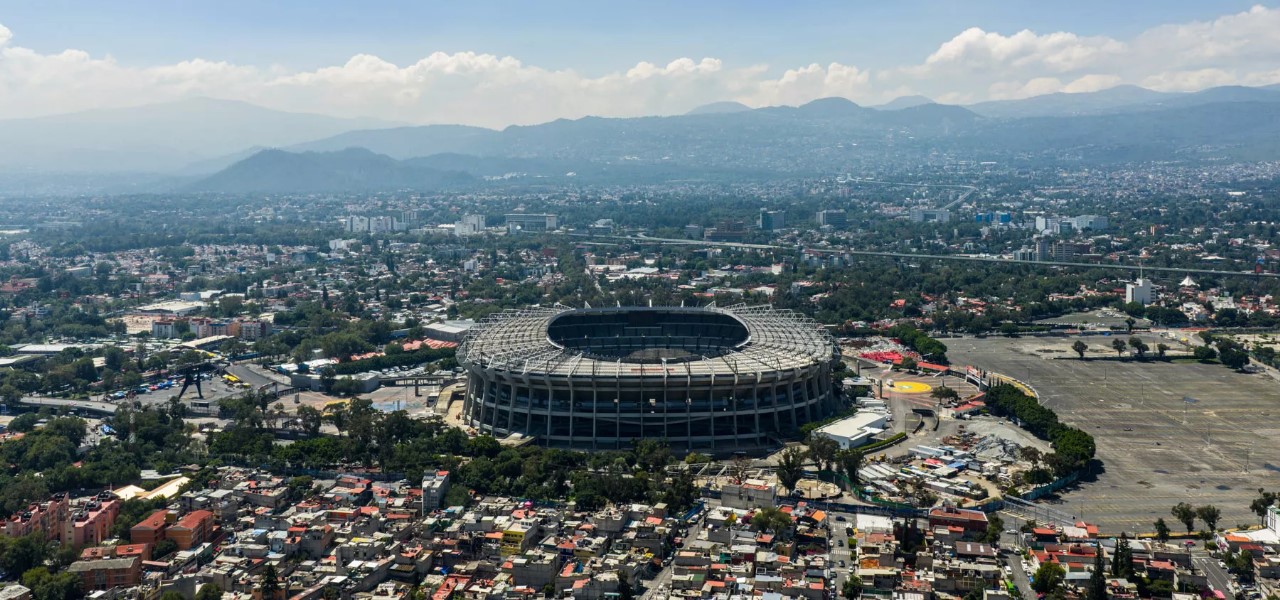
Property Prices Surge in FIFA World Cup 2026 hosting Cities.

Mexico City, Monterrey, and Guadalajara are preparing for the 2026 World Cup with multimillion dollar investments to attract tourists; however, the championship will have an impact on housing.
“Ideal for groups visiting the city for the 2026 FIFA World Cup”, says a post on the Airbnb lodging platform for accommodations in Monterrey, one of the three cities that will host the soccer matches taking place in Mexico. This interest and concern is also being echoed in Guadalajara and Mexico City, mainly in the neighbourhoods around the stadiums where World Cup matches will be held and where housing prices are rising.
According to the Federal Mortgage Society, housing prices increased by 10.9% in Guadalajara and 9.4% in Monterrey, while in Mexico City they rose by 4.8%. In the vicinity of the Azteca Stadium, which will host the opening match and four more games, prices range from 8,900 to 18,700 pesos for 24 nights, while entire homes cost between 21,200 and 43,700 pesos.
Although the boroughs with the most accommodations in the capital are Cuauhtémoc, Miguel Hidalgo and Benito Juárez, Coyoacán ranks fourth with 770 entire homes and 902 private rooms offered to tourists on the application. In the areas surrounding the stadiums in Guadalajara and Monterrey, the landscape features prices exceeding 15,000 pesos per month for rents and over 20,000 pesos per square metre for sales.
Around Akron Stadium in Guadalajara, monthly rents range from 22,000 to 45,000 pesos, according to data from Monopolio. In neighbourhoods like Granja, San Juan de Ocotán, and Rinconada del Bosque, all less than 10 minutes from the stadium, the price per square metre for sale ranges from 29,000 to 36,000 pesos, according to Clau.com. The most exclusive areas, such as Los Castaños, concentrate the highest rents, while in Ayamonte prices are slightly lower, although they are still above the metropolitan average.
In Monterrey, the area surrounding BBVA Stadium has more affordable prices. In neighborhoods like Jardines and Bosques de la Pastora, as well as Puesta del Sol, rents range from 16,000 to 28,000 pesos per month, while the price per square metre ranges from 19,000 to 23,000 pesos. In adjacent areas, such as La Quinta or Unidad Ciudad de los Niños, prices drop slightly, maintaining a more residential profile than one of high commercial demand.
According to Daniel Blum, partner at the consulting firm 4S Real Estate in Guadalajara, the Guadalajara housing market is already showing annual increases in rents of between 06% and 10%, especially in neighbourhoods such as Providencia, Puerta de Hierro and La Americana, where “the entry of new industries has brought a more specialised demand for housing, with smaller and more flexible units“.
Juan Pablo Abaroa, the firm’s regional partner in Monterrey, explains that the city has approximately 220 vertical projects under development and an average price of 80,000 pesos per square metre, with sales figures around seven million pesos. “This has led many people to be unable to buy and opt to rent. Apartments of 34 square metres without parking are now renting for between 18,000 and 20,000 pesos per month”, he notes.
The World Cup will consist of only a few matches in each venue, but it generates an impact of multimillion dollar investments and public interventions: in Mexico City, the urban improvement of the Banorte Stadium (formerly Azteca Stadium), the construction of a bike path and an elevated walkway on Calzada de Tlalpan, and more trains for the Light Rail.
In Monterrey, the construction of two new Metro lines, one of which will connect to the Mariano Escobedo International Airport, as well as the creation of the Water Park; while in Guadalajara, a new Electric Macrobus is planned from the Guadalajara International Airport to the Akron Stadium, as well as the renovation and expansion of avenues and highways.
Rosalba González Loyde, PhD in Sociology from UAM and Master in Urban Development from the Pontifical Catholic University of Chile, adds that while this investment seeks to improve mobility and provide better public spaces, it will also bring an increase in the cost of housing around the World Cup venues.
“There is investment, by both the public and private to improve public space and infrastructure. But what about the owners who take advantage of that infrastructure to now rent their homes not at the previous price but at a higher value?” he says.
The specialists at 4S Real Estate agree that these works, although currently causing traffic disruptions, will increase the value of the areas and improve connectivity in the medium term.
Daniel Blum believes that in Guadalajara, “the areas near the stadium, Andares or Chapultepec could be the most benefited”, while Abaroa anticipates an economic boost of up to $1 billion in Monterrey and the creation of new housing hubs in municipalities such as Apodaca, Escobedo, Guadalupe and San Nicolás, “thanks to the expansion of public transportation and changes in urban development plans”.
“There is an increase in property values, so we are going to start perceiving elements of the classic definition of gentrification, which is a process of expulsion of a lower-income population by a higher-income population, resulting from the increase in the cost of land and housing due to this investment”, González Loyde explained. This is compounded by the lack of regulation on housing and land costs in Mexico, notes the academic from UNAM.
Daniel Blum agrees that the phenomenon will be concentrated, especially in tourist areas or areas with better connectivity. “Many owners will likely switch their traditional rentals to short-term stays during the World Cup, and some may continue to do so after the event”.
Juan Pablo Abaroa warns that, in Monterrey, areas that receive new infrastructure will maintain high prices even after the tournament, while others will tend to stabilise.
Airbnb regulation in World Cup Cities –
In Monterrey, the regulation of tourist accommodation platforms like Airbnb is limited to the payment of a 3% lodging tax that is paid to the government of Nuevo León. In Guadalajara, Jalisco Congress has discussed a reform project that includes limiting the accommodation time of tourist homes to a maximum of 180 nights per year, a restriction against which representatives of Airbnb and Expedia spoke out in legislative forums. “In Guadalajara, the sector is uncertain about how and when the rules will be applied, but there is still a hunger for short-term rentals”, says Blum.
In Monterrey, Abaroa recalls that the boom in vertical housing began in 2013 with transit oriented development (TOD), which triggered projects in the city center and allowed for denser and more affordable products, although today construction costs and inflation limit that trend.
Mexico City is the most advanced in creating limits for lodging platforms, at least on paper.
On October 03rd, 2024, a series of reforms approved by the Mexico City Congress to the Tourism, Housing and Reconstruction laws were published to place restrictions on the rental of rooms, apartments and houses on platforms like Airbnb. However, more than a year later this legal framework is still not being applied and the city government has not yet enabled the registration platform for hosts, properties and companies that offer temporary tourist stays.
“It is impossible for the Mexico City government, given the incapacity it has demonstrated over the past year, to have the capacity in the coming months to implement a law that will also be detrimental to the government itself and the economic activity that awaits us next year”, says Patricia Urriza, deputy for Coyoacán of Movimiento Ciudadano (MC).
The legislator believes that Mexico City lacks urban planning in the lead-up to the 2026 World Cup. She explained that this is reflected in the non-enforcement of regulations for tourist rentals on platforms and the absence of a neighborhood improvement project in the districts surrounding Azteca Stadium, especially in Coyoacán and Tlalpan. Urriza recalls that for the 1975 Pan American Games, the Villa Panamericana Housing Unit was built to house athletes, diplomats, journalists and participating committees, a development that later became social housing.
However, with only 07 months left for the FIFA World Cup 2026, and given the expected demand for tourist accommodations, the legislator questions the effect it will have on housing in the neighbourhoods near the Azteca Stadium and in the south of Mexico City.
Previous World Cup host cities offer clues as to how much property values can increase. In Qatar, during the first half of 2022, the year the sporting event took place, rents rose 23% in The Pearl, an area connected to the tournament venues. Two years later, prices had fallen between 4% and 6%.
In Brazil in 2014, the most recent Latin American host country, rental housing costs increased by 35% in one year. In 2015, prices fell by 4.6%.
For Blum, the situation will be similar: “During the tournament, we’ll see a temporary increase in rents and nightly rates, but afterward, it will tend to stabilise. These companies, these gigantic consortiums, always have the option of buying their space, their time in a space, from someone who lives near where all the tourists will be”.
Housing concerns around Azteca Stadium –
In Santa Úrsula Coapa, one of the original towns in Mexico City and where the Banorte Stadium (formerly Azteca Stadium) is located, members of the Community Action Cooperative warn about the emergence of apartment building constructions that do not show signs of work. “We are concerned about this intention to develop new buildings because it could generate this real estate investment in a popular area”, says Natalia Lara, a member of the neighbourhood cooperative.
Norma Piñón is one of the affected residents. Three months ago, a house next to her home began being converted into an apartment building at Popocatépetl, block 893, lot 27. The construction currently has four levels, but construction workers told Norma that it will have at least seven floors with 17 apartments. “We have had damage and it is just beginning, there are seven or eight levels that are going to be built, we have three so far, so I don’t know what is going to happen”.
Around 30 reports were filed with the Coyoacán Mayor’s Office and the Single Citizen Attention System (SUAC), as well as a complaint to the Environmental and Territorial Planning Attorney’s Office (PAOT) to verify the construction of Popocatépetl and at least 06 more carried out in the last year: Calzada de Tlalpan 3213, San Alejandro 254, San Macario 168, San Ricardo 137, San Matías block 889 lot 12 and San Pascasio block 891 lot 12. “We want a reassessment of land-use planning and, above all, a verification of how construction and land use are being carried out”. says a member of the Community Action Cooperative.
Currently, the price of housing in the Coyoacán borough is 33,311 pesos per square metre as of October 2025, with values between 02 million and 23 million pesos per home, depending on the neighborhood; in the Santo Domingo neighbourhood, the price is 36,497 pesos per square metre, and in Santa Úrsula Coapa, it’s 35,257 pesos, the two neighbourhoods closest to Azteca Stadium. In the Villa Panamericana housing complex, the price rises to 40,772 pesos, and in Romero de Terreros, it averages 39,274 pesos.
Regarding rent, the Monopolio website reports an average price of 19,500 pesos this month in the Coyoacán borough, while in the neighbourhoods surrounding the sports complex, the average price in Santo Domingo is 17,800 pesos and in Santa Úrsula Coapa, 13,500 pesos. In Villa Panamericana, the average is 35,000 pesos, and in Romero de Terreros, 32,500 pesos.
According to the real estate agency Spot2.mx, the Santa Úrsula neighbourhood has affordable rents with potential for appreciation and presents a current opportunity given the projected increase in consumption around the 2026 World Cup, benefiting residential areas with nearby commerce.
“Santa Úrsula could capture some of that additional spending due to its strategic location south of the capital and its proximity to the Azteca Stadium”, the agency indicates.
Team Maverick




Adani’s Ayodhya Visit Inspires Gurukul Students, Reinforces Commitment to Cultural Heritage
Ayodhya, April 2026 : Students of a traditional Gurukul in Ayodhya described their interac…
Adani’s Ayodhya Visit Inspires Gurukul Students, Reinforces Commitment to Cultural Heritage
Ayodhya, April 2026 : Students of a traditional Gurukul in Ayodhya described their interaction …