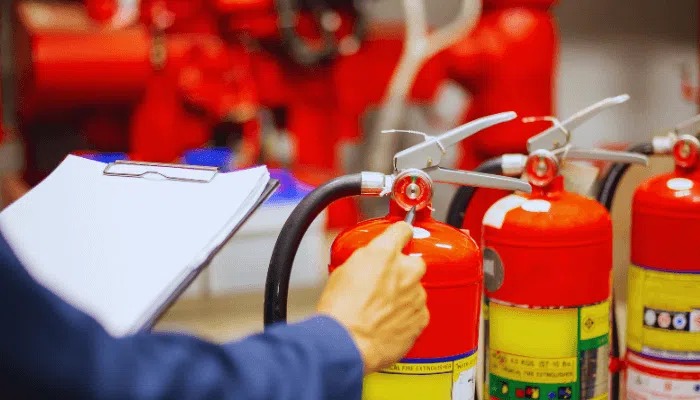
From 01st January 2026, PFOS are Being Prohibited in Fire-Extinguishing Systems in the Shipping Industry.

December 2025: Fire safety on board ships has always relied on specialised extinguishing media—particularly foams capable of suppressing difficult fires involving fuel, machinery spaces, and cargo. For many years, one of the common ingredients in these foams has been PFOS, a chemical valued for its ability to repel oil, water, and grease. However, from 1 January 2026, the International Maritime Organization (IMO) will prohibit the use and storage of firefighting media containing PFOS on all ships governed by SOLAS and the High-Speed Craft Codes. This marks a significant regulatory shift for shipowners, yards, suppliers, and flag administrations.
PFOS, short for perfluorooctane sulfonic acid, belongs to a larger family of synthetic chemicals known as PFAS (per- and polyfluoroalkyl substances). These chemicals are often called “forever chemicals” because they do not easily break down in nature or in human bodies.
PFOS became widely used because of its strong surface-active properties. In firefighting foams, it helps spread the foam quickly, resists fuels, and forms a stable blanket capable of smothering fire. Over time, however, research began linking PFOS to environmental persistence and potential health risks. Its tendency to accumulate in soil, water bodies, marine environments, wildlife, and even humans raised serious concern among regulators worldwide.
The maritime industry, given its extensive use of foam-based firefighting systems, naturally fell within the scope of global PFOS restrictions.
The IMO’s amendments to SOLAS Chapter II-2 and the 1994/2000 HSC Codes introduce a complete ban on fire-extinguishing media containing PFOS above 10 mg/kg (0.001% by weight). The aim is twofold:
- To protect people on board from exposure to hazardous firefighting agents.
- To prevent long-term environmental damage, particularly in marine ecosystems where PFOS contamination can persist for decades.
These amendments take effect on 01st January 2026, and they apply to:
- Fixed fire-extinguishing systems
- Portable firefighting equipment
- New buildings and ships already in service
- New ships (keel-laid after 1 January 2026) must be PFOS-free upon delivery. Existing vessels must demonstrate compliance by their first survey on or after 01st January 2026.
Compliance hinges on documentation and verification. Surveyors will require either:
- A manufacturer’s PFOS-free declaration,
- Laboratory test reports confirming the foam contains no PFOS above the allowed limit.
If the chemical composition of existing foam cannot be verified, sampling and testing will be mandatory. Should PFOS be detected, the foam must be removed and delivered to approved shore reception facilities. The ship’s logbook must record this handling and disposal.
When replacing foam, owners must ensure the new product is compatible with the existing system—meaning the same mixing ratio, similar viscosity, and valid type approval under the relevant IMO circulars. It is also worth noting that the EU has already banned new PFOS installations under the EU Ship Recycling Regulation, and requires PFOS to be listed in the Inventory of Hazardous Materials (IHM) for ships calling at EU ports.
The coming ban targets only PFOS, but additional PFAS restrictions are expected in the future. Regulatory discussions, including at the IMO suggest that other chemicals such as PFOA may eventually face similar treatment. For ship operators, this transition is not merely about replacing foam; it represents a broader move toward safer, more sustainable firefighting solutions.
The prohibition of PFOS-containing fire-extinguishing media marks an important step in modernising shipboard safety and environmental protection. While compliance requires preparation—documentation, verification, and in many cases replacement of existing foams—the long-term benefits to crew safety and the marine environment justify the effort.
Team Maverick.







Egypt Leads Diplomatic Push for De-escalation Amid Rising Middle East Tensions
Cairo, March 29: Egypt has intensified diplomatic efforts to ease escalating tensions in t…

Egypt Leads Diplomatic Push for De-escalation Amid Rising Middle East Tensions
Cairo, March 29: Egypt has intensified diplomatic efforts to ease escalating tensions in the …