Let Us Come Together for Constructive Work While Marching Towards Maharashtra’s Amrit Mahotsav – Chief Minister Devendra Fadnavis

Chief Minister’s assertion in the Assembly, replying to the Final Week Motion, that the state’s development will not stop
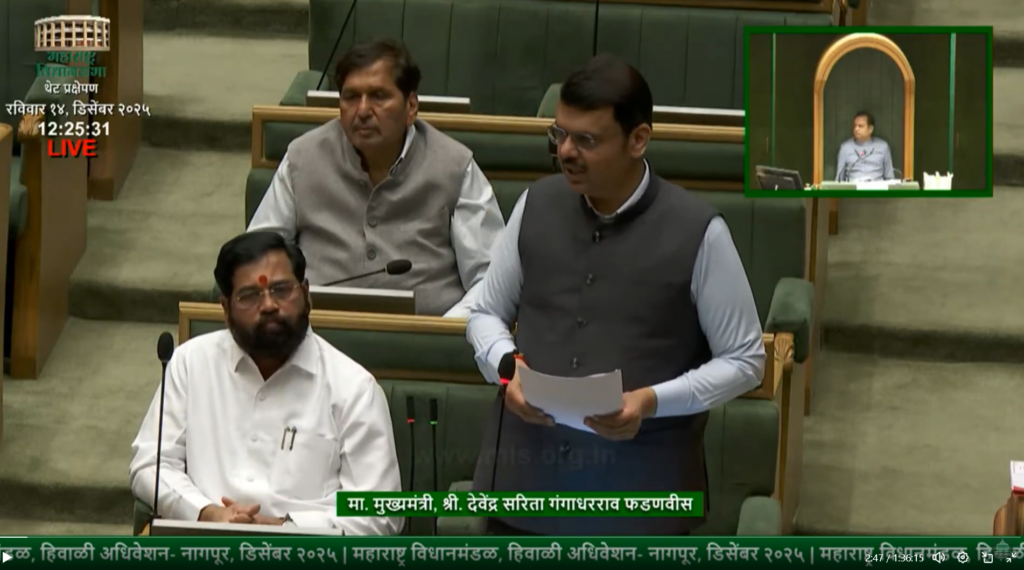
Nagpur, December 2025 : Maharashtra’s economy remains one of the strongest and most stable in the country even today, and the state qualifies on all economic parameters. The state has done substantial work in every sector including debt management, fiscal deficit, investment, employment generation, irrigation, power, transport, and law and order, Chief Minister Devendra Fadnavis said while replying to the discussion on the Final Week Motion in the Legislative Assembly. He noted that as Maharashtra moves towards its Amrit Mahotsav, the coming period is extremely decisive for the state. The Chief Minister appealed to all leaders in the House to come together and take the state forward rapidly through constructive work.
Replying to the Final Week Motion presented under Rule 293 in the Assembly, Chief Minister Fadnavis presented a detailed review. He said that after the formation of the new government, various challenges were faced and addressed through decisive and coordinated governance.
Referring to the COVID period and various difficulties, Chief Minister Fadnavis said that the state government is now making efforts to move Maharashtra forward, leaving all those issues behind. While progressing towards building an Amrit Mahotsav Maharashtra, he urged everyone in the House to unite for the state’s progress through constructive work. Stressing that positivity and a development-oriented approach are essential while moving towards the Amrit Mahotsav, he quoted, “Ab aage badh chuka hoon main… ab pag nahin rukne wale,” and expressed his resolve that the state’s march on the path of development will not stop.
Mumbai Will Remain in Maharashtra
Clarifying the stand on Mumbai, Chief Minister Fadnavis said that Mumbai was, is, and will always remain part of Maharashtra. Maharashtra was formed through the sacrifice of 106 martyrs during the Samyukta Maharashtra movement, and there is no need for any confusion in this regard. He also stated that Maharashtra will continue to move on the path shown by Chhatrapati Shivaji Maharaj and Bharat Ratna Dr Babasaheb Ambedkar, within the framework of the Constitution.
He thanked the Central Government for including a detailed 21-page section on the history of Chhatrapati Shivaji Maharaj and the Maratha Empire in the new CBSE curriculum.
A Developed Maharashtra by 2047
Referring to the Vision Document prepared for Maharashtra, the Chief Minister said that while preparing the development roadmap, three phases—2030, 2035 and 2047—have been defined. The objective is to build a developed Maharashtra by 2047, and work is underway to ensure that Maharashtra becomes the country’s first trillion-dollar economy during 2029–30.
State Schemes to Continue for the Next Five Years
Regarding various state government schemes, Chief Minister Fadnavis said that all schemes, including the ‘Ladki Bahin’ scheme and free electricity for farmers, are ongoing and will continue for the next five years.
State’s Financial Position Is Strong
Emphasising the strong financial position of the state, he said that among large states in the country, Maharashtra’s economy still qualifies on all parameters. While borrowing is necessary for development and states are permitted to borrow up to 25 per cent of their Gross State Domestic Product, Maharashtra has borrowed only 18.87 per cent. The fiscal deficit has been successfully kept within three per cent, even while implementing the Ladki Bahin scheme and providing assistance to farmers. All three financial conditions laid down by the CAG have been met, and Maharashtra has made higher capital investment than the benchmarks prescribed by the Central Government.
Maharashtra Leads in Investment
Chief Minister Fadnavis said that Maharashtra has delivered historic performance in industry, investment, employment generation, energy, agriculture and infrastructure, setting an example of all-round development in the country. He added that Maharashtra has gone far ahead in investment, with not just MoUs being signed but actually implemented. Of the Rs 17,57,801 crore worth of agreements signed at Davos, 75 per cent are under implementation. Maharashtra ranks first in foreign direct investment, having received a record Rs 1,64,775 crore in 2024–25. Of the country’s total investment, 31 per cent has come to Maharashtra alone. In 2025–26 so far, Maharashtra has received Rs 91,337 crore in FDI.
Surge of Investment in Vidarbha and Marathwada
The Chief Minister said large investments are coming to Vidarbha in electronics, defence, steel and coal gasification. Marathwada is being developed as an ‘EV Capital’, with investments from major brands like Toyota, Skoda and Ather. Thirty-one companies are operational in MIHAN, with 22 new companies starting operations, generating employment for 1.27 lakh people. He also said that Asia’s largest aviation training institute is being established at Amravati airport.
Gadchiroli Emerging as a New Investment Magnet
Gadchiroli district has emerged as a new investment magnet, with the highest inflow of investment now coming there. In the aerospace and defence manufacturing sector, Vidarbha has received investments of Rs 20,000 crore, creating 10,000 to 15,000 jobs. Investments worth Rs 1,55,000 crore have come into electronics manufacturing, semiconductors, solar panels and modules, generating around 65,000 direct and indirect jobs. The largest investment in coal gasification has come to Vidarbha, and the Chief Minister expressed confidence that Vidarbha will also rank first in solar energy.
New Nagpur on the Lines of BKC
A ‘New Nagpur’ (IBFC) will be developed on the lines of BKC, where employment for over five lakh people is expected.
About Rs 50,000 crore of investment has come to Marathwada, generating around 40,000 jobs. Significant investments are also flowing into Pune, Satara and Kolhapur regions.
Employment Generation
Referring to employment generation, the Chief Minister said that all six of the ‘Big Six’ IT companies are operational in MIHAN, providing indirect employment to 1,27,225 people. Under the ‘Mahabharati’ initiative, 1.20 lakh government jobs have been provided in three years, and a decision has been taken to provide the same number of jobs over the next two years.
Substantial Assistance for Farmers
Chief Minister Fadnavis said that of the Rs 32,000 crore package announced for farmers, Rs 15,007 crore has been directly credited to farmers’ accounts. Additional assistance of Rs 10,000 for the rabi season has been provided to 91 lakh farmers. To prevent losses to farmers in cotton procurement, a decision has been taken to increase average productivity from 1,277 kg per hectare to 2,368 kg per hectare.
A decision on loan waiver has been taken, and a committee has been formed to ensure that the benefit of loan waiver goes directly to farmers and not banks. Based on the committee’s report, the loan waiver scheme and policy will be finalised by July 1.
Major Changes in the Energy Sector
The Chief Minister said the state government is spending Rs 26,681 crore to provide free electricity to farmers. Asia’s largest 16,000 MW solar power project is operational in Maharashtra, which will ensure that by 2030, 52 per cent of the state’s energy comes from green sources. Of the 11.90 lakh solar pumps installed under the PM-KUSUM scheme across the country, 7.38 lakh are in Maharashtra alone, and a Guinness World Record was set by installing 45,911 pumps in a single month.
To stabilise the grid, agreements for 76,000 MW of pump storage capacity have been signed in Maharashtra, with a target of creating one lakh MW capacity in the next six months.
Under the Balasaheb Thackeray Agriculture Business and Rural Transformation (SMART) project, 7.5 lakh farmers will benefit. Work on Phase II of the Nanaji Deshmukh Agriculture Sanjeevani Project has begun, with an allocation of Rs 351 crore for this year.
Success in Reducing Irrigation Backlog in Vidarbha and Marathwada
The irrigation backlog of 13.83 lakh hectares in Vidarbha and Marathwada has almost been eliminated. Of this backlog identified by the Indicator Backlog Committee, irrigation has been provided to 13.34 lakh hectares, leaving only 49,000 hectares pending, mainly in Akola, Buldhana and Hingoli districts. In Akola, against a remaining backlog of 14,530 hectares, irrigation capacity of 19,335 hectares will be created by 2026–27. In Buldhana, against a backlog of 29,000 hectares, 1.68 lakh hectares will be brought under irrigation. A provision of Rs 2,399 crore has been made this year for the Zigaon project alone, which will convert Buldhana district from deficit to surplus.
The expanded work of the Gosikhurd project, considered the lifeline of eastern Vidarbha, is in its final stage and will create irrigation capacity for 2.54 lakh hectares. A fund of Rs 1,555 crore has been approved, with completion targeted by June 2027. Of the 485 irrigation projects in Vidarbha, most are complete, and the remaining 74 projects will add 7.66 lakh hectares of capacity. The Rs 1 lakh crore Wainganga–Nalganga mega project will bring 4.04 lakh hectares under irrigation, with all approvals targeted by February 2026. The Chief Minister expressed confidence that projects like the Damanganga–Narpar–Girna water diversion for Marathwada and flood diversion projects carrying excess floodwater from Kolhapur–Sangli to Ujani will permanently end drought.
Focus on Connectivity
The Nagpur–Goa Shaktipeeth Expressway will reduce travel time to eight hours and transform Marathwada. A new proposed Mumbai–Kalyan–Latur Jan Kalyan Expressway has also been announced, which will reduce Latur–Mumbai travel time to just 4.5 hours.
Metro and infrastructure works have been accelerated across the state. Mumbai currently has 91 km of operational metro lines, carrying about 9.5 lakh passengers daily. An additional 132 km will be added in the next two years. Pune has 33 km of metro lines operational, benefiting 2.23 lakh passengers daily, with another 45 km under construction. In Nagpur, 40 km of metro lines are complete and used by 1.10 lakh passengers daily, with another 43 km to be completed in the next two years.
The Chief Minister said major infrastructure projects in Mumbai are also being expedited, including the Orange Gate–Marine Drive underground tunnel, North Coastal Road, Bandra–Versova, Versova–Dahisar and Dahisar–Bhayandar roads, and the Bhayandar North–Virar coastal road. Projects like the Thane–Borivali underground road, Goregaon–Mulund Link Road, Ulwe coastal road, Atal Setu interchange and ‘Missing Link’ are in the final stage. Work has also begun on Pune’s ring road, which will make urban transport more dynamic.
Under the ‘Amritkal Roads Scheme’, road development is being undertaken considering quality, traffic and connectivity with major centres. Under the Samruddhi Expressway extension, the Rs 18,539 crore Nagpur–Gondia 162-km expressway project is in its final stage, and once land acquisition is completed, travel time from Nagpur to Gondia will reduce to just 1.25 hours.
Speeding Up Redevelopment
Urban redevelopment has been accelerated at locations such as BDD Chawl, GTP Nagar, Bandra Reclamation, Adarsh Nagar, Motilal Nagar and SVP Nagar, with large-scale rehabilitation and new construction. An Abhay Scheme has been implemented for buildings with pending occupation certificates. Premiums for self-redevelopment have been reduced, and after the tender process, approval has been granted for the redevelopment of 339 buildings in Kamathipura. A new policy has also been announced for redevelopment of old and dilapidated cess buildings in Mumbai, promoting self-redevelopment, with around 1,600 buildings currently under redevelopment under this scheme.
Strengthening Law and Order
Replying to the discussion on the Home Department, the Chief Minister presented law and order statistics, stating that crime in Pune declined between October 2024 and October 2025. After the implementation of new criminal laws, the conviction rate has risen significantly to 96.24 per cent. The response time of Dial 112 services has reduced from 15 minutes to about 7.37 minutes.
He said that over 99 per cent of complaints related to crimes against women and children are being registered, and the charge-sheet filing rate in crimes against women rose to 87.8 per cent by October 2025.
Through ‘Operation Muskan’ and ‘Operation Shodh’, thousands of missing women and children have been traced. Of registered kidnapping cases, about 86 per cent of persons are traced within a year across the state, while in Mumbai the rate is 99 per cent.
The Chief Minister said action has been intensified against cybercrime, narcotics and organised crime. Through ‘MahaCyber’, cyber fraud, fake call centres and digital arrest scams are being controlled, and MahaCyber has emerged as the country’s most advanced cyber headquarters, with several states and two countries seeking cooperation.
A zero-tolerance policy against narcotics is being implemented, with strict action under MCOCA and MPDA against peddlers. Over 88,000 police personnel have been recruited in the last ten years, and strict action against criminals will continue, he said.
Concluding his reply, Chief Minister Fadnavis said that Maharashtra will not stop now, and with everyone’s cooperation, the state must be taken forward.
Parliament Paralysed for Second Day as Opposition Protests Over NEET Leak, Student Crackdown
New Delhi, July 2026 : Parliament remained deadlocked for the second consecutive day of th…
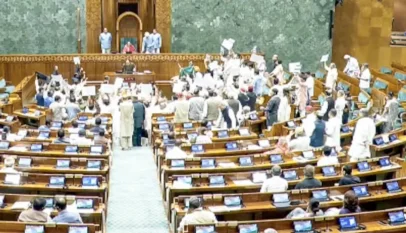
Parliament Paralysed for Second Day as Opposition Protests Over NEET Leak, Student Crackdown
New Delhi, July 2026 : Parliament remained deadlocked for the second consecutive day of …