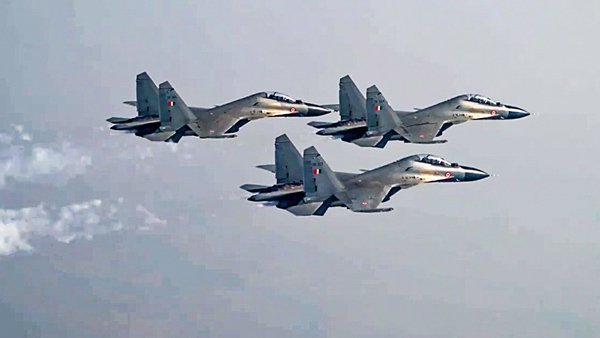
New Delhi, Sep 2026 : India is considering a major capability upgrade for its Su-30MKI fighter fleet through the integration of the Russian-origin RVV-BD long-range air-to-air missile, a move that could significantly enhance the Indian Air Force's ability to engage high-value aerial targets at extended ranges.
The proposal is currently being evaluated by the Defence Ministry and is expected to come up for discussion before the Defence Acquisition Council (DAC). If approved, the integration would provide the Su-30MKI with an additional long-range air-to-air capability designed to threaten critical enemy airborne assets operating well behind the forward edge of the battlefield.
The timing of the proposal is also significant, coming ahead of Russian President Vladimir Putin's expected visit for the BRICS summit. Several major areas of bilateral cooperation are likely to be discussed during the engagement, with defence cooperation remaining an important component of the India-Russia strategic partnership.
The RVV-BD family has been developed by Russian defence manufacturers for engaging high-value aerial platforms, including Airborne Early Warning and Control (AEW&C) aircraft, reconnaissance platforms and other support aircraft. Such assets play a crucial role in modern air operations by providing surveillance, targeting information and battlefield coordination.
With reported engagement ranges of up to 300 kilometres and speeds approaching hypersonic levels, the missile is intended to give fighter aircraft the ability to threaten adversary support platforms from considerable distances. Its potential integration with the Su-30MKI could therefore expand India's options for long-range air combat.
The Defence Ministry is simultaneously pursuing a broader strategy to strengthen the country's air-to-air missile inventory through a combination of indigenous development and overseas procurement.
The Defence Research and Development Organisation (DRDO) is advancing the Astra family of indigenous air-to-air missiles, with future variants being developed to achieve increasingly longer engagement ranges. India has also inducted or contracted advanced European-origin Meteor missiles for compatible fighter platforms, providing another long-range capability to the IAF.
The Su-30MKI remains the backbone of India's fighter fleet, with more than 260 aircraft in service. The fleet is undergoing several modernisation programmes aimed at extending its operational relevance, including upgrades to avionics, radar capabilities, weapons integration and long-range strike systems.
The aircraft's role in India's recent military operations has also highlighted its importance. During Operation Sindoor, Su-30MKI fighters were employed in missions involving long-range air-launched weapons, including BrahMos supersonic cruise missiles and Rampage precision-strike weapons. An additional long-range air-to-air missile capability would further broaden the platform's role by strengthening its ability to conduct offensive counter-air missions.
Alongside weapons integration, the DAC is also examining plans for the overhaul and life-extension of Su-30MKI airframes and their AL-31 engines. Hindustan Aeronautics Limited (HAL) is expected to play a key role in this effort, which would help maintain the fleet's serviceability and operational availability.
HAL is also expected to be involved in the supply of Advanced Light Helicopter Mk-III platforms, supporting the continued modernisation of India's rotary-wing fleet.
The proposed RVV-BD integration, if cleared and successfully implemented, would represent another step in India's effort to enhance long-range aerial warfare capabilities. Combined with indigenous missile development, foreign acquisitions and extensive fighter modernisation, the initiative reflects India's broader objective of maintaining a credible air-combat edge in an increasingly complex regional security environment.
(Disclaimer :The content of this article is sourced from a news agency and has not been edited by the Mavericknews30 team.)