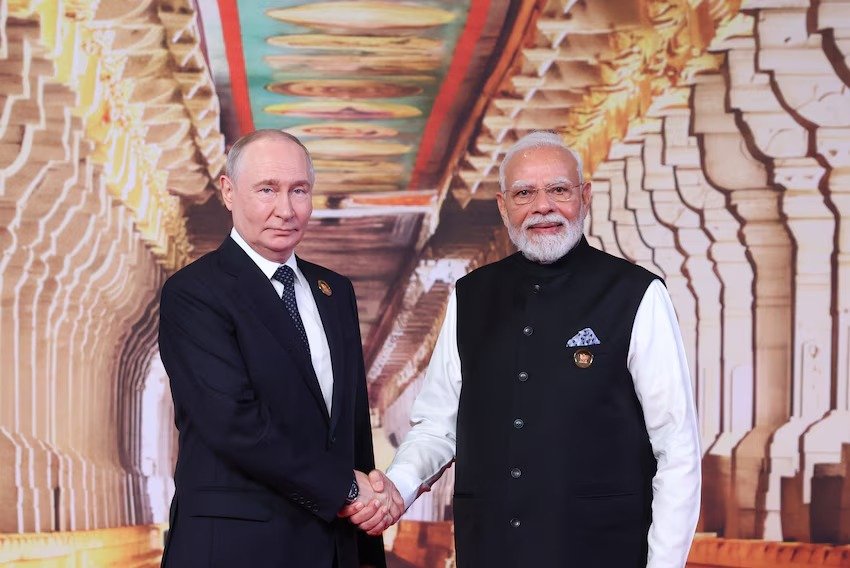
New Delhi, Sept 2026 : Prime Minister Narendra Modi and Russian President Vladimir Putin held wide-ranging bilateral discussions in New Delhi on Friday, focusing on expanding economic ties, strengthening defence cooperation and deepening collaboration in strategic sectors, including energy, critical minerals, fertilisers and manufacturing.
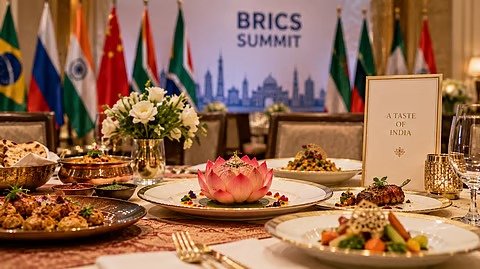
Putin arrived in the national capital earlier in the day for a three-day visit to attend the 18th BRICS Summit. His meeting with Modi at Bharat Mandapam was followed by the two leaders travelling together to a business forum, highlighting the growing economic dimension of the India-Russia relationship.
A key focus of the discussions was the ambitious target of raising bilateral trade to $100 billion by 2030. While India and Russia have set the target, New Delhi is also seeking improved access for Indian products in the Russian market. Pharmaceuticals, food products, automobile components and other manufactured goods are among the areas where India wants greater opportunities, particularly to address the existing trade imbalance.
The talks came soon after the INNOPROM India 2026 industrial trade fair in New Delhi, where the two countries explored opportunities for deeper manufacturing, investment and industrial cooperation. India has also encouraged Russian companies to make greater use of its industrial corridors and manufacturing ecosystem, potentially creating new avenues for joint production and investment.
Defence cooperation remained a major pillar of the bilateral relationship. Russia has indicated that discussions with India include the remaining deliveries of the S-400 air-defence systems. Moscow has also discussed potential cooperation involving the Su-57 fighter aircraft and further development of the BrahMos programme. However, these areas remain under discussion and should not be viewed as concluded contracts.
The defence partnership is also gradually shifting towards greater industrial cooperation and localisation. Both sides are seeking to expand joint production, technology collaboration and domestic manufacturing capabilities, moving beyond a relationship based primarily on direct equipment purchases.
Energy cooperation featured prominently in the discussions as well. India and Russia are exploring further collaboration in civil nuclear energy, while Russian supplies of crude oil and fertilisers continue to form important components of bilateral economic relations.
Critical minerals have emerged as another area of strategic importance. As India expands advanced manufacturing, electronics, clean-energy technologies and defence production, securing reliable supplies of key minerals has become increasingly important. Cooperation with Russia in this sector could therefore contribute to India's broader supply-chain security.
The meeting also carried a significant geopolitical dimension amid the continuing Ukraine conflict. Modi has consistently advocated dialogue and diplomacy as the way forward for resolving the conflict. He reiterated this position during his August 31 meeting with Putin on the sidelines of the SCO Summit.
The latest discussions therefore took place against a backdrop of continuing diplomatic efforts to address the Ukraine crisis, while India seeks to protect its economic interests and maintain its longstanding strategic partnership with Moscow.
The agenda extended beyond traditional areas of defence and energy to include fertilisers, manufacturing, railways, steel, critical minerals, skilled-worker mobility and market access. The broader focus reflects an effort by both countries to diversify their relationship and expand the role of non-defence sectors in bilateral economic engagement.
Putin's visit, coinciding with India's hosting of the BRICS Summit and following the INNOPROM India 2026 engagement, provides New Delhi with an opportunity to combine bilateral diplomacy with multilateral cooperation.
The Modi-Putin talks consequently underline the continuing evolution of the India-Russia Special and Privileged Strategic Partnership. The next phase of the relationship is increasingly expected to focus not only on defence and energy, but also on trade diversification, industrial localisation, critical minerals, nuclear energy, investment and wider economic integration.