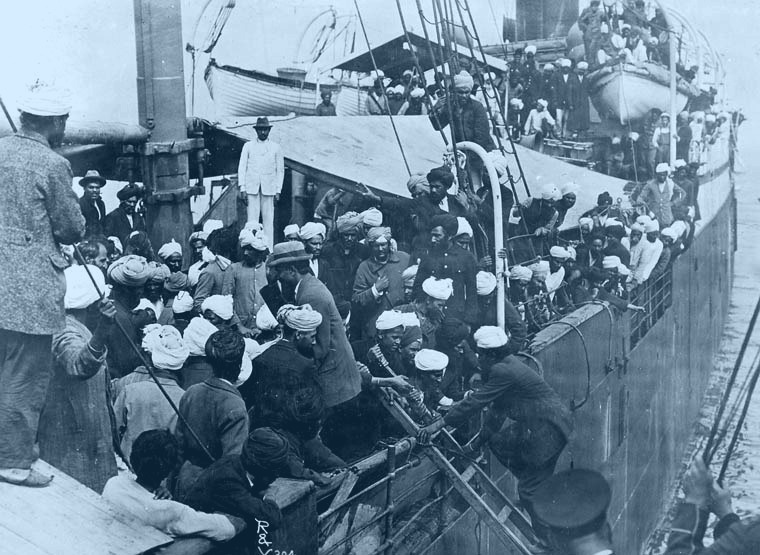
Canadian Prime Minister Has Apologised For ‘Komagata Maru’.

Ottawa; May 2026: Canada’s Prime Minister Mark Carney yesterday (23rd May 2026) has apologised for not been able to uphold the valour of Canada in the year 1914, when the country had refused providing asylum to 376 passengers on board Japanese Steamship Komagata Maru.
While commemorating the day, the Canadian Prime Minister has reiterated: “On this day in 1914, 376 Sikhs, Muslims, and Hindus of South Asian origin arrived in Vancouver’s harbour aboard the steamship Komagata Maru. Their voyage was made in search of a better life for themselves and their families.
Instead of offering them refuge, Canadian authorities refused nearly all on board the vessel entry and forced them to remain on the ship for two months, with limited access to food, water, and medical care. When the Komagata Maru was forced to return to India, then under colonial rule, many of its passengers were imprisoned or killed.
The Komagata Maru tragedy is one of the darkest chapters in our history, a moment where Canada failed to uphold our values, with horrific consequences. It reminds us of the appalling repercussions of discrimination and racism. Today, we honour the memory of all the passengers, their descendants, and their communities who suffered.
We are building a Canada that is not just strong, but good. A Canada that is not just prosperous, but fair. A Canada that is not just for some, most of the time, but for all, all of the time”.
The Komagata Maru incident was an immigration dispute in which passengers aboard the Japanese steamship Komagata Maru were denied entry in Vancouver, British Columbia, Canada, on 23rd May 1914. The 376 passengers (340 Sikhs, 24 Muslims and 12 Hindus from Punjab province, British India) were denied entry despite being British subjects under Canada’s continuous journey regulation, which barred South Asian migration.
Only 24 passengers were allowed to disembark, and the ship was forced to return to India under naval escort on 23rd July 1914. Upon reaching Budge Budge, near Calcutta (present-day Kolkata) on 27th September 1914, the Indian Imperial Police attempted to arrest the group leaders, leading to violence in which police open fired and killed 20 passengers while others were arrested or imprisoned.
The incident highlighted Canada’s racially discriminatory immigration policies in the early twentieth century, later resulting in public apologies issued by government officials, and has been the focus of scholarship, public memorialisation, artistic and literary portrayals.
KOMAGATA MARU’S JOURNEY TO CANADA –
It was Gurdit Singh, a businessman in Singapore and Malaysia who was aware of the fact that Canadian exclusion laws were preventing Punjabis from immigrating to Canada. In an attempt to break-open the jinx, Gurdit Singh chartered the ship Komagata Maru in March 1914, to sail from Calcutta to Vancouver, to reopen immigration from India to Canada.
Hong Kong became the point of departure. After signing the charter for the ship, Gurdit Singh was arrested on 25th March 1914, but the police determined they did not have a case against him. Finally, after overcoming all hurdles (Francis Henry May, the Governor of Hong Kong had detained the ship citing immigration snags), the ship departed on 04th April with 165 passengers.
The ship arrived in Shanghai on 08th April and subsequently stopped at the Japanese ports of Moji on 19th April to take on coal and embark 86 additional passengers. The ship then docked at Yokohoma for another 14 passengers, including Ghadarite leaders Maulvi Barkatullah and Bhagwan Singh Gyani.
While the ship was sailing from Moji to Yokohama, Gurdit Singh traveled ahead by train to Kobe to negotiate charter payments, eventually rejoining the ship in Yokohama. The ship left Yokohama on 03rd May with 376 passengers (340 Sikhs, 24 Muslims, and 12 Hindus).
AT VANCOUVER –
When Komagata Maru arrived at Burrard Inlet on 23rd May 1914, immigration officials prohibited the ship from docking. Authorities, including Prime Minister Robert Borden, conservative MP H. H. Stevens, immigration official Malcolm R.J. Reid, kept the ship offshore, cutting off communication and stalling the examination process, hoping to force the charter to default due to lack of funds.
The local South Asian community formed a “Shore Committee”, led by Husain Rahim, Bhag Singh Bhikiwind, Mitt Singh Pandori, Balwant Singh Khurdpur, Muhammad Akbar (Punjabi-Canadian). The committee successfully raised $20,000 to take over the ship’s charter.
On 29-30th June, lawyer J. Edward Bird pushed for a test case on behalf of passenger Munshi Singh, but the British Columbia Court of Appeal unanimously ruled against the passengers, upholding the discriminatory immigration laws and denying them entry on 06th July.
DEPARTURE –
Following the decision of the British Columbia Court Of Appeal, tensions escalated as immigration officials withheld food and water to force the ship’s departure. On 19th July, an armed police force of 150 men aboard the harbour tug Sea Lion attempted to take control of the Komagata Maru. The passengers repelled the boarding party by showering them with coal, fire bricks, and scrap metal.
Prime Minister Robert Borden had then ordered the naval cruiser HMCS Rainbow to “enforce the law firmly and effectively but with no unnecessary violence”. Under the threat of naval bombardment, the federal Minister of Agriculture, Martin Burrell, arrived in Vancouver to negotiate a peaceful resolution. The Canadian government agreed to provision the ship for the return voyage, and the Shore Committee allowed the captain to take control. Only 22 passengers were admitted to Canada. On 23rd July, the ship departed.
During the controversy, Punjabi residents of Canada had supplied information to William C. Hopkinson, a British immigration official. 02 of these informants were murdered in August 1914. Hopkinson was shot to death at the Vancouver courthouse while attending the Punjabi trials in October 1914.
RETURN TO INDIA –
With the outbreak of World War I, British officials, suspecting the passengers of harbouring anti-colonial intent, barred them from disembarking in Hong Kong and Singapore, forcing the ship to continue all the way to India.
On 26th September 1914, the Komagata Maru arrived at Budge Budge – the mouth of the Hooghly River near Calcutta. Three days later, the ship was forced to anchor at Budge Budge, where British authorities attempted to force the passengers onto a special train bound for Punjab. The passengers refused to board out of suspicion and instead marched toward Calcutta. However, armed police intercepted them. After an altercation involving a police superintendent, troops open fired into the crowd, killing 20 passengers. Others were severely injured or jailed. Gurdit Singh escaped.
Suvro Sanyal – Team Maverick.







Amarnath Yatra Crosses Four Lakh Pilgrims as Devotees Continue Sacred Journey
Srinagar, July 2026 : The annual Shri Amarnath Ji Yatra achieved a significant milestone o…

Amarnath Yatra Crosses Four Lakh Pilgrims as Devotees Continue Sacred Journey
Srinagar, July 2026 : The annual Shri Amarnath Ji Yatra achieved a significant milestone …