Russia Has Announced To Purge Decisive Election Results In Ukraine.

Kremlin; February 2026: Russia continues to discuss future elections in Ukraine to advance its false claim that the current Ukrainian government is illegitimate and insists on means of controlling Ukraine’s politics.
In an interview with Kremlin newswire TASS on February 15th, Russian Deputy Foreign Minister Mikhail Galuzin repeated the debunked claim that Ukrainian President Volodymyr Zelensky is “illegitimate” and said that Russian President Vladimir Putin’s March 2025 proposal for the United Nations (UN) to create a temporary external administration in Ukraine is still an option.
Galuzin claimed that UN governance would allow for “democratic” elections and the establishment of a government with which Russia can sign a peace treaty and “legitimate” documents on future bilateral cooperation – implying that Russia cannot sign binding agreements with the current Ukrainian government and that any future elections that the current government would oversee would be undemocratic. Russia’s calls for UN governance over Ukraine are a rejection of Ukraine’s sovereignty and legitimacy.
Meanwhile, UN Secretary General Antonio Guterres and White House National Security Council Spokesperson James Hewitt rejected such proposals when Putin first presented them in March 2025, stating that UN governance would be a violation of the legitimate Ukrainian government, the Ukrainian Constitution, and the Ukrainian people’s right of choice. Russia’s proposal for UN election oversight is an attempt to give Russia, a permanent member of the UN Security Council, veto power over any resolution that does not establish a UN governance system that will produce Russia’s desired outcome of a pro-Kremlin political arrangement in Kyiv.
Russia continues to signal that it will reject any election result that does not produce such a pro-Russia government in Ukraine. Galuzin claimed that Ukraine will try to prevent “Ukrainian citizens” living in Russia from voting in a future Ukrainian election. Russia is also setting conditions to claim that any future Ukrainian election that does not “sufficiently” allow “Ukrainians” under Russian control to vote is not free and fair. It is far from clear how Russia would determine who is a Ukrainian for purposes of voting, considering the intensive, forced passportisation efforts Russia has undertaken to coerce Ukrainians in territories under Russian control to renounce their Ukrainian citizenship in favor of Russian citizenship.
Russia’s pressure on Ukraine to hold an election before a final peace agreement comes into effect ensures that Ukrainian authorities would be completely unable to oversee electoral processes within the Russian Federation, always granting that Russia would give any Ukrainian government it does not already control the right to do so. Russia likely further aims to use “Ukrainians”, or at least those whom the Russians decide are Ukrainians for purposes of the election, voting in Russia to enable massive Russian election interference. Galuzin trumpeted the 2024 Russian presidential election as alleged evidence of the viability of wartime elections.
Kremlin officials have similarly claimed that Russia’s illegal sham referendums in occupied Luhansk, Donetsk, Zaporizhia, and Kherson oblasts in 2022 show that Ukraine does not need an extended ceasefire to hold elections. Russian elections and referendums in 2022 and 2024 were neither free nor fair; they were autocratic and rigged. The Russian legal regime in place during those events, moreover, did not explicitly ban elections, whereas the Ukrainian Constitution and martial law legislation do. Zelensky has repeatedly indicated his intent to hold free, fair, and democratic elections in accordance with the Ukrainian Constitution and law as soon as possible.
Russian Foreign Minister Sergei Lavrov recently claimed that any postwar Ukraine must be friendly and benevolent to Russia, explicitly rejecting any future Ukrainian government that is not pro-Kremlin. Russian insistence on elections in Ukraine as somehow tied to the legitimacy of any peace agreement is disingenuous, as Russia has made it clear that it will deny the legitimacy of any Ukrainian government that does not allow Russian control over its composition and political orientation.
Long-term, meaningful US security guarantees for Ukraine must precede a war termination agreement to prevent Russia from following through on its stated intent to reject such guarantees after Ukraine has committed to ceding territory. Ukrainian President Volodymyr Zelensky reported on February 14th that he met with US Secretary of State Marco Rubio and had a telephone conversation with US Special Envoy to the Middle East Steve Witkoff and former Senior Advisor to the US President Jared Kushner. Zelensky has further stated that the United States is proposing security guarantees for post-war Ukraine that would last 15 years but called for guarantees for at least 20 years, if not longer.
Zelensky also called on the United States to provide security guarantees “first” – echoing Zelensky’s February 14 statement that any security guarantees agreement must precede any war termination agreement. The Ukrainian President has stated that Russia is looking to control the whole of Ukraine – in line with international apprehensions.
Kremlin officials have repeatedly rejected any meaningful Western security guarantees for Ukraine. Any future Ukrainian territorial concessions made before a US-Ukrainian security guarantees agreement would commit Ukraine to the withdrawals before security guarantees are in place and without reason to expect that Russia would even accept such guarantees. Russian officials also repeatedly rejected US President Donald Trump’s and Zelensky’s proposal for a ceasefire that would allow for a sustainable peace agreement to be concluded and implemented. Accepting Russia’s demanded sequencing of agreements runs the high risk of leaving Ukraine open to rapidly renewed Russian attack with no assurance of US or other partner military support to deter or respond to such an attack and therefore of producing a “peace agreement” likely to fail rapidly.
Russia’s long-term goal is to occupy all of Ukraine, and Russian officials have repeatedly attempted to justify Russia’s territorial expansion in the face of pressure to negotiate a peace settlement. Kremlin rhetoric and Russia’s efforts on the battlefield indicate that Russia’s objectives extend beyond simply controlling territory in Donbas (Donetsk and Luhansk oblasts). Russian forces are currently conducting offensive operations across the entire frontline, rather than focusing their efforts on seizing the rest of Donetsk Oblast. Kremlin officials often claim that all of Zaporizhia and Kherson oblasts are part of the Russian Federation and that Russia intends for areas of occupied Kharkiv Oblast to act as a “buffer zone” to protect occupied Luhansk Oblast.
Russia has also demonstrated its commitment to its original war aims, including the replacement of the current Ukrainian government with a pro-Russian puppet government that would grant Russia political control over Ukraine even if Russia does not physically control all of its territory. Consistent Kremlin rhetoric about Russia’s commitment to its original war aims, particularly statements aimed at domestic audiences in Russia, demonstrates that Russia is not preparing Russian society to give up on these original goals. Russia’s repeated rejections of meaningful Western security guarantees for Ukraine aim to set conditions for Russia to renew its aggression in the future at a time of it choosing in pursuit of these wider, long-term goals.
General Staff Army General Valery Gerasimov continues to aggrandise Russian seizures of small villages and fields to influence ongoing negotiations and push the West and Ukraine to give in to Russian territorial demands. Gerasimov claimed yesterday that Russian forces seized 12 settlements and 200 square kilometers of Ukrainian territory in the first half of February 2026. The army general
made a big deal out of Russian gains in tiny villages throughout the frontline in an effort to frame these advances as significant. Gerasimov’s report obscures the fact that the seizures of these small villages and open fields do not require the same resources and effort as large, well-defended cities like those that Russian forces will have to take to seize the rest of Donetsk Oblast. Russian aggrandisement of the seizures of tiny villages also takes advantage of the fact that most people have no idea where or how large the named locations are.
Gerasimov attempted to undermine Ukrainian successes in eastern Zaporizhia Oblast, although he has acknowledged the recent Ukrainian counterattacks in the Hulyaipole direction but claimed that elements of the Russian Eastern Grouping of Forces are repelling the attacks. Gerasimov also claimed that Russian forces continue to expand the “buffer zone” in Sumy and Kharkiv oblasts and highlighted the claimed seizures of Sydorivka and Popivka (both northwest of Sumy City).
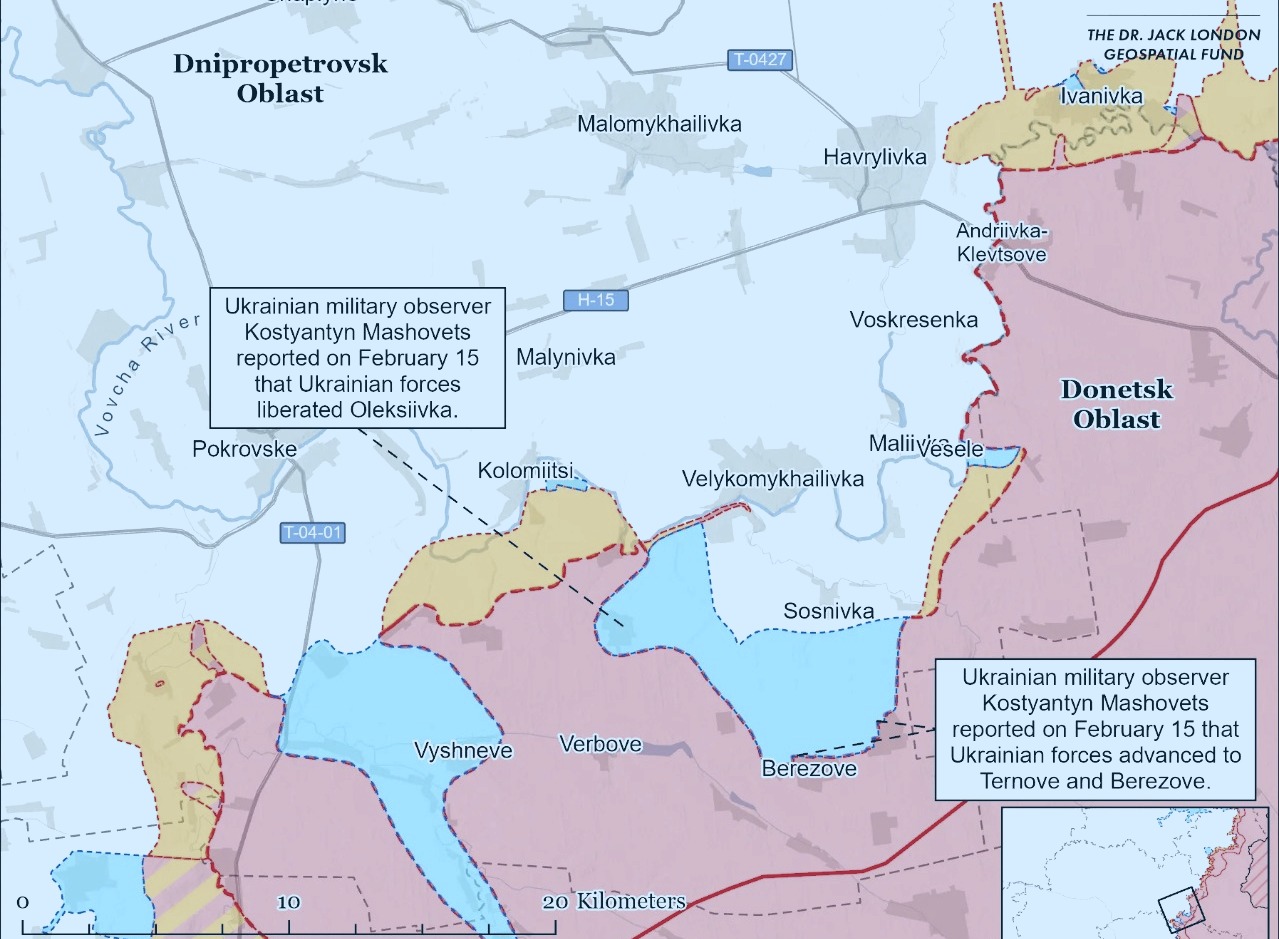
Russian gains continue to move at a footpace and do not portend the collapse of the Ukrainian lines. Russia’s weekly advances between late November 2025 and mid-February 2026 have fluctuated widely. At their height, Russian forces seized 141 square kilometers during the last week of January 25th to 31st, but Russian gains subsequently fell to 74 square kilometers in the past week (February 8 to 14). Ukrainian forces liberated territory in November and December 2025, decreasing Russian gains during some weeks. Ukrainian forces liberated territory in the Kharkiv, Kostyantynivka, Pokrovsk, and Novopavlivka directions in late November and early December, such that Russian forces lost control over 106 square kilometers of Ukrainian territory. Ukrainian forces also liberated much of Kupyansk and its surroundings in late December, and Russian forces lost control over 305 square kilometers.
Team Maverick.





China Open: Lakshya, Sindhu and Ayush Shetty Advance to Second Round After Gritty Wins
Changzhou (China), July 2026 : India’s top badminton stars Lakshya Sen, P.V. Sindhu …

China Open: Lakshya, Sindhu and Ayush Shetty Advance to Second Round After Gritty Wins
Changzhou (China), July 2026 : India’s top badminton stars Lakshya Sen, P.V. Sindhu and …