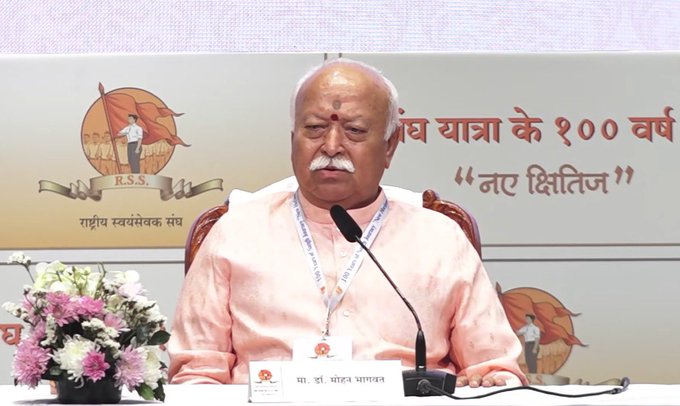
India’s Civilisational Ethos of Harmony Makes It a Global Beacon of Goodwill, Says RSS Chief Mohan Bhagwat

Gorakhpur, Feb 2026 : Rashtriya Swayamsevak Sangh (RSS) chief Mohan Bhagwat on Sunday said that India stands out globally as a land of goodwill and social harmony, rooted not in transactional relationships but in a deep civilisational philosophy of oneness and mutual belonging. He asserted that India’s strength lies in its social fabric, which binds people together beyond differences of caste, customs or appearances.
Addressing a ‘Samajik Sadbhav’ meeting organised by the Rashtriya Swayamsevak Sangh’s Goraksh province at the Baba Gambhirnath Auditorium in Taramandal, Bhagwat said society is defined by interconnectedness rather than narrow self-interest. The programme was held as part of the centenary year celebrations of the RSS.
“In many countries, relationships are viewed as transactions. In our country, human relationships are built on a sense of belonging,” Bhagwat said. He emphasised that despite the diversity of languages, traditions, clothing and customs, India has remained united because of an underlying cultural unity that transcends visible differences.
Referring to the Indian worldview, Bhagwat said, “We consider Bharat as our mother. The same divine consciousness resides in everyone.” This shared spiritual foundation, he explained, is what binds people together despite their distinct identities. He stressed that genuine social harmony, rather than mere law enforcement or administrative control, is what sustains a society in the long run.
Speaking about the RSS completing 100 years, Bhagwat said the milestone was not meant for celebration alone, but for introspection and renewed commitment. He called upon society to take greater responsibility for strengthening social cohesion. He suggested holding block-level meetings two to three times a year to foster dialogue, understanding and collective action at the grassroots.
Bhagwat urged people to rise above caste-based thinking and work for the welfare of the larger Hindu society. “Society must act on its own. The Sangh will assist, but the primary responsibility lies with society itself,” he said. He added that India’s tradition has always been to extend help to other nations during crises without any selfish motive, reinforcing its moral leadership on the global stage.
Later, while addressing a meet of prominent citizens, Bhagwat noted that expectations from the RSS have increased at a time when the world is grappling with conflict, instability and uncertainty. “There is no model elsewhere that can guarantee lasting peace and happiness for society. The world is looking towards India with hope,” he said, asserting that India’s ancient knowledge traditions offer meaningful solutions to modern challenges.
Emphasising the autonomous nature of the RSS, Bhagwat said the organisation is independent, nation-centric and not driven by the pursuit of power or popularity. “The Sangh has not come to destroy but to fulfil,” he remarked, adding that if society becomes fully organised, aware and capable, there would eventually be no need for the Sangh’s continued existence.
Tracing the ideological currents during India’s freedom struggle, Bhagwat referred to four major streams of thought that shaped the nation. These included the revolutionary path associated with leaders like Subhas Chandra Bose, the social reform movement led by figures such as Raja Ram Mohan Roy, and the civilisational resurgence articulated by spiritual visionaries like Swami Vivekananda and Swami Dayananda Saraswati.
He said RSS founder K. B. Hedgewar established the organisation on Vijayadashami in 1925 after concluding that while political freedom from colonial rule was inevitable, deep-seated social weaknesses needed to be addressed to ensure that independence, once achieved, was not lost again.
As part of the centenary initiatives, Bhagwat highlighted the RSS’s ‘Panch Parivartan’ agenda, which focuses on five key areas: social harmony, civic responsibility, environmental awareness, family awakening and self-realisation. These, he said, are aimed at building a strong, cohesive and self-reliant society capable of facing future challenges with confidence and unity.
Bhagwat concluded by reiterating that India’s civilisational values of harmony, inclusiveness and collective responsibility are not just relevant for the nation, but hold lessons for a troubled world seeking peace and stability.


Pakistan Appoint Mike Smith as Test Batting Coach Amid Batting Crisis
Mumbai, Aug 2026 : Pakistan have appointed former South African first-class cricketer and …

Pakistan Appoint Mike Smith as Test Batting Coach Amid Batting Crisis
Mumbai, Aug 2026 : Pakistan have appointed former South African first-class cricketer and Level …