“I Speak Marathi with Pride”

Special Article on Marathi Language Pride Day
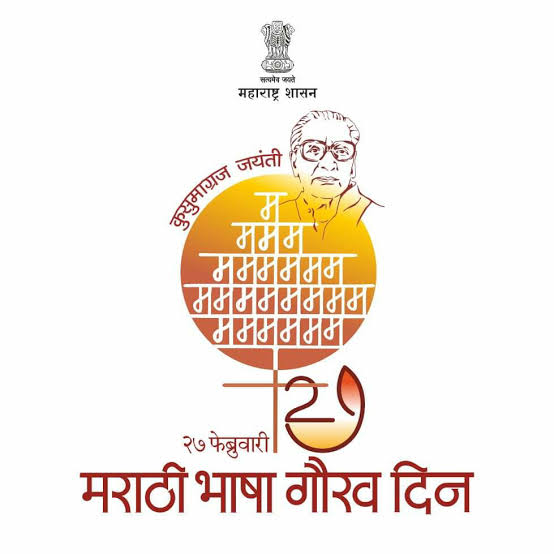
February 27th the birth anniversary of V. V. Shirwadkar (Kusumagraj), is celebrated in Maharashtra as Marathi Language Pride Day. This day is not merely for remembrance; it is a day of introspection and self-respect. Inspired by the saintly saying “Majha Marathachi Bolu Kautuken” (“I speak Marathi with pride”), this occasion invites a thoughtful review of Marathi’s historical tradition, literary richness, and classical stature.
The roots of the Marathi language can be traced to ancient Maharashtri Prakrit. During the Satavahana period, Pratishthan—present-day Paithan—served as a major political and cultural center. At that time, Maharashtri Prakrit was the dominant language of daily life, administration, and literary creation. The Gatha Saptashati, compiled by Satavahana king Hala, is considered strong evidence of this linguistic tradition. It includes verses by around 278 poets and reflects the social, cultural, and emotional world from the 2nd century BCE to the 2nd century CE. Depicting love, nature, rural life, and relationships between men and women, this work laid the early emotional foundation of Marathi literature.
From Maharashtri Prakrit to Apabhramsha and later to early Marathi, a clear linguistic evolution can be seen. Inscriptions, copper plates, and donation records provide evidence of early Marathi usage. During the Yadava period, Marathi gained prominence in administration. This era strengthened Marathi as a people’s language and made it an effective medium for the spread of knowledge.
Within the saint tradition, Sant Dnyaneshwar gave Marathi a philosophical foundation. Through Bhavarthadeepika (Dnyaneshwari) and Amritanubhav, he brought Sanskrit philosophy to the common people in their own language. His words—“Majha Marathachi Bolu Kautuken, Pari Amrutatehi Paija Jinke”—express his unshakable faith in Marathi’s expressive power. Thereafter, saints such as Sant Namdev, Sant Eknath, and Sant Tukaram, along with the entire Varkari tradition, expanded Marathi’s spiritual and social reach through abhangas and ovis. The Bhakti movement gave Marathi popular acceptance and transformed it into a powerful medium of mass communication.
Chhatrapati Shivaji Maharaj elevated Marathi from a people’s language to the language of governance in Swarajya. Its administrative strength was demonstrated through official correspondence, royal edicts, and the Rajyavyavahar Kosha. During the establishment of Swarajya, Marathi became a symbol of self-respect and pride. In the Peshwa era and later periods, Marathi encountered new challenges and opportunities within the education system. With the arrival of the printing press, newspapers, book publishing, and modern literary forms flourished.
In modern times, Marathi has established a distinct identity across novels, drama, poetry, creative writing, criticism, and journalism.
Kusumagraj emphasized linguistic self-respect by saying, “In courts of other languages, treat your language with dignity like a gentleman; but in your own home, cherish it like a mother.” Sane Guruji expressed gratitude toward the mother tongue and urged people to acknowledge their debt to it. These thoughts underline that Marathi is not merely a language of transaction, but a language of values and culture.
The Classical Language status granted to Marathi by the Government of India is an official recognition of its ancient tradition and rich literary heritage. With a history spanning over two thousand years, independent literary creation, a body of scholarly texts, and continuous linguistic development, Marathi meets all criteria for this honor. This recognition will strengthen research, academic studies, university curricula, and the preservation of ancient manuscripts.
In today’s digital age, Marathi faces new challenges. Its presence must grow in technology, artificial intelligence, computational linguistics, e-libraries, and social media. Strengthening Marathi’s use in administration, science and technology, industry, and higher education is the need of the hour, and efforts are being made in this direction. Cultivating reading habits, writing sensitivity, and linguistic pride among the younger generation is a shared responsibility.
Marathi Language Pride Day is not just a formal celebration; it is a celebration of cultural identity. Marathi is a pillar of Maharashtra’s ethos—its words carry the imprint of history, the compassion of saintly literature, the pride of Swarajya, and the leap of modernity.
Let us ensure that the spirit of “Majha Marathachi Bolu Kautuken” is reflected not only in words but in action—by increasing the use of Marathi, promoting its research and preservation, and enabling it to stand proudly on the global stage. This is the collective aspiration we express on Marathi Language Pride Day.

India Make Two Changes for Must-Win Fourth T20I as Shreyas Iyer Opts to Bat Against England
Bristol, July 2026 : India made two significant changes to their playing XI as captain Shr…

India Make Two Changes for Must-Win Fourth T20I as Shreyas Iyer Opts to Bat Against England
Bristol, July 2026 : India made two significant changes to their playing XI as …