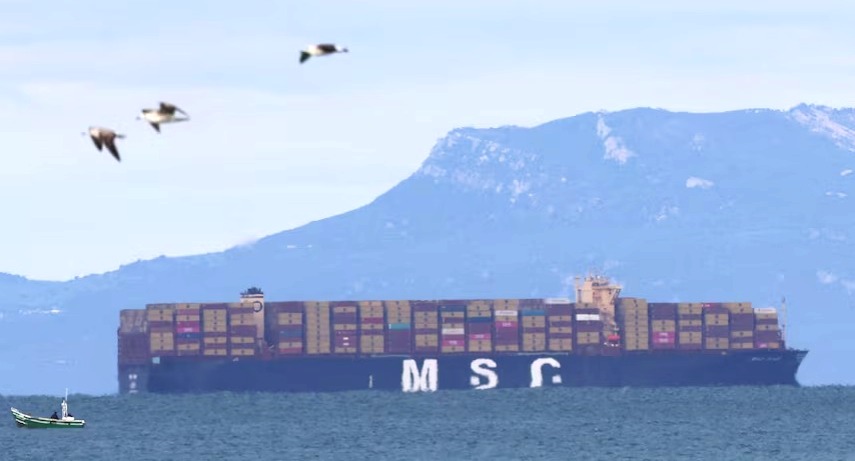
Marine Shipments To Africa and Indian Ocean islands Would Be Levied A War Surcharge Affirms MSC.

New York; March 2026: World’s Largest Shipping Company, Mediterranean Shipping Company (MSC) would implement a “war surcharge” for cargoes moving to African nations and Indian Ocean islands from the Indian subcontinent and the Gulf countries, after maritime traffic was affected in the Straits of Hormuz and Bab El-Mandeb. It was announced by the MSC vide a press release today (05th March 2026).
The surcharges which are effective from today, 05th March 2026, apply to cargoes from the Indian subcontinent to East Africa, Somalia, Mozambique and Indian Ocean islands, as well as from the Gulf nations to West Africa, East Africa, South Africa, Mozambique and the Indian Ocean islands, the company has informed.
The surcharge for cargoes from the Indian subcontinent will be $500 per 20-foot equivalent unit (TEU) for dry containers and $1,000 per TEU for refrigerated containers, MSC said. Furthermore, it will charge $2,000 for 20-foot containers, $3,000 for 40-foot containers and $4,000 for refrigerated containers on cargoes from Gulf nations to African countries, as “war surcharge” in addition to the existing freight tariff.
Although not officially disclosed by MSC, however the additional “war surcharge” is considered to be an option after leading maritime insurers have cancelled war risk cover for vessels operating in the Gulf as the escalating Iran conflict disrupted shipping and sent some freight costs surging.
Several leading mutual marine insurers, including Norway’s Gard and Skuld, the UK’s NorthStandard and the London P&I Club, and the New York-based American Club, said they were cancelling war risk cover for ships operating in the region, which have further dissuaded shipowners from traversing the Gulf. The insurers said war risk cover, which typically covers shipowners for costs and damages resulting from war, terrorism and piracy, would be cancelled in Iranian waters, as well as the Gulf and adjacent waters, with effect from 05th March.
Peter Hulyer, the head of UK protection and indemnity (P&I) at the leading insurance broker Marsh, said this related to non-poolable war cover for these mutual insurers, provided for specific, often higher-risk, exposures such as chartered vessels. “In most cases the clubs will be offering to reinstate war coverage at terms to be agreed. Mutual P&I cover offered by the clubs is unaffected by the above”.
Marcus Baker, the global head of marine at Marsh, said several other insurance markets, including Lloyd’s of London, had issued notices of cancellation, to give insurers time to look at the heightened risks in the Middle East and assess their rates. He said insurance rates could go up by 50% to 100%, or even more, from 0.25% to 0.5% or 1% of the value of the insured asset. This compares with a rating of 5% after Russia’s invasion of Ukraine in 2022 for ships going into Odesa.
The cost of transporting goods jumped, as shipping was rerouted and oil prices rose sharply on Monday (02nd March 2026). Freightos terminal container rates for Shanghai to Jebel Ali in Dubai, the largest port in the Middle East, rose from $1,800 for a 40ft container on Saturday to about $3,700 on Monday, according to the online shipping marketplace. Freightos said as only about 2% to 3% of global container volumes passed through the strait of Hormuz, its effective closure may not have much of an impact on the broader container market.
Dubai-based DP World suspended operations at Jebel Ali over the weekend after an aerial interception caused a fire on Saturday night, though operations have since resumed. However, given the wider disruption in the region, including the Red Sea, it added: “For importers or exporters trying to move goods in or out of the Middle East, services will be significantly disrupted, and costs will rise for goods that are able to move at all”.
John Wyn-Evans, the head of market analysis at the UK wealth asset management group Rathbones, said: “Any rate increases would be linked to a combination of rerouting and higher oil prices; rerouting involves being at sea for longer which reduces capacity and if the cargoes have to get there by a certain time, they have to sail faster, which uses up more fuel (and it’s exponential, like driving faster in a car and watching MPG [miles per gallon] go down)”.
Iran-backed Houthi rebels in Yemen, who had paused attacks on Red Sea vessels since October, have also threatened to resume strikes.
In response, several big shipping companies, Denmark’s Maersk, Germany’s Hapag-Lloyd and France’s CMA CGM, have diverted all their sailings away from the Red Sea until further notice, rerouting them around Africa. Denmark’s Norden has suspended all new business requiring transit through the strait of Hormuz.
CMA CGM has imposed an emergency conflict surcharge of between $2,000 (£1,491) and $4,000 a container on cargo moving through the region.
Shares in Beazley, a leading marine insurer that operates in the Lloyd’s market, initially dropped 2.8% as investors fretted about a potential large insurance loss arising from the Middle East and risks to its takeover by its bigger rival Zurich. Its share price rebounded by 1.8%, when the two companies announced on Monday afternoon that the £8.2bn deal had been agreed, but closed 1.3% lower.
“The announcement might also be read as a signal that Beazley’s loss exposures, and likely those of the broader specialty insurance market, remain contained”, said analysts at Jefferies. Beazley wrote just over $500m of premiums for marine insurance in 2024, about 8% of its total book.
Matthew Wheatley, the main data analyst at the energy analysts Wood Mackenzie, said: “Freight rates are volatile amid the fresh instability in the Middle East, with most tankers now avoiding the strait of Hormuz as attacks and insurance cancellations make the area increasingly unsafe. A substantial number of tankers are currently stranded or rerouting in the region, effectively removing a significant amount of capacity from the market. If the conflict continues and tanker availability remains tight, global freight rates could rise further”.
Suvro Sanyal – Team Maverick.






Deepti’s Five-Wicket Magic Powers India to Dominant Win Over Pakistan
Birmingham, June 2026 : India launched their ICC Women’s T20 World Cup 2026 campaign in co…

Deepti’s Five-Wicket Magic Powers India to Dominant Win Over Pakistan
Birmingham, June 2026 : India launched their ICC Women’s T20 World Cup 2026 campaign …