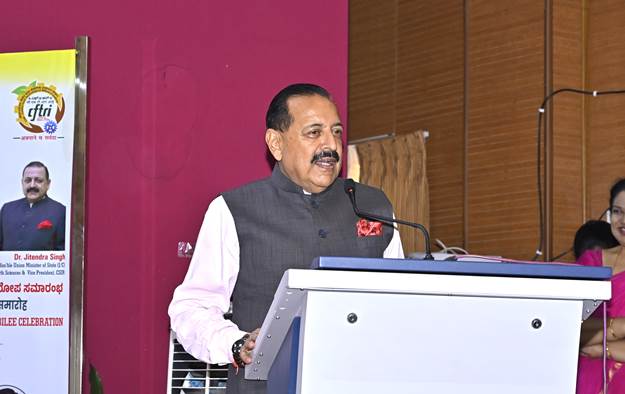
Dr. Jitendra Singh Lays Foundation of 30 single occupancy hostel for trainees at ‘Central Food Technology Research Institute’ Mysuru

Millet recipes developed with Indian technology being served by international food chains: Dr Jitendra Singh
CFTRI’s Millet Centre Drives Global Adoption, Links Research With Food Markets, says the Minister
Dr. Jitendra Singh Pushes Integrated Model Combining Millet Innovation and Grassroots Capacity-Building
MYSURU, April 2026 : India’s millet push received a dual institutional boost today as the Centre moved to scale both technology and grassroots capacity, with Union Minister for Science and Technology Dr. Jitendra Singh highlighting Millet recipes developed with Indian technology are being served by international food chains, including McDonalds.
The Centre is now working on developing similar sustainable food recipes from “Kalari” , a popular cheese product originating from Udhampur in J&K, the Minister informed.
During a visit to the country’s first dedicated ‘Centre of Excellence’ for Millets at the Central Food Technology & Research Institute here, Dr Jitendra Singh observed that the innovations from this Centre have already entered global food chains , and will now be complemented by a new residential training ecosystem to expand its reach nationwide.
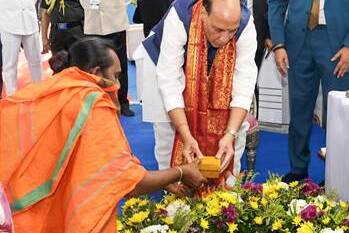
Earlier, the Minister performed the Bhoomi Pooja for 30 single occupancy hostel facility under the Rashtriya Krishi Vikas Yojana (RKVY), marking the start of a capacity-building expansion aimed at trainees, farmers, Farmer Producer Organisations (FPOs) and self-help groups, even as he positioned the institute’s millet ecosystem as a model for converting traditional crops into scalable, market-ready products.
The upcoming hostel complex at the M.G. Halli campus will include facility for around 50 participants, accommodation, and kitchen and dining infrastructure, and is expected to be completed within a year. The facility is designed to support residential training programmes, enabling participation from across the country, particularly for those unable to afford accommodation, and strengthening skill development in food processing, entrepreneurship and value addition.
Officials said the project addresses a growing demand for structured training, with the institute already conducting dozens of programmes annually for farmers, entrepreneurs and industry stakeholders. The residential format is expected to significantly enhance participation and outcomes by allowing hands-on, immersive training aligned with the government’s Skill India and livelihood generation initiatives.
Positioning millets at the centre of India’s food and nutrition strategy, Dr. Jitendra Singh described the Centre of Excellence at CFTRI as “possibly the first of its kind globally”, developed at a time when India has led the international millet movement, including the United Nations’ declaration of the International Year of Millets. He said the institute has demonstrated how traditional grains can be transformed into modern food products that are “rich in iron and protein, yet taste-friendly”, with adoption by global food chains reflecting their commercial viability and consumer acceptance.
During his visit to the Centre of Excellence on Millets, Dr Jitendra Singh reviewed the facility’s integrated processing infrastructure, which includes seven processing lines and a dedicated laboratory enabling end-to-end primary and secondary processing of all major millets. The centre is equipped with specialised lines for cleaning, dehulling, polishing and sorting, as well as for producing value-added products such as flakes, extruded items, baked goods and semolina. It also incorporates technologies that extend the shelf life of millet flour from about one month to nearly ten months, significantly enhancing commercial viability. With automated operations and a processing capacity ranging from 300 kg to 1,000 kg per hour, the facility is designed to support farmers, self-help groups and startups in developing market-ready millet-based products.
The millet facility, supported by ₹20 crore under RKVY, integrates advanced processing technologies capable of handling all nine varieties of millets within a single system. With a cleaning capacity of 60–70 tonnes per day and milling capacity of 12–15 tonnes per day, it produces a range of value-added outputs including flour, semolina (sooji and rava) and bran, while ensuring higher nutrient retention, improved shelf life and industrial-scale efficiency in a hygienic, automated environment.
Dr. Jitendra Singh emphasised that the next phase of growth lies in expanding the commercial and entrepreneurial ecosystem around such technologies. He called for stronger outreach, including digital dissemination and targeted engagement with startups and MSMEs, particularly in emerging segments such as ready-to-eat and “carry-home” food products tailored to changing urban consumption patterns.
Noting that institutions like CFTRI have already developed hundreds of technologies with high levels of commercial adoption, the Minister said the focus must now shift to ensuring wider market access and last-mile delivery. He stressed that scientific innovation must move beyond laboratories to directly support livelihoods, especially through partnerships with farmers, women’s groups and small enterprises.
The twin initiatives unveiled on Friday — a globally benchmarked millet innovation platform and a dedicated residential training facility — together signal a more integrated approach to food policy, linking research, skill development and enterprise creation. While the millet centre provides the technological backbone for value-added, nutrition-driven products, the hostel facility is expected to expand the pool of trained stakeholders capable of adopting and scaling these innovations on the ground.
With global attention turning towards climate-resilient crops and sustainable nutrition, millets are emerging as a strategic focus area for India’s food economy. The CFTRI model, combining scientific research, industry linkage and grassroots capacity-building, is being positioned as a template for translating this opportunity into both economic growth and nutritional outcomes.



Mhatre’s 73 Powers CSK to 209/5 Against PBKS in High-Scoring IPL Clash
Chennai, April 2026 : A scintillating knock from youngster Ayush Mhatre, supported by expl…

Mhatre’s 73 Powers CSK to 209/5 Against PBKS in High-Scoring IPL Clash
Chennai, April 2026 : A scintillating knock from youngster Ayush Mhatre, supported by explosive …