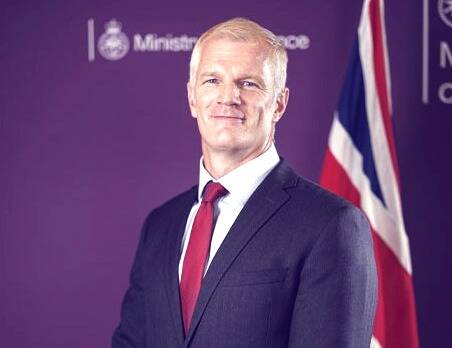
Russia Is Not Fighting A War In Ukraine, It Is Promulgating Military Tactics To Iran: Minister Of Armed Forces, UK.

London; April 2026: Yesterday on 11th April 2026, Alistair Carns, Minister Of Armed Forces – United Kingdom while delivering the closing speech at the London Defence Conference has reiterated: “In Ukraine, you see a war evolving in real time. Drones everywhere. The kill chain is now compressed. Front lines that are no longer fixed. But there is something else. A country under sustained attack with thousands of drones and missiles hitting cities night after night, energy infrastructure targeted, families living with constant uncertainty. Russia is not just fighting a war in Ukraine. It is adapting learning, and it’s exporting what it learns. Working with Iran, it’s sharing technology, enabling attacks on our allies. We’re seeing that play out in real time, every hour of every day, and we’re seeing the oil price spike to Russia’s benefit”.
With cognizance to the Iran War, the Armed Force Minister has advocated for an immediate ceasefire alongwith a rapid progress towards a substantive negotiated settlement. He further stated that Russia has continued its step up strikes on Ukraine, relentlessly and indeed at scale, with around 7000 attacks a day on the front line, and 55,000 drone and missile strikes last year alone, trying to break the country’s will and cohesion as much as its capability. And yet, despite all of that, Ukraine still stands. Its economy is under strain. Its infrastructure has been hit repeatedly. Millions have been displaced, and still people go to work, still services operate, still the country fights on. That is resilience.
He further asserted: “It’s not a concept, but as a lived reality, and it should make us all pause for thought. Because if we think resilience is something we can switch on in a crisis. You, I, we are collectively wrong. It has to be built in advance. After spending almost 24 years in uniform, and towards the end of that time, it is already clear what was going on – the warfare is changing, and one can visualise the increasing pace of adaptation”.
While praising the commendable resilience demonstrated by the Ukrainian Armed Forces (AFU) during the 2023 counter offensive on the Zaporizhzhia front, which was fought with courage and determination, counterfeiting 90,000 double stacked anti-tank mines and 600,000 anti-personnel mines. Amidst casualties in their thousands, the AFU thrived for resource drive innovation at a pace that was both unstoppable and extraordinary. The kind of innovation that only happens when a nation is under existential pressure, when survival overtakes everything else and for the industry partners out there, when winning overtakes the requirement to make profit. Hence, if pace cannot be changed, one would fall behind.
Carns highlighted that Data is the new gun powder that which is fuelling kill webs and targeting systems across the front line in Ukraine, as large conflicts nowadays are often measured in statistics. The Defence Industry is now producing millions of drones, and 90% of all casualties are linked to drone warfare, and noteworthy 85% of those systems are made in Ukraine. Russia is trying to outpace Ukraine by manufacturing 07 million drones a year.
In Ukraine, one drone equates to a lethality of 22 artillery rounds. The scale that logically comes to mind is not only the kill chain, but the supply chain behind it, the implications are profound, even more significant beyond the front line, perhaps behind it. At the height of the counter offensive, mentioned earlier, in 2023 Ukraine, was far between 16 and 18,000 rounds a day in artillery. That’s about 900 tons of metal every day flying through the air. A simplistic calculation suggests – that around 57 truckloads on average a day. Carns has further reiterated that: “what does that mean for every other factor in the battlefield, our industry, our innovation moves, our supply chains, they all need to see the new reality and adapt now. If Ukraine is the teacher that has taught us economics of modern warfare, Iran is the headmaster that’s just hit us with the ruler and told us to listen. The economics of warfare matter, and we must learn and act now and act together. The consequences of ignoring these lessons will be grievous”.
While adding further, “In the future, if Russia looks over a NATO, a JEF or an allied border and sees a force that has not adapted to the lessons of Ukraine, it will not see deterrence. It will see opportunity. Deterring a country that has taken over a million casualties, more casualties in America took in the entire Second World War, is a challenge, and I’m unsure that we collectively can comprehend what that means. Part of that is not viewing resilience just about military capability, something Ukraine has learned, but defining how a country understands its strength. Indeed, resilience is much more multifaceted. And we often talk about defence – bombs, bullets, ships, planes – but the reality is the economy, the NHS and education, we often talk about being separate”.
“Strength is not just what sits on the front line. It’s what sits behind it, and indeed underneath it. Ukraine shows us the other side of that equation, a country under immense pressure, where the cost of living has surged, where infrastructure has been damaged, and yet where resilience holds. We should not assume we would respond in the same way, unless we build that resilience now. So, when we talk about readiness, we need to think more broadly. Yes, it’s about capable Armed Forces, and of course, supporting Ukraine with 4.5 billion in military assistance over the last year. On NATO’s eastern flank, in the high north and, of course, across the Middle East. But readiness today and resilience today is about how quickly we can also adapt, how quickly you can learn, and whether you can scale when it matters”, Carns said.
Ukraine has indeed changed the perception of war; since the First World War, artillery has been overtaken as the major contributor to casualties, where relatively cheap systems can destroy high value exquisite targets, where innovation cycles are measured in weeks, not months, definitely not years. This is however not any niche capability, but the future of warfare, and nations are investing to the tune of 04 billion in uncrewed systems, bolstering an integrated targeting network, and working directly with Ukraine. Because readiness is not just what is bought, it’s how fast you learn. The battle space now includes infrastructure, energy networks, data communication, supply chains and the digital layer that sits across it.
While, Russia remains the primary threat to European security, further underlined by the Defence Secretary on Thursday who exposed just their latest hostile naval activity. However, the war in Ukraine, the tactics used by Iran are separate. They are connected through shared technology, through shared and aligned interests, and through pressure they place on our economics and energy systems.
“Our response is clear. It’s NATO first, but not NATO only. We lead with allies across Europe, across the JEF and beyond, because readiness is a collective. And for those of you here from the United States, let me say this, the UK and US relationship is not measured in commentary. Rather, it is measured in what we do and what we have done, in the depth of our integration, in the intelligence and operations we have shared, and indeed in our history, in the capabilities we developed together, and in the access and support we provide from the North Atlantic to the systems that underpin the very foundations of modern warfare. Friends can disagree. We’ve been here before: Vietnam, the Falklands. In reality is our cooperation is continuous. It’s deeply embedded across our economy, our industry, our culture and our militaries, and it will take more than a year or two to pull that apart. The answer is, united, we are stronger. That’s the reality”, Carns asserted.
“You can have the best equipment in the world, but if people do not feel valued, you will not get the best out of them. That’s why pay matters. Housing matters. Families matter because readiness is about sustaining a force, not just generating one. And we’re seeing the results: recruitment up, outflow down. Because if you want a ready force, you have to build a country that supports it. So let me finish, perhaps where I started. Our people are ready. They are capable. They are delivering. But readiness is not a fixed state. It is something you build, and you have to rebuild it continuously over time. It runs through everything we do in our Armed Forces, yes, but just as much in our economy, our infrastructure and indeed, the resilience of our society” he concluded, “You can spend billions in defence, but if the country underneath is not strong, it will not hold. Our job in this government is to build both and a country that is secure and a country that is strong enough to sustain the security. That is what readiness and resilience really mean. And if we get this wrong, if we fail, we increase the chances of war. Let’s be absolutely clear, we increase the chances of conflict by not being ready, and we will, if we don’t get it right, find ourselves on the wrong side of history”.
Team Maverick.







Vijender Singh Questions Rahul Gandhi Over Silence on India’s Commonwealth Games Success
New Delhi, Aug 2026 : Olympic medallist boxer Vijender Singh has questioned Congress leade…

Vijender Singh Questions Rahul Gandhi Over Silence on India’s Commonwealth Games Success
New Delhi, Aug 2026 : Olympic medallist boxer Vijender Singh has questioned Congress leader …