OSCE: Hungary’s Parliamentary Elections Were Vibrant, But No Equal Opportunities For Contestants.

Budapest; April 2026: The 12 April parliamentary elections saw active citizen engagement with record voter turnout and genuine choice, but there was no level playing field, with the ruling party benefitting from systemic advantages that blurred the line between state and party. The election administration managed the preparations efficiently and professionally. While the campaign was marred by the divisive and fearmongering rhetoric on the part of the ruling party, including unsubstantiated claims of foreign interference advanced by the government, candidates were able to campaign freely. The extensive misuse of public office, administrative resources, and government messaging, a clear bias in monitored media and news coverage in favour of the ruling party, and serious shortcomings in the regulation of campaign finance further undermined equality of opportunities among contestants.
Additionally, insufficient efforts by the authorities to protect the online space and counter disinformation reinforced the atmosphere of deep polarization and undermined public confidence. Shortcomings in the handling of election disputes, together with the limited effectiveness of legal remedies, weakened accountability. The International Election Observation Mission (IEOM) positively assessed all stages of the election day process in the overwhelming majority of polling stations observed, despite some procedural shortcomings.
The legal framework continues to contain a number of omissions and key provisions that fall short of OSCE commitments and other international standards for democratic elections. The legislation underwent a series of extensive amendments following the last parliamentary elections, mainly technical and procedural in nature with some substantive changes. The changes were adopted without broad and inclusive consultations. The recent amendments did not address a number of previous ODIHR and Council of Europe Venice Commission recommendations. For example, the lack of an explicit prohibition against misuse of public office and administrative resources for campaign purposes fail to ensure a fair basis for contestants. Under the current state of danger in place since 2022 and repeatedly extended, the government holds extraordinary powers to issue decrees that may restrict fundamental rights and freedoms beyond what is allowed under ordinary circumstances.
Contrary to international standards, the 2024 redrawing of the boundaries of more than one-third of the single-member constituencies were not conducted by an independent body in an inclusive and transparent manner, and the principle of equality of the vote continues to be challenged. The technical preparations of the elections were administered efficiently and professionally and within legal deadlines by the dual structure of the election commissions and offices headed by the National Election Commission (NEC) and National Election Office (NEO). The current composition of the NEC, predominantly drawn from members elected or delegated by governing parties, impacted the impartiality and independence of its decision-making on several key campaign-related matters.
The legal framework also limits inclusiveness and collegiality within the body, as only the NEC president may propose decisions and a 2022 amendment repealed the voting rights of nonparliamentary party delegated members. Consequently, the scope of deliberation was narrowed, particularly with respect to the handling of electoral disputes, as observed by the ODIHR EOM. NEC sessions were public and decisions were published in a timely manner, contributing to transparency. Some 8.1 million voters were included in the central voter register, which is maintained by the NEO.
There was confidence in the accuracy of the in-country voter register while there are serious concerns regarding the reliability of the postal voter register. There is a lack of safeguards for postal compared to in-person voting, including the permitted use of third-parties for the collection and delivery of postal ballots, which was taken advantage of by organizations aligned with Fidesz. Suffrage restrictions based on mental disability and distinctions based on marital status are contrary to OSCE commitments and international standards. Further, restrictions on voting rights of persons belonging to national minorities are in violation of the European Convention for Human Rights.
“I was impressed by the spirited citizen engagement we have witnessed in these elections. It is a testament to the voters that the ruling party’s divisive and inflammatory rhetoric and misuse of office did not stop them voting in record high numbers yesterday,” said Sargis Khandanyan, the OSCE Special Co-ordinator and leader of the short-term observers. “This was a hard-fought campaign, and while the ruling party leveraged government powers to tip the scales in its advantage, it remained competitive.”
The campaign was active and highly visible, both online and across the country. The ruling party’s divisive messaging on Ukraine and the EU institutions dominated the highly polarized campaign discourse with domestic issue-based policies receiving less prominence. The authorities’ failed to adequately address public and stakeholders’ concerns regarding foreign interference. Several foreign leaders and political actors came out in support of the incumbent, reiterating Fidesz’s campaign messaging on security.
“Congratulations to the people of Hungary, who expressed a clear and unequivocal choice. The exceptionally high voter turnout demonstrates that fearmongering, threats and intimidation cannot suppress the democratic will of the people”, said Pablo Hispán, Head of the PACE delegation. “It’s a powerful democratic response, and reflects the indispensable role played by civil society and independent media in preserving scrutiny, accountability and the conditions for political change. Péter Magyar and Tisza have a clear mandate to turn the page and now carry a great responsibility – to honour the trust placed in them by the Hungarian people and strengthen the rule of law, balance of powers and democracy”.
The media landscape in Hungary, although formally diverse, is heavily skewed in practice, with independent journalism at a clear structural disadvantage compared to a much larger and better resourced pro-government media sector. Restricted access to information and a tense operating environment for journalists, marked both by physical incidents and online threats, are of concern. ODIHR social media monitoring observed the use of generative AI and manipulative content for purposes of domestic disinformation and to discredit political opponents.
“It is abundantly clear that the public service media’s coverage was slanted in favour of the government and the ruling party. Admittedly, there was free political advertising available to parties, but failure of the public media to provide balanced and information is disturbing”, said Rupa Huq, the Head of the delegation from the OSCE Parliamentary Assembly. “Given the overall restrictive media attention to the campaign, the massive engagement of voters who turned out yesterday is all the more remarkable to have witnessed”.
The legal framework, which underwent a series of mainly technical and procedural changes since the last elections, continues to fall short of OSCE commitments and other international standards for democratic elections, including by failing to explicitly prohibit the misuse of public office and resources for campaign purposes. Overall, the handling of election disputes was not impartial, which, together with the limited effectiveness of legal remedies, weakened accountability.
“There was an active and highly visible campaign, and candidates were able to campaign freely, but the framework for the elections does not ensure a fair basis for contestants”, said Eoghan Murphy, Head of the Mission from the OSCE Office for Democratic Institutions and Human Rights. “For example, our monitoring showed that the ruling party greatly benefitted from the misuse of government messaging to amplify campaign messages, the removal of spending limits, significant increases in public funding for parliamentary groups prior to the election funding which can be used in the campaign, all further distorting the playing field”.
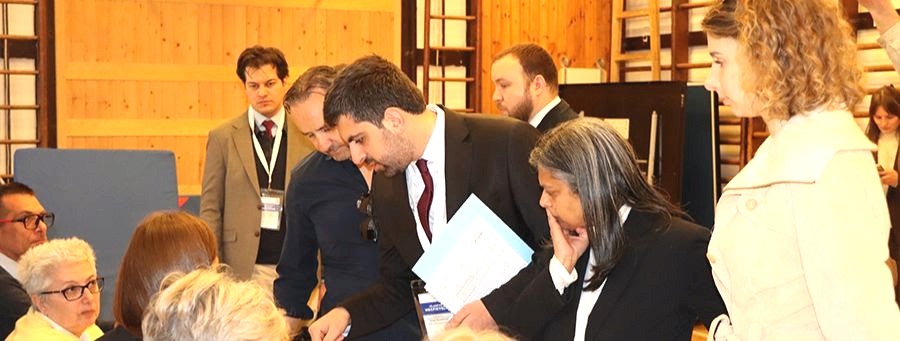
The technical preparations for the elections were administered efficiently and professionally, and the election administration was transparent in its work. However, the current composition of the National Election Commission, predominantly drawn from members elected or appointed by governing parties, impacted the impartiality and independence of its decision-making on several key campaign-related matters. On election day, the observers assessed all stages of the election process positively in the overwhelming majority of polling stations observed, despite some procedural shortcomings.
Authorities and parties have made virtually no efforts to enhance women’s political participation, resulting in their significant underrepresentation, and less than one quarter of candidates were women. With few exceptions, women did not feature prominently in the campaign.
Contrary to OSCE commitments and international good practice, the legal framework continues to lack provisions for domestic non-partisan election observation, thereby constraining opportunities for independent citizen oversight of polling and counting processes.
Team Maverick.






TSA Delivers Unmatched Security, Efficiency For FIFA World Cup 2026.
Washington DC; June 2026: The world’s largest soccer tournament kicks off tomorrow (Thursd…

TSA Delivers Unmatched Security, Efficiency For FIFA World Cup 2026.
Washington DC; June 2026: The world’s largest soccer tournament kicks off tomorrow (Thursday – …