Yogi govt raises maintenance allowance for destitute cows to Rs 50 per cow per day

Mahakumbh Nagar : After the cabinet meeting of the Yogi government, an important meeting of the Animal Husbandry and Dairy Development Department was held at Mahakumbh 2025 on Saturday. The meeting, chaired by Animal Husbandry and Dairy Development Minister Dharampal Singh, was attended by state-level officials along with officers from Prayagraj, Vindhyachal, and Varanasi divisions.
Key decisions were taken at the meeting regarding cow protection, increasing milk production, and the commercial use of cow dung and cow urine, alongside a review of the department’s ongoing initiatives.
A detailed strategy was outlined by the state government to adopt a holistic approach to cow protection. A vermicompost unit will be established with the support of the Agriculture Department to ensure the economic self-reliance of cow shelters across the state.
The department will also facilitate the supply of earthworms for vermicompost production, as well as handle the licensing, standardization, and marketing of manure.
Additionally, efforts will be made to develop technology for manufacturing various products from cow dung and cow urine across all districts. Training programs will be organized for cattle rearers and cow shelter operators to enhance their skills and promote sustainable practices.
The government is also considering incorporating cow and cattle rearing into the school curriculum to help children understand the significance of cows and cow milk.
Cow shelter operators and fodder-producing farmers will be provided training in silage production technology using green fodder cultivated on pasture lands. In collaboration with the Indian Grassland and Fodder Research Institute, training will be conducted on various green fodder varieties, including Napier and Azolla, to improve fodder availability and livestock nutrition.
Prioritizing cow protection, the state government has provided shelter to 12,43,623 destitute cows across 7,713 cow shelters. The maintenance allowance per cow has been increased from Rs 30 to Rs 50 per day. Additionally, under the Mukhyamantri Sahbhagita Yojana, 1,62,625 destitute cows have been handed over to 1,05,139 beneficiaries, each of whom receives Rs 1,500 per month as financial assistance.
During the meeting, officials were informed that on the occasion of Makar Sankranti, 1,511 destitute cows were handed over to identified malnourished families as part of a special campaign. Approval was also granted for the construction of 543 large cow conservation centers, with the unit construction cost increased from Rs 120 lakh to Rs 160.12 lakh.
So far, 372 centers have been completed and are fully functional. Efforts are underway to install radium belts on cattle near highways and national highways, along with CCTV cameras in cow shelters, utilizing funds from the Cow Conservation Fund at the district level.
To enhance the commercial utilization of cow dung and cow urine, new initiatives have been launched to integrate them into the rural economy. The marketing of cow dung and cow urine-based products has vast potential to make cow shelters self-reliant and generate employment in rural areas. Schemes such as Gocast, pots, Godip, vermicompost, and biogas production are being implemented in 38 districts with the involvement of women self-help groups and NGOs.
A cow sanctuary and CBG (compressed biogas) plant with a capacity of 5,000 cattle has been set up in Tughlakpur Kamheta village, Muzaffarnagar district, in collaboration with the National Dairy Development Board (NDDB). Additionally, vermicompost produced from cow dung is being utilized to enhance agricultural productivity, contributing to sustainable farming practices.
A total of 9,450 hectares of pasture land across the state has been linked to cow shelters, with 5,977 hectares specifically earmarked for green fodder production. An action plan has been prepared to cultivate green fodder on 50,000 hectares over the next three years, promoting the cultivation of oats, berseem, and Napier grass to enhance livestock nutrition.
To boost milk production, the state government is implementing high-quality breed improvement programs. The cost of sexed semen doses for artificial insemination has been significantly reduced from Rs 700 to Rs 100, making it more accessible to farmers. Additionally, 8,000 youth have been trained as paravets, providing artificial insemination services in rural areas.
The government has also imported 100 high-yield Sahiwal embryos from Brazil, which are currently being implanted in Uttar Pradesh. Advanced techniques like IVF and Embryo Transfer Technology (ETT) are being utilized to develop high-quality bovine breeds.
To strengthen livestock health services, 520 mobile veterinary units have been set up, ensuring on-call veterinary and vaccination services at farmers’ doorsteps through the toll-free number 1962.
Over six crore animals in the state have been provided with free deworming medicines and treatment, reinforcing the government’s commitment to cow protection and dairy development. The Uttar Pradesh government continues to make consistent efforts to enhance the livestock sector and improve animal welfare.

CM Rekha Gupta hands over ₹1 crore each to families of Covid warriors
‘Their sacrifice will never be forgotten,’ says CM after meeting bereaved families Flags d…
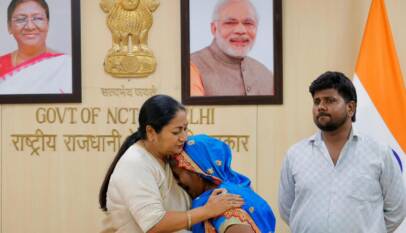
CM Rekha Gupta hands over ₹1 crore each to families of Covid warriors
‘Their sacrifice will never be forgotten,’ says CM after meeting bereaved families Flags delay …