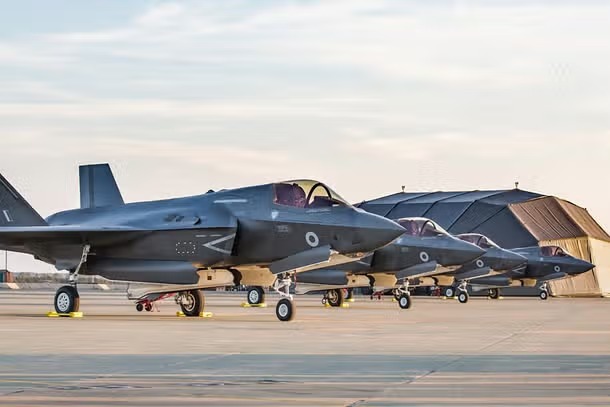
India’s F-35 Dilemma: Strategic Edge or Costly Gamble?

India’s urgent search for 114 multi-role fighter aircraft (MRFA) and its aspirations for a fifth-generation combat aircraft program have taken a new turn with an unexpected offer. U.S. President Donald Trump has proposed the F-35 Joint Strike Fighter (JSF) for India, while Russia has extended an invitation to collaborate on the production of its Su-57E Felon in partnership with Hindustan Aeronautics Limited (HAL) within the year. These offers have sparked widespread debate across mainstream and social media, raising critical strategic and operational questions. Does the F-35 align with the Indian Air Force’s (IAF) operational needs, given its depleting fighter squadron strength? More importantly, does this deal make sense from a geopolitical and strategic standpoint for India?
The F-35’s Troubled Track Record
An in-depth analysis of fighter aircraft cannot be reduced to simplistic number-crunching comparisons. The F-35 program has been plagued by serious reliability, availability, and maintenance challenges, failing to meet testing guidelines and mission readiness goals. The U.S. Department of Defense’s ‘Fiscal Year 2024 Annual Operational Test and Evaluation’ report, published in January 2025, highlights several key concerns. The aircraft’s stealth features are difficult to maintain and have yet to be fully tested in diverse combat scenarios. Additionally, the logistics train is extensive, making rapid deployment difficult.
The financial aspect is equally concerning. Initially estimated at $200 billion to develop and procure approximately 3,000 F-35s, costs have skyrocketed to $412 billion for just 2,456 aircraft. The F-35 has been labeled a ‘trillion-dollar trainwreck’ that has stretched the U.S. Air Force’s budget to its limits. Even prominent figures such as Elon Musk have criticized the program as emblematic of inefficient government spending.
For India, the high procurement and operational costs would significantly limit the number of squadrons the IAF could afford, weakening its conventional deterrence capabilities. Hidden costs related to dedicated maintenance infrastructure, specialized repair facilities, and weapons storage would further strain resources. India has already faced challenges integrating U.S.-origin platforms like the C-17, C-130, and Apache helicopters due to unique maintenance and operational requirements. Adding the F-35 to its already diverse fleet—comprising Russian, French, and indigenous aircraft—would further complicate fleet management.
Operational Constraints and Strategic Limitations
A major concern with U.S. military platforms is the stringent control over technology and operational autonomy. The F-35’s critical systems, including radar source codes, radar warning receivers, and electronic warfare (EW) suites, would remain under U.S. control. This severely restricts the IAF’s ability to modify, upgrade, or integrate these systems independently, raising questions about operational sovereignty.
Moreover, the F-35’s data-link and networking protocols would not be compatible with the IAF’s existing net-centric operations. India’s mainstay Su-30MKI fighters, airborne warning and control systems (AWACS), airborne early warning and control (AEW&C) aircraft, indigenous radars, and active denial systems (ADS) operate on different architectures. The lack of seamless integration would prevent the F-35 from participating in multi-platform joint operations—a critical factor in modern warfare.
Another operational disadvantage is the F-35’s single-engine design, which affects survivability in combat and increases risks during peacetime training, especially in bird-intensive environments. Given India’s vast and diverse operational terrain, a twin-engine platform is preferable for both safety and performance.
Pakistan, China, and the U.S. Factor
India must also assess how acquiring the F-35 would impact its strategic relations with adversaries and allies. The U.S. has a long history of providing military assistance to Pakistan, including supplying its mainstay F-16 fleet. In a potential conflict, deploying the F-35 against Pakistan’s U.S.-equipped air force could lead to operational constraints, as Washington may impose restrictions on India’s use of the aircraft.
The situation with China adds another layer of complexity. The U.S. may impose peacetime restrictions on F-35 operations near India’s northern borders, given China’s robust electronic and signals intelligence (SIGINT) capabilities. This would further impact the IAF’s operational flexibility. Additionally, India’s routine interactions between its Russian-origin fighters, electronic warfare systems, and air defense (AD) networks may raise concerns in Washington, potentially affecting mission effectiveness.
Impact on Indo-Russian Relations and Indigenous Programs
A first-time purchase of U.S. fighters would have significant implications for India’s long-standing defense partnership with Russia. Russia has been a consistent supplier of cutting-edge defense technology to India, with the Su-30MKI forming the backbone of the IAF. Opting for the F-35 could strain this relationship, affecting not only fighter aircraft procurement but also broader defense collaboration, including submarine, missile, and space technology cooperation.
Moreover, the deal could undermine India’s indigenous defense programs. The country’s ambitious fifth-generation Advanced Medium Combat Aircraft (AMCA) project and future Combat Air Teaming System (CATS) program depend on seamless integration with India’s existing combat platforms. A shift to U.S. technology, which operates in isolation from non-NATO systems, would complicate efforts to develop indigenous capabilities.
The challenges with the Tejas fighter program further highlight the risks of dependency on U.S. technology. The Tejas, powered by U.S.-supplied engines, has faced prolonged delays due to geopolitical considerations and supply chain issues. A similar scenario with the F-35 could compromise India’s strategic autonomy.
The Urgent Need for MRFA and a Clear Strategy
The IAF’s combat strength has been on a steady decline for over two decades, with its squadron numbers dwindling far below the sanctioned 42. The MRFA procurement process, which seeks 114 multi-role fighters, has stalled due to bureaucratic indecision, a broken procurement system, and a failure to recognize the long-term consequences of delays.
India’s MRFA requirement is distinct from its fifth-generation fighter program, and conflating the two could exacerbate an already complex situation. While the development of indigenous fifth-generation fighters remains a strategic necessity, the MRFA purchase is an immediate requirement to prevent further erosion of airpower deterrence. A weakened IAF would directly impact India’s national security across air, land, and sea domains.
India’s adversaries—China and Pakistan—have invested heavily in airpower modernization, including stealth fighters and advanced air defense systems. To maintain a credible deterrent, India must prioritize its MRFA acquisition, ensuring a platform that balances cost, capability, interoperability, and strategic autonomy.
Evaluating Alternatives: Rafale and Su-57
Given the complexities surrounding the F-35, India must carefully assess alternative options that align with its strategic and operational requirements. The French Rafale and the Russian Su-57E offer viable alternatives, free from U.S. export control restrictions and with proven upgrade pathways.
The Rafale, already operational with the IAF, has demonstrated high mission readiness and ease of integration into existing systems. Its twin-engine design, advanced electronic warfare suite, and multi-role capabilities make it a strong contender for the MRFA program. Moreover, France has a track record of reliable defense partnerships with India, ensuring long-term support without geopolitical constraints.
The Su-57E, while still undergoing refinements, presents an opportunity for India to collaborate on a next-generation fighter. With potential technology transfer agreements, it could enhance India’s indigenous aerospace capabilities while maintaining compatibility with existing Russian-origin systems.
Conclusion: Balancing Military Capability and Strategic Autonomy
India’s fighter acquisition strategy must be driven by military necessity rather than political pressures. The F-35, while technologically advanced, comes with significant operational, financial, and strategic challenges. Its high costs, stringent U.S. controls, and lack of interoperability with the IAF’s existing fleet raise concerns about its suitability for India’s long-term defense needs.
To preserve strategic autonomy and enhance combat capabilities, India must carefully weigh its options. A well-balanced approach—prioritizing the MRFA acquisition with a platform that integrates seamlessly into the IAF’s ecosystem while continuing to develop indigenous fifth-generation capabilities—will be key to maintaining air superiority in the coming decades.

Air Marshal (Dr) Diptendu Choudhury is a former Commandant of the National Defence College at New Delhi. A fighter pilot with a vast experience in air operations and strategy. An avid scholar and writer on air power and a postgraduate of Kings College London, with a PhD from Osmania University. He is also author of the book Indian Air Power: Contemporary and Future Dynamics.






Supriya Sule Rules Out NDA Tie-Up, Says NCP(SP) Focused on Independent Political Path
Mumbai, July 2026 : Nationalist Congress Party (Sharadchandra Pawar) MP Supriya Sule on Fr…

Supriya Sule Rules Out NDA Tie-Up, Says NCP(SP) Focused on Independent Political Path
Mumbai, July 2026 : Nationalist Congress Party (Sharadchandra Pawar) MP Supriya Sule on Friday …