Trump to Host Pakistan’s Army Chief Munir at White House Amid Evolving Diplomatic Realignment

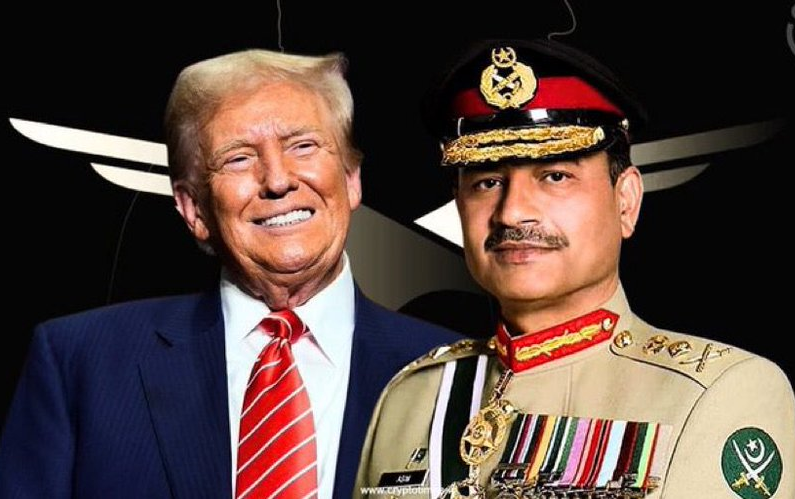
Washington, D.C : In a surprising and diplomatically significant move, U.S. President Donald Trump is set to host Pakistan’s Chief of Army Staff (COAS), Field Marshal Syed Asim Munir, for a closed-door lunch at the White House Cabinet Room on Wednesday. The meeting, not open to the press, has been listed on the president’s official schedule and is being interpreted in Islamabad as a major foreign policy success.
Munir’s visit to the U.S., part of a five-day official tour, comes at a delicate time in South Asian geopolitics. Just weeks ago, an Indian delegation held high-level meetings in Washington, including an engagement with U.S. Vice President JD Vance. Indian media had projected that visit as a diplomatic triumph, contrasting it with Pakistan’s perceived lack of access to senior American officials. However, Munir’s White House invitation has now been cast in Pakistan as a powerful diplomatic counter-narrative.
In Islamabad, the optics of this engagement are being hailed as a political win, especially as the region recovers from last month’s aerial confrontation between India and Pakistan — a standoff that brought the two nuclear-armed rivals dangerously close to open conflict.
Field Marshal Munir, who was promoted to the rarely conferred five-star rank last month — the first Pakistani officer to receive such an elevation since Ayub Khan in 1959 — has used his U.S. visit to highlight Pakistan’s perspective on regional affairs.
Addressing members of the Pakistani-American community in Washington on Monday evening, Munir emphatically rejected Indian claims that Pakistan was responsible for the recent Pahalgam attack. He accused India of manufacturing a pretext for cross-border aggression and warned against what he called a dangerous new precedent of violating international borders. “We would rather embrace martyrdom than accept this dishonour,” he declared to an enthusiastic audience at the Four Seasons Hotel in Georgetown.
Supporters showered Munir with rose petals and chanted slogans praising him, even as protesters aligned with the opposition PTI party gathered outside, calling for democratic reforms and the release of jailed leaders. Inside the venue, however, the army chief’s speech was met with strong approval and patriotic fervor.
During his address, Munir also expressed unequivocal support for Iran in its ongoing conflict with Israel, while simultaneously endorsing U.S.-led efforts to de-escalate tensions in the Middle East. “We want this war to end immediately,” he said, striking a balance between ideological solidarity and practical diplomacy.
Yet one of the most consequential outcomes of Munir’s visit may be the deepening of U.S.-Pakistan counterterrorism cooperation, particularly in relation to the threat posed by Islamic State Khorasan (IS-K). On Tuesday, General Michael Kurilla, head of the U.S. Central Command (Centcom), described Pakistan as a “phenomenal partner” in the fight against IS-K, citing recent successful operations along the Pakistan-Afghanistan border.
Kurilla informed the House Armed Services Committee that Pakistan, aided by U.S. intelligence, had eliminated dozens of IS-K operatives and captured several high-value targets, including Mohammad Sharifullah, a key figure behind the Abbey Gate bombing in Kabul that killed 13 American troops.
“The first person Munir called was me,” Gen Kurilla recounted. “He said, ‘I’ve caught him — ready to extradite him back to the U.S. Please tell the Secretary of Defense and the President.’” Sharifullah was subsequently extradited to the United States.
In a separate statement to the Senate Armed Services Committee, Kurilla further highlighted Pakistan’s role in conducting “dozens of operations” to dismantle IS-K safe havens, describing Islamabad as a cornerstone of regional counterterrorism efforts.
Despite grappling with over 1,000 terrorist incidents in 2024 alone, resulting in the deaths of approximately 700 security personnel and 2,500 civilians, Pakistan continues to play a critical role in stabilizing South and Central Asia. Kurilla’s praise of Pakistan’s efforts signals a warming of ties between Washington and Islamabad, particularly in the security domain.
During his address to the diaspora, Munir also took the opportunity to commend overseas Pakistanis for their economic contributions. He reframed concerns about brain drain, calling it instead a “brain gain” for Pakistan. Notably, he steered clear of engaging in domestic political commentary.
When one audience member tried to criticize former Prime Minister Imran Khan, Munir quickly discouraged the remark. Another guest joked that political opponents might need their “software fixed” — a euphemism for coercive political re-education. Munir replied firmly that democratic societies must uphold the right to dissent, signaling a conciliatory tone amid Pakistan’s ongoing internal political turmoil.
As Munir prepares to meet President Trump, the visit marks a turning point in U.S.-Pakistan relations, potentially resetting a strained alliance that has seen turbulence in recent years. His engagements reflect Islamabad’s intent to reassert its strategic relevance while balancing multiple geopolitical equations — from South Asia and the Middle East to counterterrorism cooperation with Washington.
The outcomes of this trip may not just shape Pakistan’s foreign policy trajectory, but also influence the broader regional order as alliances and rivalries continue to evolve.

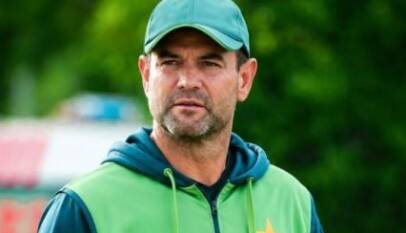
Pakistan Appoint Mike Smith as Test Batting Coach Amid Batting Crisis
Mumbai, Aug 2026 : Pakistan have appointed former South African first-class cricketer and …
Pakistan Appoint Mike Smith as Test Batting Coach Amid Batting Crisis
Mumbai, Aug 2026 : Pakistan have appointed former South African first-class cricketer and Level …