Four Key Reports from State Planning Commission Presented to CM Stalin

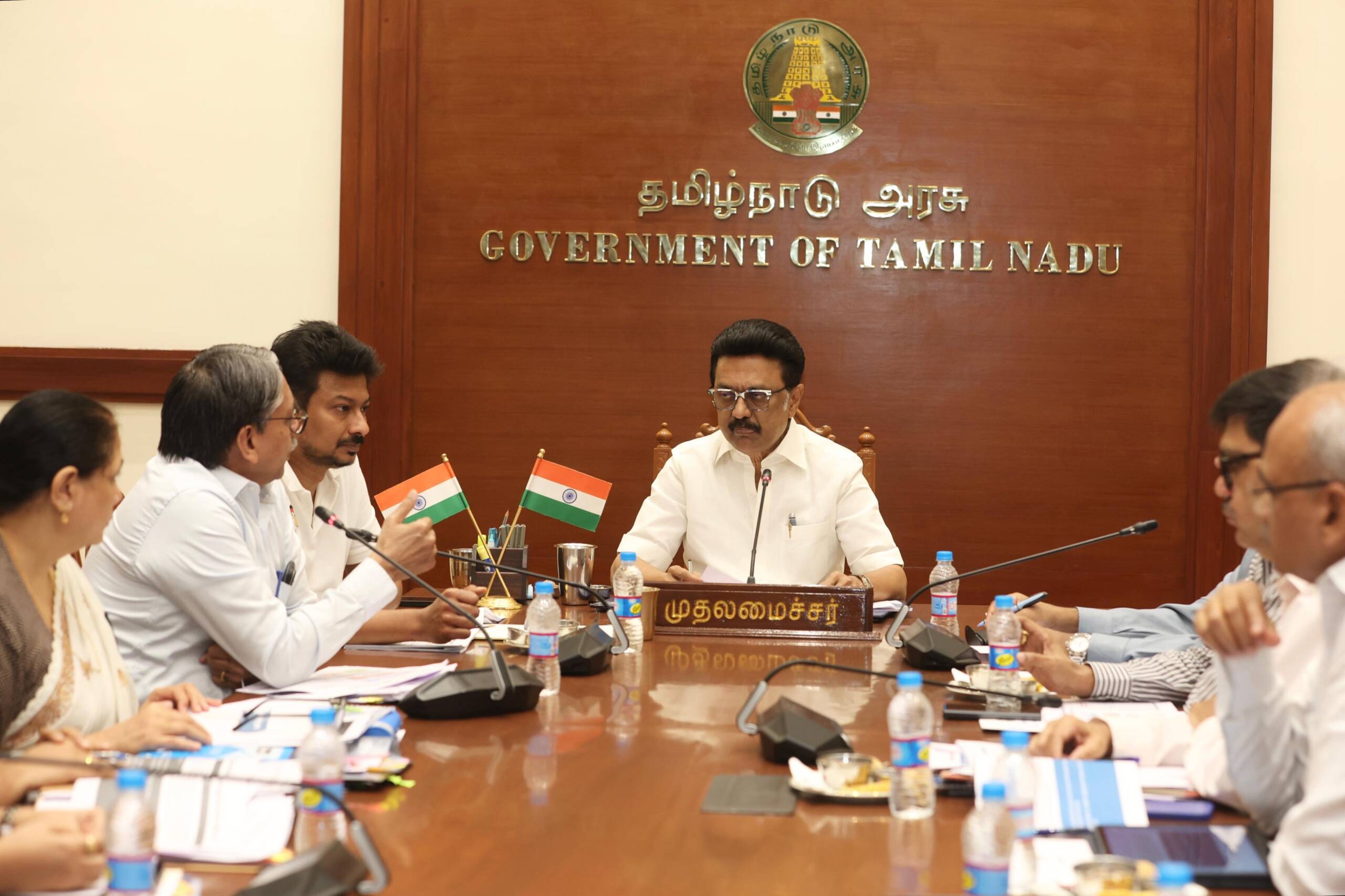
Chennai — Tamil Nadu Chief Minister M.K. Stalin was presented with four significant policy reports prepared by the State Planning Commission. The reports were submitted by Youth Welfare Minister and Vice-Chairman of the Commission Udhayanidhi Stalin, along with the Commission’s Member-Secretary Dr. C. Sivaraj.
The reports cover crucial developmental and environmental topics:
- Assessment and Rehabilitation of Abandoned Mines in Tamil Nadu The report evaluates over 3,000 unused and partially used mines across Tamil Nadu. Forty sample sites were selected for in-depth study, analyzing factors like soil quality, water availability, biodiversity impact, and suitability for environmental restoration. The study categorizes mines based on potential for repurposing into ecological parks, water conservation zones, forest regeneration areas, and solar energy fields. Mines with softer rock types such as limestone and magnesite were found more suitable for rehabilitation, while granite mines posed challenges due to their rugged terrain.
- Child Nutrition in Tamil Nadu: Challenges and Strategic Interventions This report identifies gaps in child nutrition, particularly in severe and moderate acute malnutrition. It emerged from a March 2025 workshop involving health professionals, nutritionists, researchers, and administrators. Key recommendations include promoting exclusive breastfeeding for the first six months, diversified weaning diets, gut health awareness, and consistent monitoring of malnourished children. The report emphasizes integrated, low-cost solutions and improved coordination across sectors to enhance child health resilience.
- Nature-Based Solutions (NbS) for Tier-2 Cities in Tamil Nadu Focused on addressing urban flooding, heat stress, water scarcity, and biodiversity loss in smaller cities, this report suggests deploying NbS for urban resilience. Developed with the Tamil Nadu Land Use Research Board, German cooperation (GIZ), and IIT-Madras’ CUBE initiative, the strategy includes restoring wetlands, developing urban green spaces, and climate-proof infrastructure. Cities like Chengalpattu and Kayambathur are highlighted for wetland recovery, while Pichavaram is mentioned for mangrove restoration.
- Urban Heat Stress and Climate Impact Assessment in Tamil Nadu (Decadal Review) This long-term study documents the impact of climate change on urban heat islands and land surface temperatures across the state. Of 94 districts analyzed, 64 showed significant temperature spikes. Major cities such as Chennai, Karur, and Ramanathapuram have experienced increases of up to 2°C above the state average. The report links these trends to urban expansion, deforestation, and rising built-up areas. Recommendations include real-time temperature monitoring, adoption of climate-responsive building technologies, and prioritized support for highly affected regions.
The Chief Minister acknowledged the importance of evidence-based policy-making and praised the Planning Commission’s efforts. The meeting was attended by Principal Secretary Na. Muruganandam IAS, Additional Chief Secretary Ramesh Senthilkumar IAS, Member Secretary S. Sudha IES, and full-time Member Jyoti Srinivasan.
Issued by: Director, Department of Information and Public Relations, Chennai-9

The Ukrainian Alchemist Who Tricks Russian Missiles Into Thinking They’re Flying Over Peru.
Kyiv; July 2026: As Russia escalates its recent strikes on Ukraine killing several, and da…
The Ukrainian Alchemist Who Tricks Russian Missiles Into Thinking They’re Flying Over Peru.
Kyiv; July 2026: As Russia escalates its recent strikes on Ukraine killing several, and …