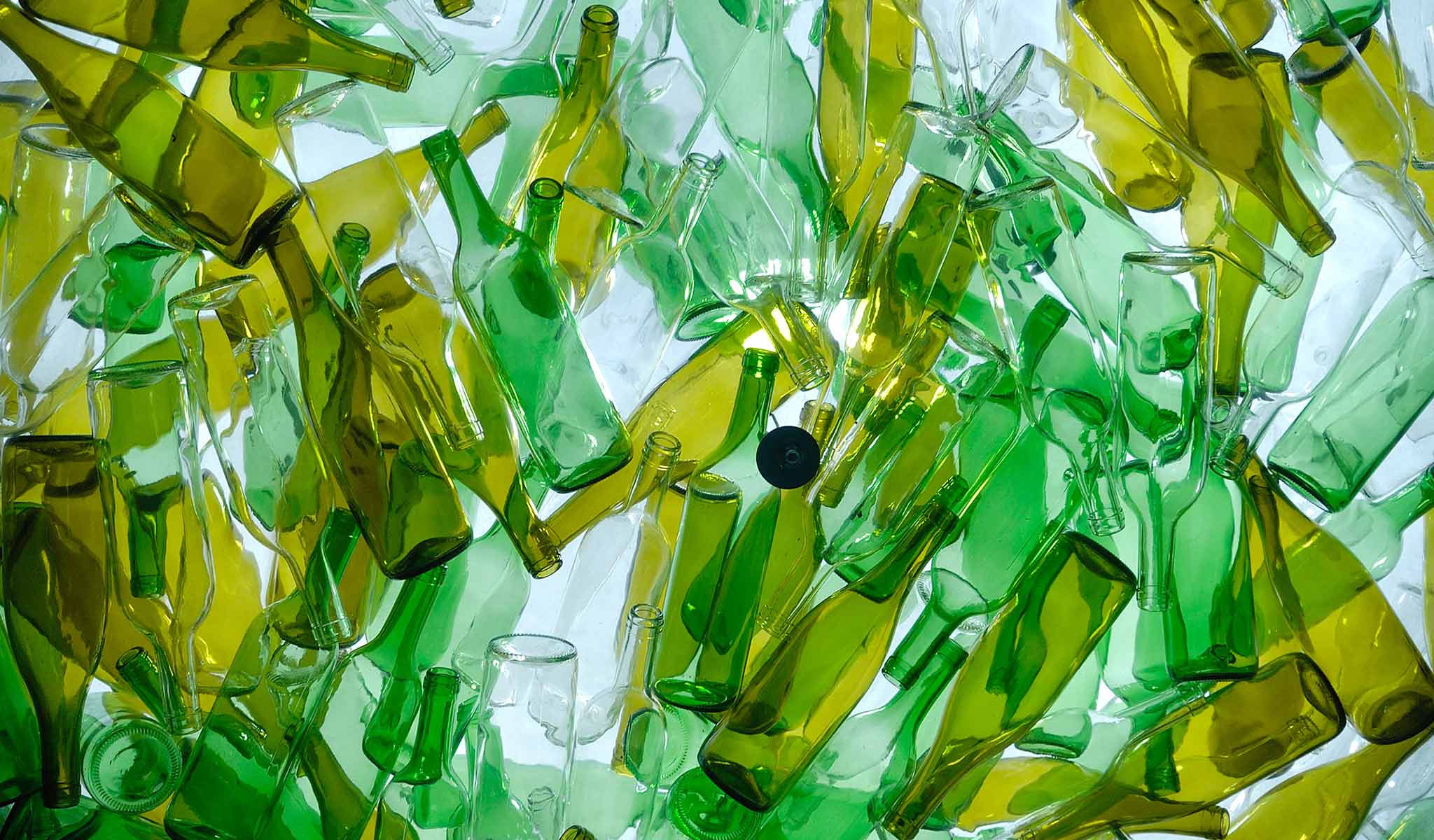
Recycled glass helps build sustainability into construction

Recycled glass could become a staple ingredient in building, paving the way for greener construction materials and more sustainable development. In a study published in Discover Civil Engineering, scientists tested the potential for using recycled glass, in powdered form, as a stabilizing agent in compressed earth blocks.
Building blocks made of soil mixed with water, and compressed at high pressure (compressed earth blocks), are usually stabilized with cement. The scientists—including a team from the University of Portsmouth—have found that a reliable level of stabilization can be achieved with a mix that includes recycled glass together with lime and a significantly reduced amount of cement.
Testing was undertaken on compressed earth blocks prepared with recycled waste glass particles (RWGP) in the mix at ratios of zero to 25%. Apart from determining the mechanical properties, the blocks were examined for microstructural characteristics using an electron microscope for 28 days.
Co-author, Dr. Muhammad Ali, associate professor in materials and environmental innovation at the University of Portsmouth’s School of Civil Engineering and Surveying, said, “There is an increased demand for the use of recycled industrial waste as sustainable building and construction materials, so we wanted to assess the properties of compressed earth blocks using recycled glass particles”.
SEM images of CEBs stabilized with RWGP and lime; a) 10% RWGP and lime, b) 25% RWGP and lime. Credit: Discover Civil Engineering (2025). “At each percentage level we tested for water absorption, how resistant to breaking the blocks were when compressed, and to determine the maximum stress the block could withstand while being stretched or pulled, before breaking or becoming deformed”.
“After testing blocks with varying mixes using lime and recycled waste glass, we found that a composition of 10% lime and 10% recycled glass particles produced the strongest blocks with no cracking under intense pressure“.
The highest compressive strength of 5.77 MPa (megapascal—a unit of pressure) was achieved at 10% recycled waste glass particles (RWGP) and 10% lime compressed earth blocks (CEB), while the unstabilised specimens achieved 3.03 MPa at 28 days of curing, representing about 90% improvement. The highest tensile strength of 0.52 MPa was achieved at 10% RWGP and lime CEBs, while the unstabilised specimens achieved 0.40 MPa at 28 days of curing, which represents a 30% improvement.
The microstructural analysis showed no visible cracks in the 10% RWGP and lime mixes, while the 25% showed micro-cracks in the earth blocks. Future studies could assess the thermal and durability properties of these greener construction materials.
Team Maverick




HAL Set to Increase TEJAS MK-1A Production to 30 Jets Annually as GE Commits Higher Engine Deliveries
New Delhi, July 2026 : Hindustan Aeronautics Limited (HAL) is preparing to significantly r…

HAL Set to Increase TEJAS MK-1A Production to 30 Jets Annually as GE Commits Higher Engine Deliveries
New Delhi, July 2026 : Hindustan Aeronautics Limited (HAL) is preparing to significantly ramp …