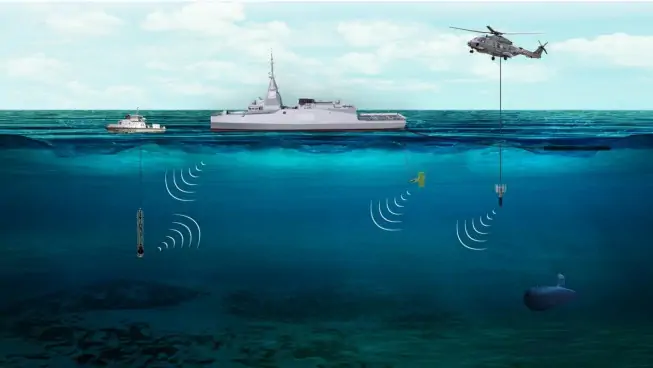
A United States trump card – Undersea sensors; Chinese target of elimination.

The United States Navy’s vast network of underwater sonars can detect many, if not most, enemy submarines through much of the world’s oceans. The US Navy was a pioneer in seabed surveillance. In 1950, the service launched the then highly secret Project Jezebel, a generational effort to lay thousands of miles of undersea cable connecting sensitive acoustic sensors to shore stations staffed by sonar analysts. Today, the system, largely cloaked in secrecy, probably also features many small drones on the surface and under the waves. Shore sensors, ocean surveillance satellites and reconnaissance aircraft, crewed and uncrewed, also complement the undersea equipment. Mostly Unseen, largely unknown and, until recently, were highly classified.
The problem for the US is that the Chinese fully appreciate how vulnerable they are underwater—and they’re actively thinking about ways to end that vulnerability. A submarine that can be detected can also be killed. It’s a profound problem for the Chinese navy as it eyes a possible amphibious assault across the Taiwan Strait. Its growing fleet of quiet attack submarines could protect the landing force—but only if they themselves can avoid detection.
The US fleet needs new and better ways of defending its underwater sensors during a seabed battle that could get very nasty, very quickly in the months and weeks leading up to a possible Chinese move against Taiwan. In particular, the US needs more ships that can repair the sensor network at sea. By the time the navy declassified the Integrated Undersea Surveillance System in 1991, it also included catamaran surveillance ships towing additional acoustic arrays.
“There are only a small handful of vessels capable of such at-sea repairs, fewer than 10 globally, and they are easy targets when on station“, warned Chris O’Flaherty, a retired Royal Navy captain with deep experience in undersea warfare.
CHINESE APPREHENSION –
“The probability that PRC submarines are discovered when leaving port is extremely high“, Senior Captain Zhang Ning, a faculty member at China’s Naval University of Engineering. “There is a fairly high probability that PRC submarines will be detected and intercepted while operating in the Near Seas’ along the First Island Chain between the Philippines and Japan”, Zhang had warned.
Cued by surveillance, US and allied anti-submarine forces—submarines, ships and aircraft—can cut off Chinese attack boats from the deep water where they could best perform their missions. “But the US surveillance system isn’t invulnerable”, Zhang reiterated.
US INTERVENTION –
As per experts, the location of individual ‘nodes’ … in the US undersea surveillance system can be located and ‘removed’. The ways by which the Chinese forces could disable US undersea sensors, ranges from the “relatively overt”’—the deployment of remotely operated vehicles from unhidden surface motherships, “to go down to almost any depth and to uncover and sever cables”, to “semi-covert” methods. One such semi-covert method would be sending autonomous submarines equipped with sonars to find the cables and plant explosive charges to cut them.
The Chinese may want to undertake a covert counter-cable effort far in advance of any attempt to invade Taiwan. Long-range underwater vehicles could, “leave an explosive charge in the immediate vicinity of a cable, ready for actuation at a time of the owner’s choosing—which could be years”.
Cables can be repaired, of course—usually by highly trained crew aboard specialised auxiliary vessels. The US Navy operates just one cable-repair ship, the 14,600-ton USNS Zeus, delivered to US Military Sealift Command in 1984. For several years now, the navy has been studying a possible replacement for the ageing Zeus, but the service is still years away from signing a contract and cutting steel.
It’s possible the US fleet’s single special-mission submarine—the heavily modified, 12,000-ton USS Jimmy Carter—could covertly deploy divers for select cable repairs. After all, finding, tapping and eavesdropping on the enemy’s cables is reportedly among the boat’s secret missions.
Even with Jimmy Carter on cable duty, the US Navy would be stretched thin trying to safeguard the surveillance system that lends it one of its greatest advantages in wartime.
The US fleet still spends most of its nearly US$40 billion annual shipbuilding budget on aircraft carriers, amphibious ships, destroyers, logistics ships and submarines. It had better start prioritising cable vessels, too—and figure out how to protect them after the shooting starts.
Team Maverick



FIFA Chief Infantino Hails Messi’s ‘Timeless Brilliance’ After Record-Equalling World Cup Feat
New Delhi, June 2026 : FIFA President Gianni Infantino has showered praise on Lionel Messi…

FIFA Chief Infantino Hails Messi’s ‘Timeless Brilliance’ After Record-Equalling World Cup Feat
New Delhi, June 2026 : FIFA President Gianni Infantino has showered praise on Lionel …