Telangana Deputy CM Warns of ₹26,930 Crore Revenue Loss from GST; Seeks Compensation Mechanism

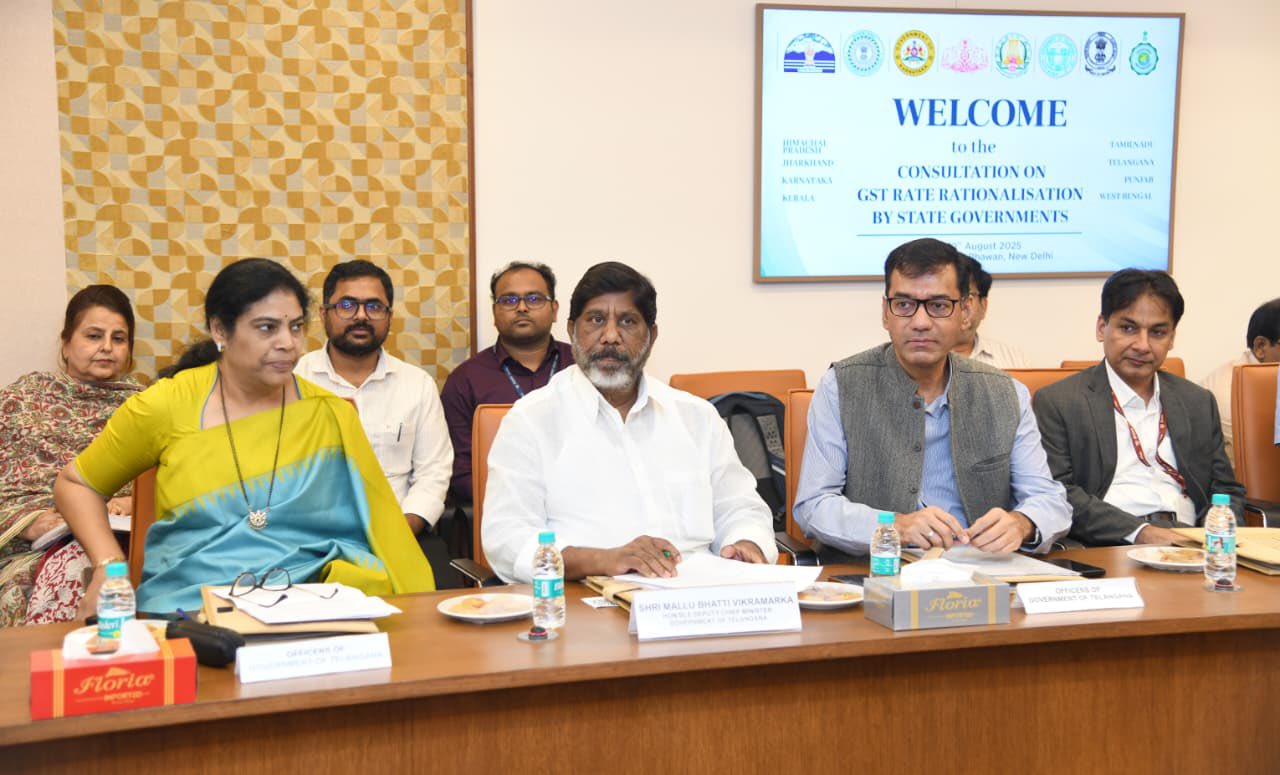
Telangana Deputy Chief Minister and Finance Minister Mallu Bhatti Vikramarka has expressed deep concern that the Goods and Services Tax (GST) regime is severely impacting the state’s fiscal health. At a multi-state consultation meeting on GST rate rationalisation, he warned that Telangana could lose nearly ₹26,930 crore in 2024–25, with an additional burden of ₹7,000 crore if rationalisation proposals are implemented. He urged the Centre to establish a fair compensation mechanism to safeguard state revenues and protect welfare and development programmes.
Delhi, Aug 2025 – Telangana Deputy Chief Minister Mallu Bhatti Vikramarka has raised strong concerns over the financial implications of the Goods and Services Tax (GST) on states, particularly Telangana, cautioning that the state could face a significant ₹26,930 crore loss in revenue during 2024–25. He further warned that the proposed rationalisation of GST rates could lead to an additional shortfall of ₹7,000 crore, aggravating Telangana’s fiscal burden.
Vikramarka made these remarks at a consultation meeting of various states on “GST Rate Rationalisation” hosted by the Karnataka government at Karnataka Bhavan in Delhi. He presented 15 key points underscoring the adverse impact of GST on Telangana’s revenue system.
Sharp Decline in Revenue under GST
The Deputy CM compared the current GST regime with the earlier Value Added Tax (VAT) system, under which states enjoyed fiscal independence. He pointed out that, had VAT continued, Telangana’s revenues in 2024–25 would have been ₹69,373 crore. However, under GST, the state’s revenue has dropped to ₹42,443 crore, which is just 39% of its own tax revenue.
“Any reduction in GST rates hits state revenues much harder than it affects central revenues,” he explained, adding that the proposed rate rationalisation could worsen the situation further.
According to his estimates, the rationalisation alone would reduce Telangana’s revenues by ₹5,100 crore. When other losses are factored in, the total impact could rise to around ₹7,000 crore—nearly 15% of the state’s GST revenue.
“This would have a serious impact on the overall financial position of the state. More than 80% of Telangana’s revenue is devoted to welfare expenditure, and such a decline would severely restrict our ability to support the poor and vulnerable,” Vikramarka emphasised.
Support for Rationalisation, But with Safeguards
Despite highlighting the risks, the Deputy CM reiterated Telangana’s support for GST rate rationalisation. “We agree that rationalisation is necessary, but two key issues must be addressed,” he said. “A proper compensation mechanism must be designed to protect state revenues and enable us to continue essential welfare, development, and infrastructure programmes.”
He noted that Telangana’s GST-to-GSDP ratio has been steadily falling—from 3.07% in 2022–23 to 2.58% in 2024–25. Rationalisation of rates, he warned, would reduce it further.
Call for Cooperative Federalism
Vikramarka criticised the unilateral manner in which the Centre announced the rationalisation proposal. “In a multi-party parliamentary democracy, every state is important. In the spirit of cooperative federalism, the Centre should have consulted states either directly or through the GST Council. Unfortunately, this was not done,” he said.
As a newly formed state with high developmental aspirations, Telangana requires substantial financial resources, he stressed. “At the time of GST’s implementation, it was assured that any shortfall in states’ revenue would be compensated. It was estimated that GST revenues would grow significantly within five years, making the compensation cess unnecessary. But so far, Telangana has achieved only 10% CAGR (compound annual growth rate) in GST revenues, compared to the 18% CAGR under VAT,” he explained.
Unequal Share of Cess and Fiscal Stress
Highlighting inequities in the system, Vikramarka pointed out that cess on luxury items accounts for only 15% of Telangana’s GST revenue. Without the ability to levy independent taxes or raise additional revenue, the fiscal burden on the state becomes unsustainable.
“Any tax cut or exemption should truly benefit the poor and middle classes, not just widen the state’s financial deficit,” he urged.
Multi-State Concerns
The consultation meeting was attended by senior ministers and officials from several states, including Karnataka Revenue Minister Krishna Byre Gowda, Punjab Finance Minister Harpal Singh Cheema, Kerala Finance Minister K. N. Balagopal, Jharkhand Finance Minister Radha Krishna Kishore, Tamil Nadu Finance Minister Thangam Thennarasu, Himachal Pradesh Minister Rajesh Dharmani, and West Bengal Resident Commissioner Ujjayini Dutta.
Following the meeting, Vikramarka announced that another round of discussions would be held at Tamil Nadu Bhavan on September 3, where the same concerns would be deliberated before being presented formally to the Centre.
“These issues will also be raised in the upcoming GST Council meeting,” he said. “Several states, including NDA-ruled ones, are grappling with fiscal deficits. Therefore, we strongly urge the Centre to reconsider the rationalisation proposal and arrive at a balanced decision that protects state revenues while meeting national economic goals.”


Iran Imposes $2 Million Transit Fee in Strait of Hormuz Amid Rising Tensions
Tehran, March 2026 : Amid escalating tensions with the United States and Israel, Iran has …

Iran Imposes $2 Million Transit Fee in Strait of Hormuz Amid Rising Tensions
Tehran, March 2026 : Amid escalating tensions with the United States and Israel, Iran …