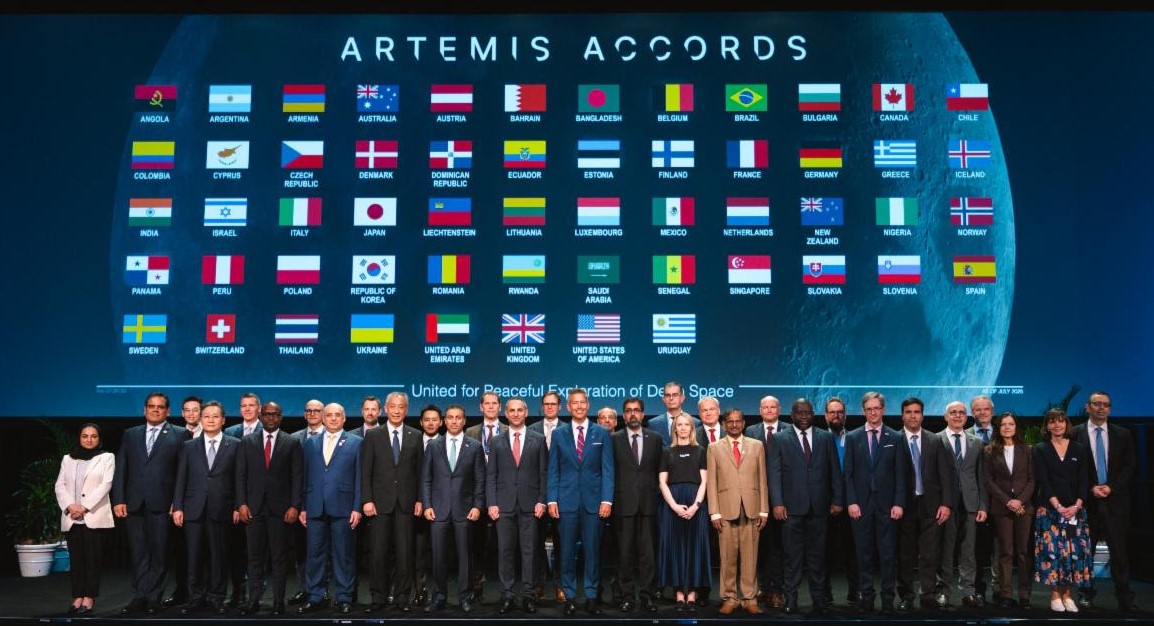
NASA & International Partners Deepen Commitment to Artemis Accords.

Oct 2025 : NASA, along with leaders from global space agencies and government representatives worldwide, convened on Monday to further the implementation of the Artemis Accords — practical principles designed to guide the responsible exploration of the Moon, Mars, and beyond.
The meeting was held during the 76th International Astronautical Congress (IAC) taking place in Sydney. In opening remarks, acting NASA Administrator Sean Duffy highlighted the five-year anniversary of the Artemis Accords next month.
“When President Trump launched the Artemis Accords in his first term, he made sure American values would lead the way, bringing together a coalition of nations to set the rules of the road in space and ensure exploration remains peaceful. After five years, the coalition is stronger than ever. This is critical as we seek to beat China to the Moon, not just to leave footprints, but this time to stay”, said Sean Duffy.
The United States, led by NASA and the U.S. Department of State, signed the accords on 13 October, 2020, with seven other founding nations. The accords were created in response to the growing global interest in lunar activities by governments and private companies. They now comprise 56 country signatories, nearly 30% of the world’s countries.
The event was co-chaired by NASA, the Australian Space Agency, and the UAE Space Agency. Dozens of nations were represented, creating the foundation for future space exploration for the Golden Age of exploration and innovation.
“Australia is a proud founding signatory of the Artemis Accords and is focused on supporting new signatories in the Indo-Pacific region”, said Head of Australian Space Agency Enrico Palermo. “The purpose of the accords is as important if not more, as it was when first established. This annual gathering of principals at IAC 2025 is a key opportunity to reaffirm our collective commitment to exploring the Moon, Mars and beyond in a peaceful, safe, and sustainable way”.
During the meeting, leaders discussed recommendations for non-interference in each other’s space activities including transparency on expected launch dates, general nature of activities, and landing locations. They also discussed orbital debris mitigation and disposal management, interoperability of systems for safer and more efficient operations, and the release of scientific data.
In May 2025, the United Arab Emirates hosted an Artemis Accords workshop focused on topics, such as non-interference and space object registration and reporting beyond Earth orbit.
“Through our active participation in the Artemis Accords and by organizing specialised workshops, we aim to reinforce the principles of transparency, sustainability, and innovation in space activities. We are committed to strengthening international partnerships and facilitating the exchange of expertise, thereby contributing to the development of a robust global framework for safe and responsible space exploration, while opening new frontiers for scientific research”, said UAE Minister of Sports and Chairman of UAE Space Agency Ahmad Belhoul Al Falasi. “This reflects the UAE’s unwavering commitment to enhancing international cooperation in space exploration and promoting the peaceful use of space”.
More countries are expected to sign the Artemis Accords in the months and years ahead, as NASA continues its work to establish a safe, peaceful, and prosperous future in space.
Artemis Accord: Method of Operation –
The Artemis Accords, established in 2020, are a practical set of non-binding principles, guidelines, and best practices grounded in the Treaty on Principles Governing the Activities of States in the Exploration and Use of Outer Space, including the Moon and other Celestial Bodies (Outer Space Treaty), and other existing instruments such as the Registration Convention and Agreement on the Rescue and Return of Astronauts, to ensure safe, transparent, and sustainable civil space exploration. In signing the Artemis Accords, countries have committed to follow these principles, the implementation of which is designed to promote safe, sustainable, and transparent activities in space. Signing the Artemis Accords does not imply or initiate specific, cooperative space activities with or among other signatories, nor does doing so preclude any country from engaging in cooperative space activities with any other country, signatory or not.
Countries that have signed the Artemis Accords are actively working to define how best to implement the principles of the Artemis Accords and to define best practices for safe, transparent, and sustainable space exploration and use. The work of the Artemis Accords signatories can complement and inform multilateral discussions taking place within the United Nations (UN) Committee on the Peaceful Uses of Outer Space (COPUOS) and other international bodies.
The Artemis Accords signatories’ group is open and inclusive, where all signatories share an equal and valued voice and participation is wholly voluntary. The goal of all discussions is consensus; however, Signatories may decline to participate or implement any output developed by the group. Policy discussions among the signatories will be informed and supported by technical considerations. The Artemis Accords signatory group is considered to consist of senior leaders from each country (Principals, typically the head of national space agencies and/or senior ministry official
or equivalent) and a working group of representatives assigned by the Principals. For ease of
coordination, each country should assign a working group point of contact (POC).
The Artemis Accords Principals are envisioned to meet at least once annually, preferably during the International Astronautical Congress or another forum where many are already present (with the opportunity for virtual participation, where feasible). To facilitate the organisation of the meeting, participating Principals will be identified at least two weeks prior to the meeting. Based on the successful practice of the past two years, the annual meeting is envisioned to have rotating co-chairs to assure the broadest representation and participation, are recommended at three in total, one of whom is expected to host an interim, working-level workshop to prepare for the annual meeting. The working-level workshop host will capture and disseminate meeting materials during the year they serve as hosts.
Each workshop and the related preparations will generally be co-led by the host country and a second signatory. In addition, interim meetings and forums may be offered for information sharing purposes or for continued development of best practices.
Recognising the Artemis Accords principle of transparency and the overall objective of inclusivity, the Artemis Accords signatories group intends to seek opportunities to share information about its activities and output, either through UNCOPUOS or other appropriate means, with the concurrence of the signatories.
Team Maverick






India Make Two Changes for Must-Win Fourth T20I as Shreyas Iyer Opts to Bat Against England
Bristol, July 2026 : India made two significant changes to their playing XI as captain Shr…

India Make Two Changes for Must-Win Fourth T20I as Shreyas Iyer Opts to Bat Against England
Bristol, July 2026 : India made two significant changes to their playing XI as …