Venezuela surges in counterfeiting United States Air Defence Capabilities.

Oct 2025 : With the possibility of direct inland actions by the United States on Venezuelan cartels, which are now designated by the Trump Administration as unlawful combatants, is inevitably posing a drastic threat, as the Trump administration’s counter-narcotics operations in the Caribbean expanding to become a “non-international armed conflict”, the prospects of some kind of confrontation between the U.S. military and Venezuela are rising, too. On top of the counter-narcotics effort, some officials in the Trump administration are pushing to oust Venezuela’s President Nicolás Maduro.
What the United States should keep in mind, is the air defence assets available to Venezuela, which comprise a somewhat unusual mix of older, lower-end equipment and smaller numbers of very capable systems, mainly Russian-supplied. Meanwhile, 10 U.S. Marine Corps F-35Bs forward-deployed to the former Roosevelt Roads Naval Station in Puerto Rico. These jets are now undertaking patrols in the region, with open-source flight trackers pointing to sorties off the coast of Venezuela.
Venezuela’s Minister of Defence, Vladimir Padrino López, has claimed that the country’s armed forces had tracked F-35s flying off the coast in the Maiquetía Flight Information Region (FIR). Moreover, images asserts that Venezuelan mobile surface-to-air missile systems are being redeployed, perhaps in response to U.S. military activities. Meanwhile, it’s not only F-35s that are active in the region. A growing mix of U.S. forces is now active in the counter-narcotics operation, with Marine Corps AV-8B attack jets also in theater as part of the Air Combat Element (ACE) deployed to the amphibious assault ship USS Iwo Jima, and other assets that could be quickly deployed.
MQ-9 Reapers have also previously been used in maritime drug interdiction operations here. Of the U.S. military’s four deadly strikes against alleged drug-smuggling boats in the Caribbean, the latest of which was today, at least two targeted vessels that originated from Venezuela. MQ-9s would be the most likely choice for operations in lightly contested and non-contested airspace. It is now to observe whether the United States decides to strike the cartels directly at their inland bases in Venezuela, or even expanded operations against the Maduro regime directly, the F-35 may well be the weapon of choice. These jets have the ability to penetrate into enemy airspace, even when relatively heavily defended, and strike fixed and moving targets.
Venezuelan officials too have suggested that they are planning for a possible U.S. attack on the country, with Maduro saying that he is gearing up to call a state of emergency should that happen. At the sharp end of the Venezuelan military’s capabilities to disrupt or degrade any U.S. air operations directed against the country are its air defence systems. These include ground-based systems that are operated by the Venezuelan Army (Ejército Bolivariano, EB, or Bolivarian Army of Venezuela), as well as fighter jets flown by the Venezuelan Air Force (Aviación Militar Bolivariana Venezolana, AMBV, or Bolivarian Venezuelan Military Aviation). Certain air-defence-capable warships also serve with the Venezuelan Navy (Armada Bolivariana de Venezuela, or Bolivarian Navy of Venezuela).
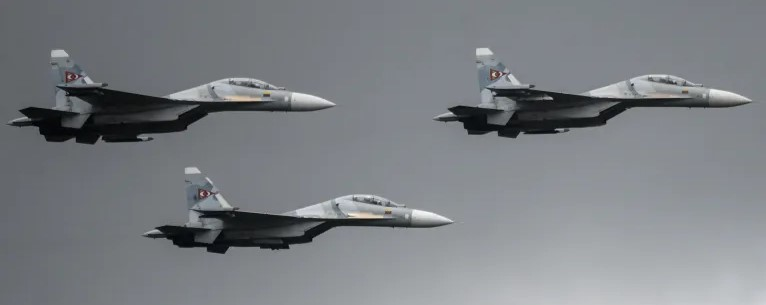
Venezuelan Air Force’s AMBV, the mainstay of its fighter force is provided by 21 Su-30MK2V Flanker fighters, 24 of which were delivered between 2006 and 2008. These can be armed with beyond-visual-range air-to-air missiles, but they are multirole types, also able to carry a variety of precision-guided air-to-ground ordnance, including Kh-31A (AS-17 Krypton) supersonic anti-ship missiles. Air-to-air armament for the Su-30s includes the R-77 beyond-visual-range missile known to NATO as the AA-12 Adder. With a reported maximum range of 50 miles, the R-77 is typically launched under inertial guidance, with midcourse updates provided by datalink, before using its active radar seeker for the terminal phase. Reportedly, the R-77 can switch to a home-on-jam mode if it encounters heavy electronic countermeasures, engaging the source of the jamming.
The Flankers can also carry the older R-27 (AA-10 Alamo) series beyond-visual-range air-to-air missiles. Basic versions are the semi-active radar-homing R-27R and the infrared-guided R-27T, as well as the longer-range radar-guided R-27ER and the infrared-guided R-27ET. The extended-range versions add a more powerful dual-pulse engine section to the same missile. The maximum range of the R-27R is reportedly 37 miles, and 31 miles for the R-27T. The extended-range versions are able to hit targets at a maximum range of 59 miles (R-27ER) or 56 miles (R-27ET). Close-range missile armament for the Su-30 is provided by the R-73, known in the West as the AA-11 Archer. It has an all-aspect infrared seeker, high off-boresight capability, thrust-vectoring controls, and can be cued by the pilot’s helmet-mounted sight. It has a maximum range of around 18.6 miles against a head-on target, or 8.7 miles in a tail-on engagement.
The F-16s have no beyond-visual-range weapons, relying on the Israeli-made Python 4 infrared-guided air-to-air missile, supplementing the AIM-9L/P-4 Sidewinder, 150 of which were supplied when the F-16s were first ordered.
Turning to the Army, its most powerful air defence system is the S-300VM, an unspecified number of which were acquired from Russia by Maduro’s predecessor, Hugo Chávez. The purchase was reportedly part of a deal for a loan of $2 billion provided by Moscow. The EB’s S-300VM made its first public appearance in Venezuela during a military parade in Caracas in 2013.
The S-300VM (SA-23 Gladiator/Giant), sometimes marketed as the Antey-2500, is a modernised version of the Cold War-era S-300V1 (SA-12, also Gladiator/Giant), originally designed for the Soviet ground forces. This is a long-range surface-to-air/anti-ballistic missile system carried on tracked transport-erector-launcher (TEL) vehicles, for improved cross-country mobility, something that could be a big problem for the U.S. military. In the S-300VM, the two primary types of missiles offered in the S-300V1 — the 9M83 (SA-12A Gladiator) with a maximum engagement range of around 47 miles and the 9M82 (SA-12B Giant) that can engage targets out to 62 miles, are replaced with new 9M83M and 9M82M missiles. These are claimed to be able to hit targets out to a range of 81 miles and 124 miles, respectively. Launcher units can either be loaded with four 9M83M missiles or two 9M82Ms.
The S-300VM can engage ballistic missiles, as well as aircraft and cruise missiles. While its anti-ballistic-missile capability is relatively limited, the Antey-2500 marketing name highlights its claimed ability to engage 2,500-kilometer (1,553-mile) range intermediate-range ballistic missiles (IRBMs), with re-entry velocities around 4.5 kilometres/second (2.8 miles/second). Venezuela has reportedly fielded a single battalion equipped with two S-300VM units, with their main operating base at Capitán Manuel Ríos Air Base in Guárico state. Making a stark contrast with the S-300VM is Venezuela’s S-125 Pechora (SA-3 Goa) medium-altitude surface-to-air system, the first version of which entered Soviet service in the early 1960s. However, the EB’s S-125s have been modernised to Pechora-2M standard, with different reports stating that 24 or 44 systems have been fielded.
In the Pechora-2M, which is a joint Russian/Belarusian upgrade, the missiles are moved from the previous static launchers to a wheeled TEL. Meanwhile, the modernised 5V27D and 5V27DE missiles feature new fuses and warheads, and enhanced electronics. The Low Blow engagement radar is also mounted on the same 6×6 MZKT-8022 truck as the missile launchers.
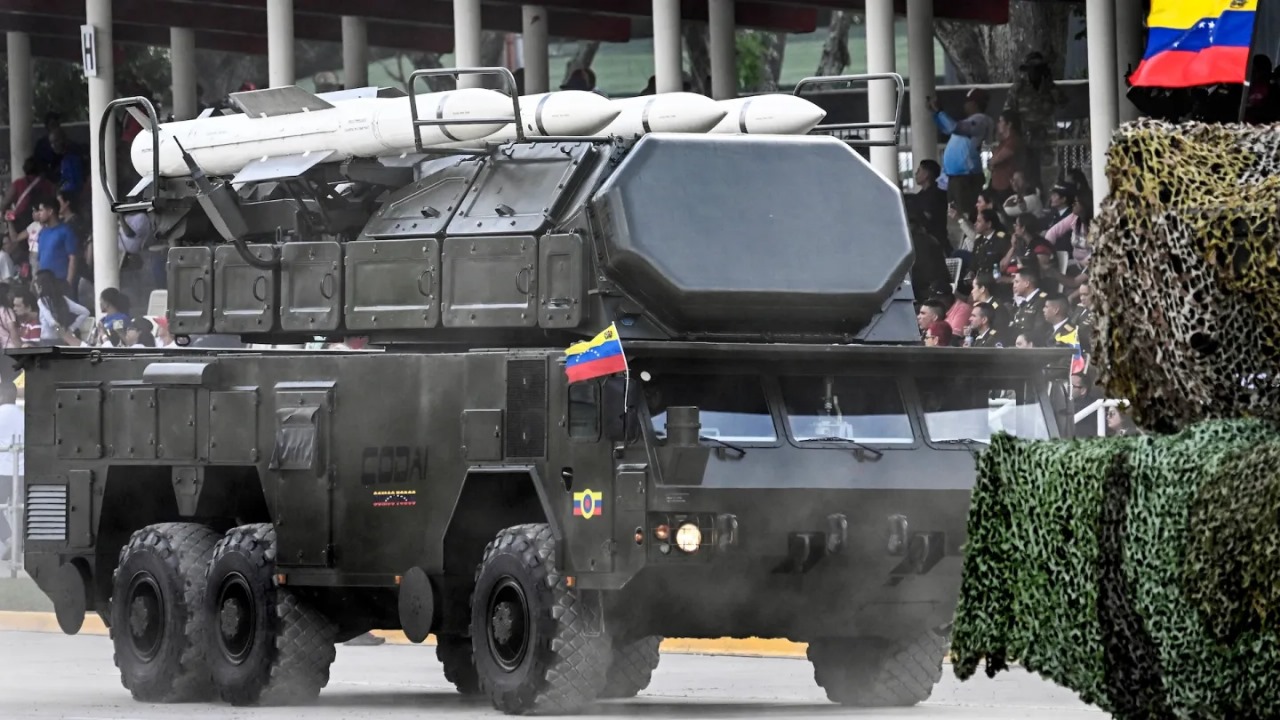
Unlike the S-125, the more modern Buk-M2 (SA-17 Grizzly) medium-range surface-to-air system was designed to be fully mobile from the outset. It is a further development of the 9K37 (SA-11 Gadfly) developed toward the end of the Soviet era. However, while Soviet and Russian versions of the Buk series are based on a tracked TEL vehicle carrying four ready-to-fire missiles, as well as the fire control radar, the variant supplied to Venezuela is on a 6×6 wheeled chassis.
With its combination of high mobility and independence of operation, as well as its reported ability to hit targets operating as high as 80,000 feet, the Buk-M2 is one of the most capable and versatile ground-based air defence systems available to the EB. In Russian hands, the Buk-M2 has proven to be a fearsome adversary for the Ukrainian Air Force. Former Ukrainian Air Force MiG-29 pilot known as Andrii Pilshchykov, have singled out the Buk-M2 and the latest Buk-M3 version among the most concerning threats. Venezuela is understood to have received 12 Buk-M2 systems, which are also shared with the Navy, for the defence of naval installations and in amphibious operations by the Venezuelan Marine Corps.
All these Russian surface-to-air missile systems are road-mobile, with varying degrees of high-mobility capability. This makes them especially threatening to even advanced combat aircraft, including the F-35, as they can pop up without warning and in close proximity. They are also much harder to find and fix, with this unpredictability making them a significant threat. Recently, the EB has received around 300 ZU-23-2 towed twin-barreled 23mm anti-aircraft guns. A first unit was reportedly equipped with these autocannons in 2011, somewhat surprising given that this is a relatively antiquated system. With a maximum engagement altitude of around 6,500 feet, the ZU-23-2 is most relevant for engaging helicopters, low-flying drones, and cruise missiles. At the same time, it can be very effective when used against ground targets. First fielded in the 1950s, the versions of the ZU-23-2 used by the EB are more advanced than their predecessors, with a computerized fire-control system and an electro-optical sighting system.
Finally, the EB also issues man-portable air defence systems (MANPADS), including the Russian-made Igla-S (SA-24 Grinch) and the Swedish RBS 70. The Igla-S is among the latest versions of the Igla family and among the most advanced such weapons available on the market today. Compared to older variants, the Igla-S has a longer range and a significantly larger warhead. Its maximum range of 20,000 feet is more than 5,000 feet greater than that of the U.S.-made FIM-92 Stinger MANPADS. The country had a total inventory of approximately 5,000 Igla-S missiles. These would pose a significant threat to any low-flying aircraft or cruise missiles.
The EB also has a smaller number of RBS 70s. This laser-beam-riding MANPADS was attributed with the destruction of an OV-10 Bronco close-support aircraft during the military coup launched against President Carlos Andres Perez in November 1992. It should be noted that, despite the influx of new Russian-made equipment, the EB has also lost some of its previous capabilities in recent years, primarily due to the effect of sanctions and ostracization from much of the international community.
In this way, the EB has been forced to decommission its three Israeli-supplied Barak-1 ADAMS short-range air defence systems (SHORADS), which were decommissioned relatively soon after they were acquired, after appearing only once in a public parade in 2006. These towed systems were primarily acquired for point-defence of airbases, a requirement highlighted during the 1992 coup attempt. Reportedly, the ZU-23-2 is now the primary weapon for defending Venezuelan airbases against low-level attack.
As well as Igla-S and RBS 70 MANPADS, as well as Buk-M2 systems shared with the Army, the Venezuelan Navy has a single operational Mariscal Sucre class frigate, the Almirante Brión. The Italian-made warship was supplied armed with a Mk 29 octuple launcher for Sea Sparrow/Aspide air defence missiles, providing a point-defence capability.
Overall, Venezuela has an unusually varied collection of air defence assets, including smaller numbers of more capable systems. However, even most of the older surface-to-air missile systems have been upgraded and, as stated earlier, are generally highly mobile, meaning they can appear virtually anywhere, disrupting carefully laid mission plans. They could still pose a threat that would have to be taken seriously during any kind of offensive U.S. air operation directed against Venezuela.
At the very least, it might be expected that the Venezuelan air defence picture would prompt the U.S. military to rely heavily on stealthy aircraft like the F-35, especially for any direct strikes on targets in defended areas of the country, as well as costly standoff munitions. Such a campaign would also require the support of defence-suppression assets and other support aircraft with their associated capabilities. Using any crewed aircraft complicates operations dramatically, with a combat search and rescue (CSAR) package needing to be ready at a moment’s notice.
For now, it remains unclear whether U.S. military activities directed against suspected drug-smugglers and/or the Maduro regime will be escalated. However, as U.S. assets continue to arrive in the Caribbean, that scenario seems to be becoming more likely.
Team Maverick







More Than a Café: How MITTI Café is Brewing Hope, Dignity and Dreams at Rashtrapati Nilayam
Hyderabad, July 2026 : Tucked away inside the serene campus of Rashtrapati Nilayam in Boll…

More Than a Café: How MITTI Café is Brewing Hope, Dignity and Dreams at Rashtrapati Nilayam
Hyderabad, July 2026 : Tucked away inside the serene campus of Rashtrapati Nilayam in …