
China sells US Treasuries, Buys Gold.

China’s Central Bank added to its gold reserves for the eleventh straight month in September, the People’s Bank of China (PBOC) announced on Friday. China’s gold reserves rose to 74.06 million troy ounces at the end of September, up from 74.02 million ounces at the end of August.
The PBOC said the country’s gold reserves were valued at $283.29 billion at the end of last month, up from $253.84 billion at the end of August. “A strong figure would reinforce the idea that China is keen to de-dollarise and accelerate its actions in that space“, independent precious metals analyst Ross Norman told Reporters. “Further purchases, even modest ones, will be seen domestically as positive for a price-sensitive market. It may narrow the significant discounts at Loco Shanghai. It will give investors, ETF buyers, and institutions confidence that gold will continue rising“.
Gold has gained over 52% year-to-date in 2025, fuelled by the escalating political and economic uncertainty surrounding U.S. tariffs, geopolitical conflicts, expectations of interest rate cuts, a weakening dollar, and strong central bank buying. In May 2024, the PBOC paused its gold purchases after an 18-month-long gold buying spree, but the central bank resumed purchases in November of last year.
The reason why China has opted for Gold –
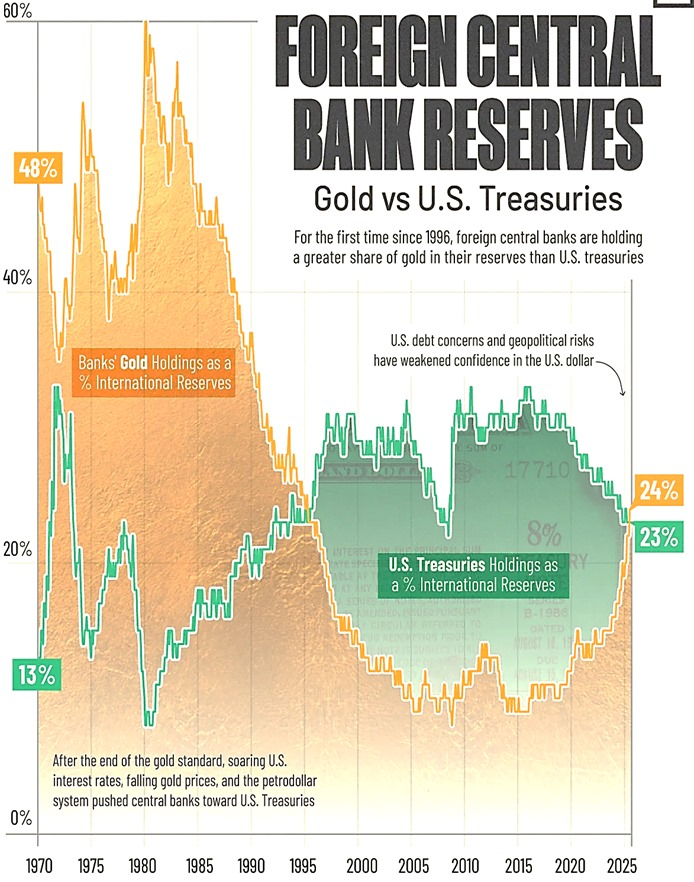
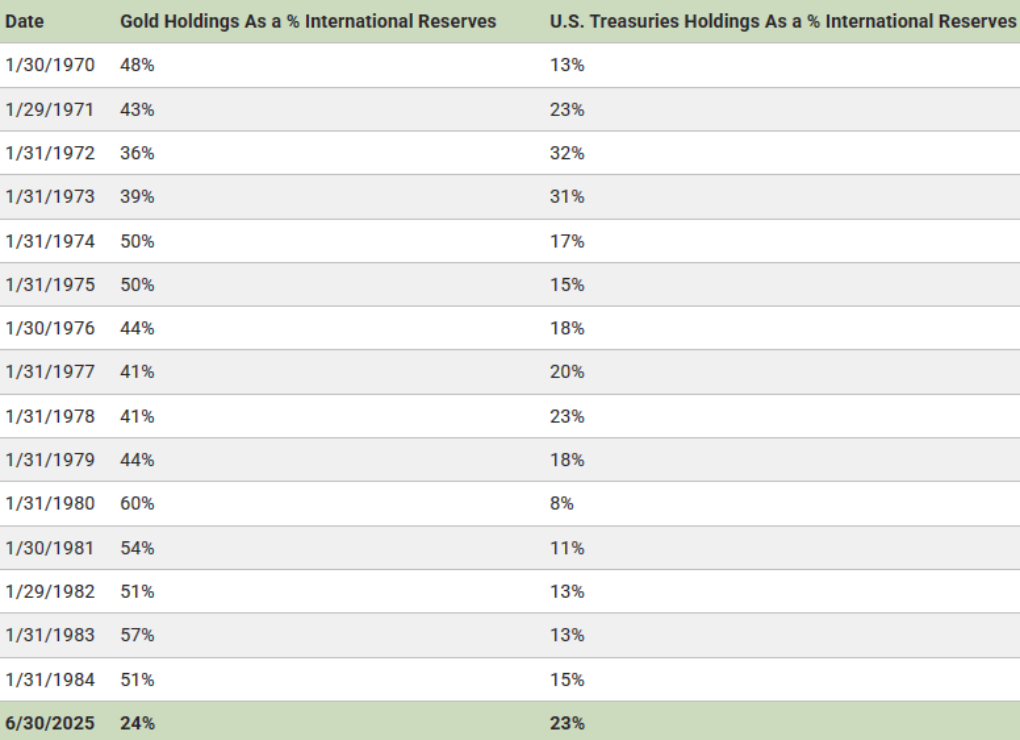
For the first time since 1996, foreign central banks’ gold reserves have overtaken their U.S. Treasury holdings. Persistent gold buying and rising U.S. debt risks are reshaping reserve composition toward hard assets. Central banks have crossed a symbolic line: their combined gold reserves now exceed their U.S. Treasury holdings for the first time in nearly three decades.
The crossover underscores a gradual diversification away from dollar-denominated securities and toward hard assets.
From Petrodollars to De-Dollarisation:
After the end of Bretton Woods, soaring real interest rates and the rise of the petrodollar steered reserve managers toward U.S. Treasuries through the 1980s and 1990s. In the 2000s, the dollar’s depth and liquidity reinforced that preference. Since 2022, however, heavy official gold buying has picked up again, a record 1,136 tons in 2022, with 2023 and 2024 maintaining historically strong accumulation. The trend is even more striking considering that nearly one-fifth of all the gold ever mined is now held by central banks.
As political uncertainty and geopolitical risks continue to fuel safe-haven demand, this purchasing momentum has also lifted prices: gold surpassed $4,000 an ounce for the first time ever in October 2025.
Why “More Gold than Treasuries” Matters:
Crossing above Treasuries signals that reserve managers are prioritizing durability, portability, and neutrality over yield. According to the IMF, gold’s share of global reserves climbed to about 18% in 2024, up sharply from mid-2010s levels, reflecting a structural reweighting toward tangible assets.
Seen as an alternative to heavily indebted fiat currencies, especially the U.S. dollar, the share of gold in central bank reserves has increased most among emerging market economies. China, Russia, and Türkiye have been the largest official buyers over the past decade.
Team Maverick





Lebanon At ‘Breaking Point’ As Displacement Soars And Strikes Intensify.
Beirut; April 2026: The UN’s top humanitarian official warned the Security Council (USA – …

Lebanon At ‘Breaking Point’ As Displacement Soars And Strikes Intensify.
Beirut; April 2026: The UN’s top humanitarian official warned the Security Council (USA – …