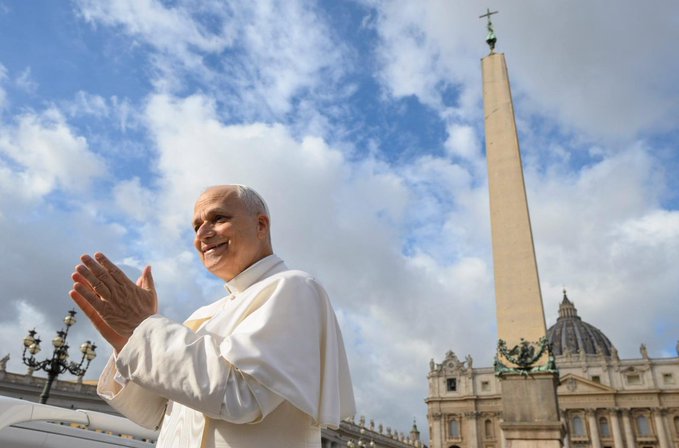
Pope Leo XIV’s First Apostolic Journey Abroad Highlights Christian Unity, Interfaith Dialogue, and a Moving Tribute in Beirut

Oct 2025 : Pope Leo XIV is set to embark on his first apostolic journey outside Italy—a mission of faith, reconciliation, and remembrance that will take him to Turkey and Lebanon from November 27 to December 2, 2025. The Vatican’s official program, released earlier this week, outlines an itinerary filled with prayer, historical commemoration, interfaith dialogue, and gestures of solidarity with communities still bearing the scars of tragedy.
The journey holds special significance as it marks the 1,700th anniversary of the First Council of Nicaea, a defining moment in Christian history, and culminates in a solemn prayer at the site of the 2020 Beirut Port explosion, one of the most devastating events in Lebanon’s modern history.
A Journey Rooted in Faith and Dialogue
Pope Leo XIV will depart from Rome’s Fiumicino Airport on the morning of Thursday, November 27, arriving in Ankara, Turkey, shortly after midday. His first official engagement will be a visit to the Mausoleum of Mustafa Kemal Atatürk, founder of the Turkish Republic—a gesture symbolizing respect for the nation’s modern identity. Later that day, the Pope will meet with President Recep Tayyip Erdoğan, civil society representatives, and members of the diplomatic corps.
These meetings, according to Vatican officials, reflect the Holy See’s ongoing commitment to building bridges between faiths and maintaining open diplomatic dialogue in a region often marked by tension and mistrust.
That evening, the Pope will travel to Istanbul, setting the stage for several days dedicated to Christian unity, humanitarian outreach, and interreligious understanding.
Commemorating Nicaea: 1,700 Years of Christian Unity
On Friday, November 28, Pope Leo will begin the day with prayer at the Cathedral of the Holy Spirit in Istanbul, joined by bishops, priests, and pastoral workers. He will then visit a home for the elderly run by the Little Sisters of the Poor, underscoring the Church’s enduring commitment to the marginalized and forgotten.
Later that day, he will journey to İznik (ancient Nicaea) for an ecumenical prayer gathering near the ruins of the Basilica of St. Neophytus. The event commemorates the First Council of Nicaea, convened in 325 AD by Emperor Constantine—a council that produced the original Nicene Creed, which continues to unite Christian denominations around the world.
“This visit is both a commemoration and a call,” Vatican News reported. “A call to rediscover the shared faith that once united the Church and continues to inspire dialogue between East and West.”
That evening, Pope Leo XIV will return to Istanbul for a private meeting with Turkey’s bishops, reaffirming the Vatican’s support for the country’s small but resilient Christian community.
Interfaith Harmony in Istanbul
The following day, Saturday, November 29, will highlight interreligious harmony and Christian heritage. The Pope will visit both the Blue Mosque and Hagia Sophia—two architectural and spiritual icons that have stood for centuries as symbols of coexistence and faith.
Later, at the Syriac Orthodox Church of Mor Ephrem, the Pope will meet with leaders of other Christian Churches before joining Ecumenical Patriarch Bartholomew I for a doxology and the signing of a joint declaration at the Patriarchal Church of St. George. The day will culminate with a Mass at Istanbul’s Volkswagen Arena, expected to draw thousands of faithful from across the region.
According to the Holy See Press Office, the Pope’s shared moments with Patriarch Bartholomew I will reaffirm the Vatican’s “commitment to the journey toward full Christian unity,” a goal that has guided modern pontiffs for decades.
From Istanbul to Beirut: A Message of Solidarity
On Sunday, November 30, Pope Leo XIV will visit the Armenian Apostolic Cathedral and attend a Divine Liturgy at the Patriarchal Church of St. George, strengthening ties with Orthodox and Armenian Christian leaders. Following a farewell ceremony at Istanbul’s Atatürk Airport, he will depart for Beirut, Lebanon, later that afternoon.
Upon arrival, the Pope will be received by Lebanese President Joseph Aoun, who assumed office earlier this year after years of political gridlock. He will also meet with the Prime Minister and the President of the National Assembly, reflecting Lebanon’s unique confessional political structure that allocates leadership among Maronite Christians, Sunni Muslims, and Shiite Muslims.
In his address to Lebanese authorities and civil society, Pope Leo XIV is expected to touch on the country’s ongoing political and economic crises, exacerbated by the 2020 port explosion and years of financial instability. Vatican observers say the Pope’s visit aims to inspire “hope, accountability, and renewal” in a nation struggling to recover.
A Nation’s Faith Amid Crisis
On Monday, December 1, the Pope will travel to Annaya to pray at the tomb of St. Charbel Makhlouf, the revered 19th-century Maronite monk known for his miracles and humility. From there, he will visit the Shrine of Our Lady of Lebanon in Harissa, where he will meet with clergy and pastoral workers, before holding a private meeting with Catholic patriarchs at the apostolic nunciature.
That afternoon, Pope Leo XIV will participate in an ecumenical and interreligious gathering in Beirut’s Martyrs’ Square and later meet young people outside the Maronite Patriarchate in Bkerké. His message to Lebanon’s youth will likely emphasize resilience, coexistence, and faith amid adversity—core themes that have defined his papacy since its beginning.
A Prayer for Beirut: Memory and Hope
The final day of the visit, Tuesday, December 2, will begin with a stop at De la Croix Hospital in Jal ed Dib, where the Pope will meet staff and patients, extending his pastoral compassion to those suffering from illness and hardship.
The most emotional moment of the trip will come later that morning, when Pope Leo XIV stands in silent prayer at the site of the 2020 Beirut Port explosion. The blast killed more than 200 people and destroyed large parts of the city, leaving deep social and emotional wounds. His visit there, Vatican News notes, “will serve as a gesture of solidarity with all those affected and a prayer for national unity and peace.”
That evening, the Pope will celebrate a closing Mass at the Beirut Waterfront, expected to draw tens of thousands of worshippers. He will then return to Rome, arriving at 4:10 p.m. local time, marking the end of a historic and deeply symbolic journey.
Carrying Forward Pope Francis’s Legacy
The Vatican has emphasized that this journey also fulfills an unrealized dream of the late Pope Francis, who had long hoped to visit both Lebanon and Turkey but passed away earlier this year before he could make the trip. By embarking on this mission, Pope Leo XIV both honors his predecessor’s legacy and reaffirms his own commitment to Christian unity, interfaith understanding, and solidarity with suffering communities across the Middle East.
Throughout the journey, the Pope will share multiple moments of joint prayer with Ecumenical Patriarch Bartholomew I, symbolizing the shared roots of Christian faith that transcend centuries of division.
For many in Turkey and Lebanon, the visit represents more than a diplomatic or religious event—it is a beacon of hope. In lands where ancient faith meets modern struggle, Pope Leo XIV’s pilgrimage will stand as a testament to the power of faith, memory, and dialogue to heal divisions and rekindle peace.
Rahul Gandhi, INDIA Bloc Hold Candlelight Vigil at Gandhi Smriti Over NEET Paper Leak Row
New Delhi, July 2026 : The Opposition intensified its campaign over the alleged NEET exami…
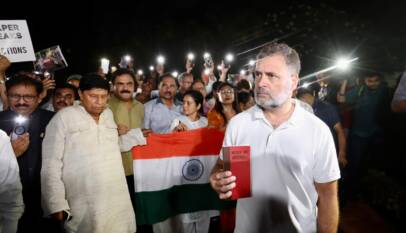
Rahul Gandhi, INDIA Bloc Hold Candlelight Vigil at Gandhi Smriti Over NEET Paper Leak Row
New Delhi, July 2026 : The Opposition intensified its campaign over the alleged NEET …