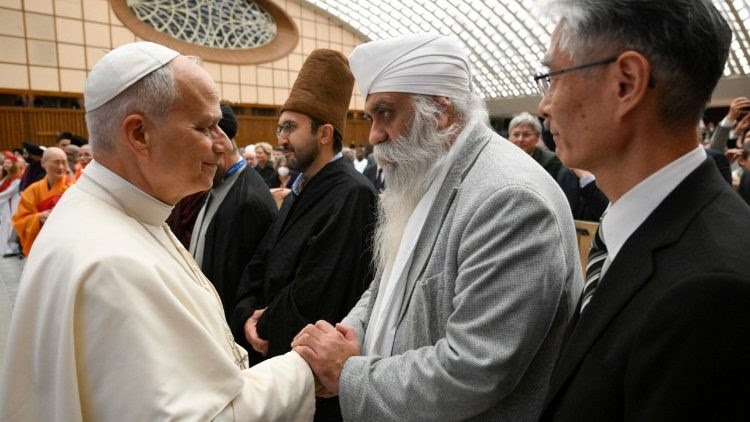
Pope Leo reaffirms ‘Nostra aetate’ remains as urgent as ever.

Pope Leo XIV presides at “Walking Together in Hope – a celebration of 60 years of
“Nostra aetate”, which is the Second Vatican Council’s Declaration on Interreligious Dialogue.
Oct 2025 : Sixty years ago, with the publication of Nostra aetate, the Second Vatican Council’s Declaration on the relation of the Church to non-Christian Religions, “a seed of hope for interreligious dialogue was planted”, Pope Leo XIV said on Tuesday evening. “Today, your presence bears witness that this seed has grown into a mighty tree, its branches reaching far and wide, offering shelter and bearing the rich fruits of understanding, friendship, cooperation and peace”.
The Holy Father was addressing to the distinguished representatives of world religions, members of the diplomatic corps accredited to the Holy See, and Vatican and Church officials committed to interreligious dialogue, who had gathered in the Paul VI Hall to celebrate the anniversary of the Council’s historic Declaration.
The Holy Pope XIV said, “Nostra aetate, has opened our eyes to a simple yet profound principle: dialogue is not a tactic or a tool, but it’s a way of life, a journey of the heart that transforms everyone involved, the one who listens and the one who speaks”. While referring to the title of the anniversary celebration, “Walking Together in Hope”, Pope Leo said, “We walk this journey” not by compromising our beliefs, but by remaining true to our convictions. Authentic dialogue, he continued, “begins not in compromise but in conviction, in the deep roots of our own belief that gives us the strength to reach out to others in love”.
Later, recalling the Jubilee of Hope and noting that “hope” and “pilgrimage” “are realities common to all our religious traditions. This is the journey that Nostra aetate invites us to continue to walk together in hope“. This, he said, in not the work of a single religion, nation, or generation, but “a sacred task for all humanity, to keep hope alive, to keep dialogue alive, and to keep love alive in the heart of the world“.
The Holy Father began his address by recalling the many people of all beliefs who have worked over the past sixty years “to bring Nostra aetate to life”, even to the point of giving their own lives, “martyrs for dialogue, who stood against violence and hatred”. We are where we are today, he said, “because of their courage, their sweat, and their sacrifice”.
Insisting that the message of Nostra aetate remains “highly relevant today”, Pope Leo humbly recalled the Council’s lessons: that humanity is drawing closer together, that all human beings belong to one human family with one origin and one goal; that all religions try to respond to the restlessness of the human heart; and that the Catholic Church rejects nothing that is true and holy in these religions.
Pope Leo also recalled the origins of the Declaration, which stemmed from a desire for a document describing “a new relationship between the Church and Judaism”. This desire was realised in Nostra aetate’s fourth chapter, which forms “the heart and generative core of the entire declaration”. The Pope continued, that this chapter led to the final chapter, which teaches that “we cannot truly call on God, the Father of all, if we refuse to treat in a brotherly or sisterly way any man or woman created in the image of God”.
In the final portion of his remarks, the visible head of the Catholic Church reminded religious leaders that they share a sacred responsibility: to help our people to break free from the chains of prejudice, anger and hatred; to help them rise above egoism and self-centeredness; to help them overcome the greed that destroys both the human spirit and the earth. “In this way, we can lead our people to become prophets of our time, the voices that denounce violence and injustice, heal division, and proclaim peace for all our brothers and sisters”.
He reminded them of the “great mission” with which they have been entrusted: “to reawaken in all men and women their sense of humanity and of the sacred. This, my friends, is precisely why we have come together in this place, bearing the great responsibility, as religious leaders, to bring hope to a humanity that is often tempted by despair”.
Pope Leo concluded his remarks with the words of Pope Saint John Paul II, who while in Assisi in 1986, said, “If the world is going to continue, and men and women are to survive in it, the world cannot do without prayer. And thus, he invited them all to pause together for silent prayer, with the invocation, “May peace come down upon us and fill our hearts”.
DECLARATION ON
THE RELATION OF THE CHURCH TO NON-CHRISTIAN RELIGIONS
NOSTRA AETATE
PROCLAIMED BY HIS HOLINESS
POPE PAUL VI
ON OCTOBER 28, 1965.
1. In our time, when day by day mankind is being drawn closer together, and the ties between different peoples are becoming stronger, the Church examines more closely her relationship to non-Christian religions. In her task of promoting unity and love among men, indeed among nations, she considers above all in this declaration what men have in common and what draws them to fellowship.
One is the community of all peoples, one their origin, for God made the whole human race to live over the face of the earth. One also is their final goal, God. His providence, His manifestations of goodness, His saving design extend to all men, until that time when the elect will be united in the Holy City, the city ablaze with the glory of God, where the nations will walk in His light.
Men expect from the various religions answers to the unsolved riddles of the human condition, which today, even as in former times, deeply stir the hearts of men: What is man? What is the meaning, the aim of our life? What is moral good, what is sin? Whence suffering and what purpose does it serve? Which is the road to true happiness? What are death, judgment and retribution after death? What, finally, is that ultimate inexpressible mystery which encompasses our existence: whence do we come, and where are we going?
2. From ancient times down to the present, there is found among various peoples a certain perception of that hidden power which hovers over the course of things and over the events of human history; at times some indeed have come to the recognition of a Supreme Being, or even of a Father. This perception and recognition penetrates their lives with a profound religious sense.
Religions, however, that are bound up with an advanced culture have struggled to answer the same questions by means of more refined concepts and a more developed language.
In Hinduism, men contemplate the divine mystery and express it through an inexhaustible abundance of myths and through searching philosophical inquiry. They seek freedom from the anguish of our human condition either through ascetical practices or profound meditation or a flight to God with love and trust.
In, Buddhism, in its various forms, realises the radical insufficiency of this changeable world; it teaches a way by which men, in a devout and confident spirit, may be able either to acquire the state of perfect liberation, or attain, by their own efforts or through higher help, supreme illumination.
Other religions found everywhere try to counter the restlessness of the human heart, each in its own manner, by proposing “ways”, comprising teachings, rules of life, and sacred rites.
The Catholic Church rejects nothing that is true and holy in these religions. She regards with sincere reverence those ways of conduct and of life, those precepts and teachings which, though differing in many aspects from the ones she holds and sets forth, nonetheless often reflect a ray of that Truth which enlightens all men. Indeed, she proclaims, and ever must proclaim Christ “the way, the truth, and the life“, in whom men may find the fullness of religious life, in whom God has reconciled all things to Himself.
The Church, therefore, exhorts her sons, that through dialogue and collaboration with the followers of other religions, carried out with prudence and love and in witness to the Christian faith and life, they recognize, preserve and promote the good things, spiritual and moral, as well as the socio-cultural values found among these men.
3. The Church regards with esteem also the “Moslems”. They adore the one God, living and subsisting in Himself; merciful and all powerful, the Creator of heaven and earth, who has spoken to men; they take pains to submit wholeheartedly to even His inscrutable decrees, just as Abraham, with whom the faith of Islam takes pleasure in linking itself, submitted to God. Though they do not acknowledge Jesus as God, they revere Him as a prophet. They also honour Mary, His virgin Mother; at times they even call on her with devotion. In addition, they await the day of judgment when God will render their deserts to all those who have been raised up from the dead. Finally, they value the moral life and worship God especially through prayer, almsgiving and fasting.
Since in the course of centuries not a few quarrels and hostilities have arisen between Christians and Moslems, this sacred synod urges all to forget the past and to work sincerely for mutual understanding and to preserve as well as to promote together for the benefit of all mankind social justice and moral welfare, as well as peace and freedom.
4. As the sacred synod searches into the mystery of the Church, it remembers the bond that spiritually ties the people of the New Covenant to Abraham’s stock.
Thus, the Church of Christ acknowledges that, according to God’s saving design, the beginnings of her faith and her election are found already among the Patriarchs, Moses and the prophets. She professes that all who believe in Christ-Abraham’s sons according to faith are included in the same Patriarch’s call, and likewise that the salvation of the Church is mysteriously foreshadowed by the chosen people’s exodus from the land of bondage. The Church, therefore, cannot forget that she received the revelation of the Old Testament through the people with whom God in His inexpressible mercy concluded the Ancient Covenant. Nor can she forget that she draws sustenance from the root of that well-cultivated olive tree onto which have been grafted the wild shoots, the Gentiles. Indeed, the Church believes that by His cross Christ, Our Peace, reconciled Jews and Gentiles. making both one in Himself.
The Church keeps ever in mind the words of the Apostle about his kinsmen: “theirs is the sonship and the glory and the covenants and the law and the worship and the promises; theirs are the fathers and from them is the Christ according to the flesh“, the Son of the Virgin Mary. She also recalls that the Apostles, the Church’s main-stay and pillars, as well as most of the early disciples who proclaimed Christ’s Gospel to the world, sprang from the Jewish people.
As Holy Scripture testifies, Jerusalem did not recognise the time of her visitation, nor did the Jews in large number, accept the Gospel; indeed not a few opposed its spreading. Nevertheless, God holds the Jews most dear for the sake of their Fathers; He does not repent of the gifts He makes or of the calls He issues-such is the witness of the Apostle. In company with the Prophets and the same Apostle, the Church awaits that day, known to God alone, on which all peoples will address the Lord in a single voice and “serve him shoulder to shoulder“.
Since the spiritual patrimony common to Christians and Jews is thus so great, this sacred synod wants to foster and recommend that mutual understanding and respect which is the fruit, above all, of biblical and theological studies as well as of fraternal dialogues.
True, the Jewish authorities and those who followed their lead pressed for the death of Christ; still, what happened in His passion cannot be charged against all the Jews, without distinction, then alive, nor against the Jews of today. Although the Church is the new people of God, the Jews should not be presented as rejected or accursed by God, as if this followed from the Holy Scriptures. All should see to it, then, that in catechetical work or in the preaching of the word of God they do not teach anything that does not conform to the truth of the Gospel and the spirit of Christ.
Furthermore, in her rejection of every persecution against any man, the Church, mindful of the patrimony she shares with the Jews and moved not by political reasons but by the Gospel’s spiritual love, decries hatred, persecutions, displays of anti-Semitism, directed against Jews at any time and by anyone.
Besides, as the Church has always held and holds now, Christ underwent His passion and death freely, because of the sins of men and out of infinite love, in order that all may reach salvation. It is, therefore, the burden of the Church’s preaching to proclaim the cross of Christ as the sign of God’s all-embracing love and as the fountain from which every grace flows.
5. We cannot truly call on God, the Father of all, if we refuse to treat in a brotherly way any man, created as he is in the image of God. Man’s relation to God the Father and his relation to men his brothers are so linked together that Scripture says: “He who does not love does not know God“.
No foundation therefore remains for any theory or practice that leads to discrimination between man and man or people and people, so far as their human dignity and the rights flowing from it are concerned.
The Church reproves, as foreign to the mind of Christ, any discrimination against men or harassment of them because of their race, colour, condition of life, or religion. On the contrary, following in the footsteps of the holy Apostles Peter and Paul, this sacred synod ardently implores the Christian faithful to “maintain good fellowship among the nations”, and, if possible, to live for their part in peace with all men, so that they may truly be sons of the Father who is in heaven.
Team Maverick


CM Yogi directs action on 2,200 proposals: Budget to be released by July 15, projects to be launched on the ground from August 15
CM takes a tough stand during PWD review, warns of action over delays in pending projects …
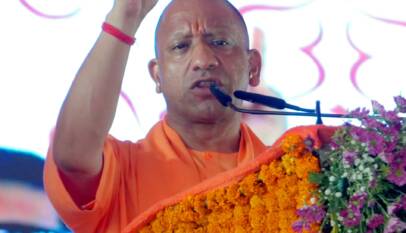
CM Yogi directs action on 2,200 proposals: Budget to be released by July 15, projects to be launched on the ground from August 15
CM takes a tough stand during PWD review, warns of action over delays in …