NASA Shares SpaceX Crew-12 Assignments for Space Station Mission.

Washington; December 2025: As part of NASA’s SpaceX Crew-12 mission, 04 crew members from three space agencies will launch no earlier than Sunday, February 15th, 2026, to the International Space Station for a long-duration science expedition.
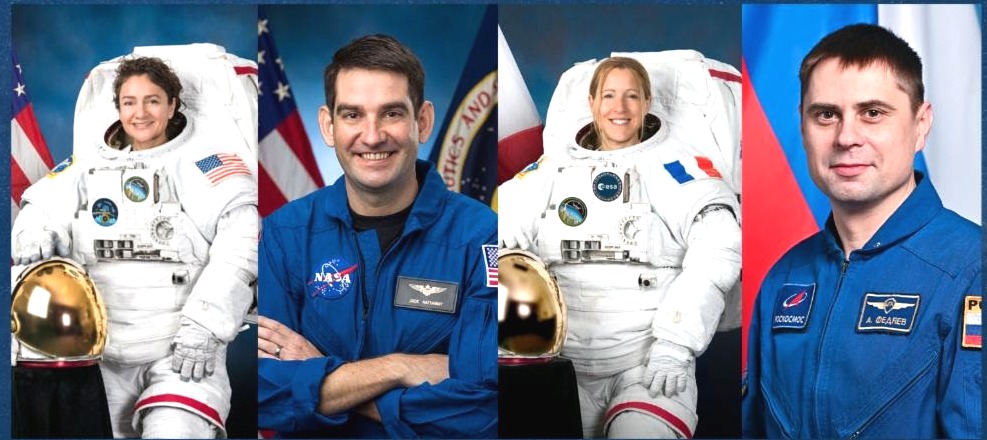
NASA astronauts Jessica Meir and Jack Hathaway will serve as spacecraft commander and pilot, respectively, and will be accompanied by ESA (European Space Agency) astronaut Sophie Adenot and Roscosmos cosmonaut Andrey Fedyaev, who will both serve as mission specialists. Crew-12 will join Expedition 74 crew members currently aboard the space station.
The flight, which is the 12th crew rotation with SpaceX to the orbiting laboratory as part of “NASA’s Commercial Crew Program” (1). Crew-12 will conduct scientific investigations and technology demonstrations to help prepare humans for future exploration missions to the Moon and Mars, as well as benefit people on Earth.
This will be the second flight to the space station for Meir, who was selected as a NASA astronaut in 2013. The Caribou, Maine, native earned a bachelor’s degree in biology from Brown University, a master’s degree in space studies from the International Space University, and a doctorate in marine biology from Scripps Institution of Oceanography in San Diego.
On her first spaceflight, Meir spent 205 days as a flight engineer during Expedition 61/62, and she completed the first three all-woman spacewalks with fellow NASA astronaut Christina Koch, totaling 21 hours and 44 minutes outside of the station. Since then, she has served in various roles, including assistant to the chief astronaut for commercial crew (SpaceX), deputy for the Flight Integration Division, and assistant to the chief astronaut for the human landing system.
A commander in the United States Navy, Hathaway was selected as part of the 2021 astronaut candidate class. This will be Hathaway’s first spaceflight. The South Windsor, Connecticut, native holds a bachelor’s degree in physics and history from the U.S. Naval Academy and master’s degrees in flight dynamics from Cranfield University and national security and strategic studies from the U.S. Naval War College, respectively. Hathaway also is a graduate of the Empire Test Pilot’s School, Fixed Wing Class 70 in 2011. At the time of his selection, Hathaway was deployed aboard the USS Truman, serving as Strike Fighter Squadron 81’s prospective executive officer. He has accumulated more than 2,500 flight hours in 30 different aircraft, including more than 500 carrier arrested landings and 39 combat missions.
The Crew-12 mission will be Adenot’s first spaceflight. Before her selection as an ESA astronaut in 2022, Adenot earned a degree in engineering from ISAE-SUPAERO in Toulouse, France, specializing in spacecraft and aircraft flight dynamics. She also earned a master’s degree in human factors engineering at Massachusetts Institute of Technology in Cambridge. After earning her master’s degree, she became a helicopter cockpit design engineer at Airbus Helicopters and later served as a search and rescue pilot at Cazaux Air Base from 2008 to 2012. She then joined the High Authority Transport Squadron in Villacoublay, France, and served as a formation flight leader and mission captain from 2012 to 2017. Between 2019 and 2022, Adenot worked as a helicopter experimental test pilot in Cazaux Flight Test Center with DGA (Direction Générale de l’Armement, the French Defence Procurement Agency. She has logged more than 3,000 hours flying 22 different helicopters.
This will be Fedyaev’s second long-duration stay aboard the orbiting laboratory. He graduated from the Krasnodar Military Aviation Institute in 2004, specialising in aircraft operations and air traffic organisation, and earned qualifications as a pilot engineer. Prior to his selection as a cosmonaut, he served as deputy commander of an Ilyushin-38 aircraft unit in the Kamchatka Region, logging more than 600 flight hours and achieving the rank of second-class military pilot. Fedyaev was selected for the Gagarin Research and Test Cosmonaut Training Center Cosmonaut Corps in 2012 and has served as a test cosmonaut since 2014. In 2023, he flew to the space station as a mission specialist during NASA’s SpaceX Crew-6 mission, spending 186 days in orbit, as an Expedition 69 flight engineer. For his achievements, Fedyaev was awarded the title Hero of the Russian Federation and received the Yuri Gagarin Medal.
For more than 25 years, people have lived and worked continuously aboard the International Space Station, advancing scientific knowledge and making research breakthroughs that are not possible on Earth. The station is a critical testbed for NASA to understand and overcome the challenges of long-duration spaceflight and to expand commercial opportunities in low Earth orbit. As commercial companies concentrate on providing human space transportation services and destinations as part of a robust “low Earth orbit economy” (2), NASA is focusing its resources on deep space missions to the Moon as part of the Artemis campaign in preparation for future human missions to Mars.
- What is Commercial Crew? – NASA’s Commercial Crew Program is delivering on its goal of safe, reliable, and cost-effective human transportation to and from the International Space Station from the United States through a partnership with American private industry. A new generation of spacecraft and launch systems capable of carrying astronauts to low-Earth orbit and the International Space Station provides expanded utility, additional research time, and broader opportunities for discovery on the orbiting laboratory.
The station is a critical testbed for NASA to understand and overcome the challenges of long- duration spaceflight. As commercial companies focus on providing human transportation services to and from low-Earth orbit, NASA is freed up to focus on building spacecraft and rockets for deep space missions. With the ability to purchase astronaut transportation from Boeing and SpaceX as a service on a fixed-price contract, NASA can use resources to put the first woman and the first person of color on the Moon as a part of our Artemis missions in preparation for human missions to Mars.
NASA has officially certified SpaceX’s crew system and started regular missions with astronauts to the space station. SpaceX’s Crew Dragon spacecraft launches on the company’s Falcon 9 rocket from Launch Complex 39A at NASA’s Kennedy Space Center or Space Launch Complex 40 at Cape Canaveral Space Force Station in Florida.
NASA and Boeing continue to make progress on the company’s first crewed flight on the CST-100 Starliner system to prove its capability to carry astronauts to low-Earth orbit and the International Space Station. The end-to-end Crew Flight Test launched on the United Launch Alliance Atlas V rocket from Space Launch Complex 41 on Cape Canaveral Space Force Station in Florida in June 2024. If successful, this mission will pave the way for NASA’s certification of Boeing’s astronaut transportation system for regular missions to the orbiting laboratory.
- What is the low Earth orbit economy? – Low Earth orbit economy is the production, distribution, and trade of goods and services this region of space. As technology progresses, the market will grow to include government agencies, commercial providers, academic organisation, and potentially more, all contributing to the economy’s continued expansion and supporting future sustainable space enterprises.
Space is a growing industry and low Earth orbit is full of opportunity. Establishing a robust commercial space economy ensures that national interests for research and development in low Earth orbit are fulfilled, while also allowing NASA to focus government resources on deep space exploration through the Artemis program. NASA’s goal is a low Earth orbit marketplace where NASA is one of many customers, and the private sector leads the way.
NASA has partnered with American private industry throughout its history of spaceflight, including through public-private for commercial resupply missions, commercial crew activities, and the research and development from the ISS National Lab aboard the International Space Station. American companies will continue to play an essential role in establishing a sustainable presence in space.
The commercialisation of low Earth orbits is the precedent step in humanity’s exploration of the solar system. It provides an ideal environment for crew training, research, and hardware testing for exploration use. NASA will need access to a human-rated destination in low Earth orbit following the life of the International Space Station, and the agency intends to be a significant customer of space services.
To support the development of future commercial destinations and services, NASA is increasing access to the resources and infrastructure of the International Space Station to assist the commercial sector in developing and deploying new capabilities in low Earth orbit. Both U.S. Congress and the National Space Council have stated that it is in the national and economic security interests of the United States to encourage the development of a healthy and robust commercial sector in low Earth orbit.
Team Maverick.





FIFA Chief Infantino Hails Messi’s ‘Timeless Brilliance’ After Record-Equalling World Cup Feat
New Delhi, June 2026 : FIFA President Gianni Infantino has showered praise on Lionel Messi…

FIFA Chief Infantino Hails Messi’s ‘Timeless Brilliance’ After Record-Equalling World Cup Feat
New Delhi, June 2026 : FIFA President Gianni Infantino has showered praise on Lionel …