Maharashtra Scripts Success Story with Asia’s Largest Decentralized Solar Energy Program

16 Gigawatts of Electricity Expected by Year-End Through Solar Power – Chief Minister Devendra Fadnavis
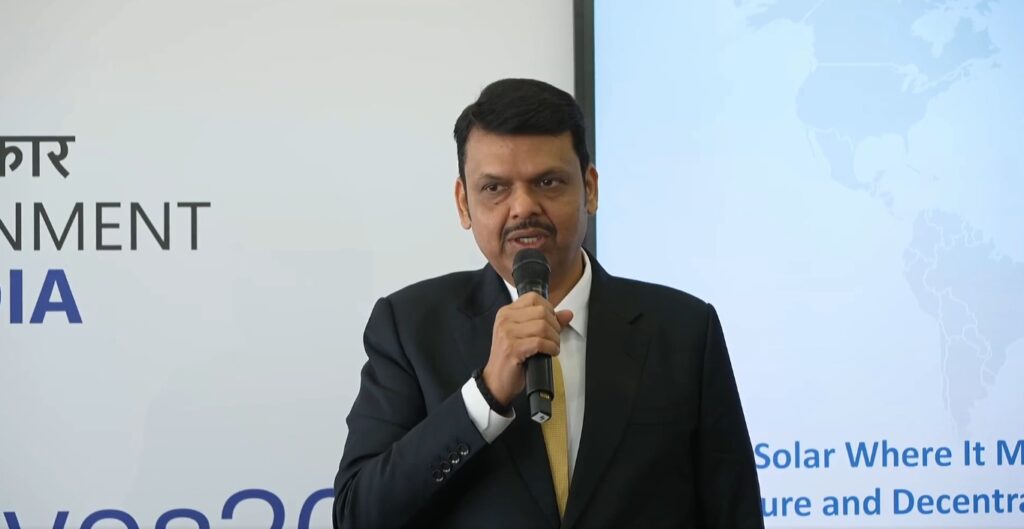
Davos, Jan 2026 : Maharashtra has scripted a remarkable success story by implementing Asia’s largest decentralized solar energy program, and by the end of this year, 16 gigawatts of electricity will be generated through solar power, said Chief Minister Devendra Fadnavis.
At the India Pavilion during the World Economic Forum’s Annual Meeting, CM Fadnavis presented on “Scaling Solar Energy Where It Matters”, organized on behalf of the International Solar Alliance. The event was attended by dignitaries including Union Minister of New and Renewable Energy, Pralhad Joshi.
The Chief Minister highlighted initiatives such as rooftop solar, solar pumps, massive electricity cost savings, major reductions in carbon emissions, and plans to stabilize state and national electricity grids through solar power, battery storage, and pumped storage solutions in the future.
CM Fadnavis stated that Maharashtra has transformed its entire energy sector in less than a decade. About 10% of electricity consumers in Maharashtra are agricultural pump owners, who were consuming 30% of total electricity. The cost of supplying electricity to them was ₹8 per unit, while only ₹1 was charged, with the remaining ₹7 subsidized by the state. This created a vicious cycle, increasing costs for industrial and other consumers.
Following the vision of Prime Minister Narendra Modi, the state shifted the entire agricultural electricity load to solar power, launching Asia’s largest decentralized solar energy program. Each agricultural feeder was independently connected to solar energy. A separate company was established to supply electricity to farmers. Through this distribution system, 16 gigawatts of electricity will be generated by year-end. Currently, about 500 MW per month is being added, soon reaching 1 GW capacity. The cost of electricity for farmers has reduced from ₹8 to less than ₹3 per unit, easing the financial burden on industries and households.
The PM Surya Ghar Yojana is also being successfully implemented in Maharashtra, with approximately 4 GW of rooftop solar systems coming online. The generated electricity is not only used for households but also fed back into the grid, reducing carbon emissions. Under the “Maagel Tyala Solar Pump” program, aligned with the central government’s agricultural pump scheme, 60% of all solar pumps in India are in Maharashtra, soon exceeding 1 million units. This has stabilized electricity tariffs, which were previously increasing at 9% annually, and will save $10 billion in electricity purchase costs over the next five years.
CM Fadnavis also noted that the carbon emission reduction from the solar energy program is equivalent to planting 300 crore (3 billion) trees. By 2032, Maharashtra aims to generate an additional 45 GW of electricity, with 70% from solar energy. Renewable energy contribution in the state, which was 13% a few years ago, will reach 52% by 2030. To stabilize the grid, battery storage and pumped storage projects utilizing the Western Ghats’ geography are being expanded. Currently, 80,000 MW of pumped storage projects are operational, soon to reach 100,000 MW, said CM Devendra Fadnavis.
Japanese F-2 Fighter Reloaded With New Large Stealth Cruise Missile Under Its Wings.
Gifu Air Field, Kakamigahara City, Japan; August 2026: Yesterday (Friday – 31st July 2026)…

Japanese F-2 Fighter Reloaded With New Large Stealth Cruise Missile Under Its Wings.
Gifu Air Field, Kakamigahara City, Japan; August 2026: Yesterday (Friday – 31st July 2026) …