Workers’ Party Of Korea (WPK) General Secretary Kim Jong Un Publicly Dismissed A Senior Economic Official.

Pyongyang; January 2026: On 20th January 2026, Kim Jong Un told Cabinet Vice Premier Yang Seung Ho to resign due to incompetence while delivering a speech at the opening ceremony site of the Ryongsong Machine Complex. Yang who has served as the vice premier in the Cabinet since April 2020, was a core technocrat under former Premier Kim Tok Hun, who served from August 2020 to December 2024. Yang and Kim Tok Hun started their career at the Taean Machine Industry Complex. Yang’s promotion followed Kim Tok Hun’s rise in ranks. The South Korean Ministry of Unification (MOU) reported that Kim Tok Hun has not appeared in public since December 2025, indicating possible demotion or removal.
Meanwhile, the South Korean intelligence have assessed that Yang and Kim Tok Hun are part of a faction led by WPK Politburo Standing Committee member Choe Ryong Hae. They both rose within the party and state while Choe was the head of the WPK Organisational Department, the party’s key organ responsible for official appointments and removals in between 2017 and 2019.
It is well understood that their affinity to Choe likely protected Yang and Kim Tok Hun for some time. Kim Jong Un criticised Kim Tok Hun over a failed project in August 2023 but did not dismiss him, reportedly due to support from then-Central Audit Commission Chairman Kim Jae Ryong, who is a member of Choe’s faction.
The regime demoted Kim Jae Ryong to commission vice chair in 2024, which may have removed this protection. The regime have removed at least two other Choe-associated officials in 2025, including former Vice Chairman of the Central Military Commission Ri Pyong Chol and former Director of the Korea People’s Army Reconnaissance General Bureau and the United Front Department Kim Yong Chol.
Kim Jong Un may be purging officials due to the upcoming Party Congress, based on established precedent. North Korea replaced 66% of the ruling elites who had dominated the 08th Party Congress in January 2021. The Party Congress typically serves as a platform for announcing new economic policies. Kim may want a new Cabinet formation aligned with his post-COVID-19 pandemic priorities.
The removals specifically targeting Choe’s network could reflect Kim Jong Un’s efforts to manage the influence of competing factions in the WPK. Kim Jong Un has historically prevented any single faction from gaining a dominant position in the WPK.[9] The systematic weakening of Choe’s network suggests that Kim perceives Choe’s power as increasingly problematic. Kim may conduct additional purges ahead of the 9th Party Congress.
North Korea’s internal political instability has historically correlated with external provocations, as Kim seeks to consolidate domestic cohesion through nationalist rallying. The absence of immediate military mobilisation indicators suggests current internal tensions are manageable and unlikely to trigger near-term escalation.
South Korean President Lee Jae Myung appears to be prioritising escalation management and diplomacy over denuclearisation or unification efforts. On 21st January, Lee has said that North Korea is unlikely to abandon its nuclear program but maintained that complete denuclearisation remains South Korea’s ideal outcome. Lee reiterated his three-stage denuclearisation proposal that involves freezing nuclear material and weapons production, reducing nuclear capabilities, and ultimately achieving denuclearisation. Lee’s focus on escalation management and diplomacy marks a departure from the previous Yoon Suk-yeol administration. Yoon viewed pre-emptive economic incentives for engagement without a denuclearisation commitment as an acknowledgement of Pyongyang as a nuclear weapons state.
Earlier, North Korea had rejected the Yoon administration’s proposals and instead codified a nuclear doctrine in September 2022 and declared South Korea an “enemy state” in its Constitution in January 2024. Lee separately said on January 21 that his administration would work toward peaceful coexistence on the Korean Peninsula and “set aside” unification talks for now.
North Korea is unlikely to accept Lee’s calls for dialogue, even as South Korea deemphasises its denuclearisation goals. North Korea is not facing immediate food or aid shortages due to its trade with the People’s Republic of China (PRC) and Russia, meaning that North Korea lacks an immediate incentive to engage in diplomacy. North Korean leaders appear increasingly confident given their growing diplomatic, military, and economic power, in fact, further reducing the incentive to grant concessions. South Korea’s challenges vis-a-vis North Korea are compounded by the fact that there appears to be little coordination with the United States on their North Korea policies.
Meanwhile, South Korea (PRK) may propose an inter-Korean economic cooperation effort to incentivise Pyongyang’s engagement while counterfeiting the US and China in order to facilitate a dialogue between Kim and Lee. South Korea’s MOU is already seeking to import North Korean food and approved a draft to allocate around 12 million US dollars (17.1 billion KRW) to various inter-Korean exchange projects. North Korea, however, has recently intensified its anti-United States and anti-South Korea narratives to its domestic audience without signs of reversal in the near future.
As demonstrated in Trump 2.0 foreign policy, the US 2026 National Defence Strategy (NDS) urged South Korea to take primary responsibility for defending itself without reaffirming US extended deterrence against North Korean nuclear threats. On the otherside, North Korea may view this as the United States retreating from extended deterrence commitments on the Korean Peninsula.
The United States has released the 2026 NDS on January 23rd, presenting the Department of Defence’s role in implementing the National Security Strategy (NSS). The 2026 NDS marked a departure from longstanding US policy toward North Korea. The strategy did not mention achieving North Korean denuclearisation or enforcing UN Security Council resolutions. The 2022 and 2017 NDS’s both committed to “complete, verifiable, and irreversible denuclearisation”.
Furthermore, the 2026 NDS did not include explicit extended deterrence guarantees either, such as previous language that North Korean nuclear use would “result in the end of that regime”. The NDS shifted the primary responsibility of maintaining Korean peninsula stability to South Korea by stating that Seoul is capable of deterring North Korea with only “critical but limited support from US forces”. North Korea may interpret the reduced US security guarantee as a vulnerability that it can exploit and test.
The NDS also removed language on enforcing UN sanctions and denuclearisation, two long-standing US policies toward North Korea. North Korea annually earns over 01 billion to 03 billion US dollars through cyber theft, arms sales to Russia, and sanctions evasion. These revenues are likely funding nuclear weapons development. Reduced sanctions enforcement will likely accelerate North Korea military expansion.
The Lee administration could respond to the new US strategy by calling for the acceleration of the transfer of wartime operational control (OPCON) from the US forces to South Korean forces. South Korea has increased defence spending by 7.5% to 44.8 billion US dollars in 2026 in order to strengthen its independent warfighting capabilities against North Korea.
US commitments to provide extended deterrence would remain essential even after the transfer of OPCON, however. The NDS language on “updating US force posture” likely signals Washington’s desire for greater US Forces Korea (USFK) flexibility to deploy assets to higher-priority areas, particularly for potential cross-strait contingencies or Middle East crises. The 2026 National Defence Authorisation Act legally prevents reducing USFK below 28,500 troops, however.
Team Maverick.
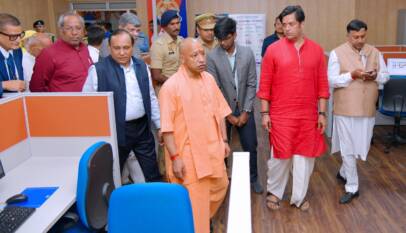
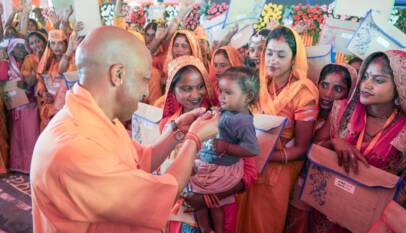
“Lights, Camera, Delhi!” — Grand Inauguration of International Film Festival Delhi (IFFD) 2026 in the Capital
Chief Minister reiterates commitment to making Delhi a global film hub at the inauguration…

“Lights, Camera, Delhi!” — Grand Inauguration of International Film Festival Delhi (IFFD) 2026 in the Capital
Chief Minister reiterates commitment to making Delhi a global film hub at the inauguration …