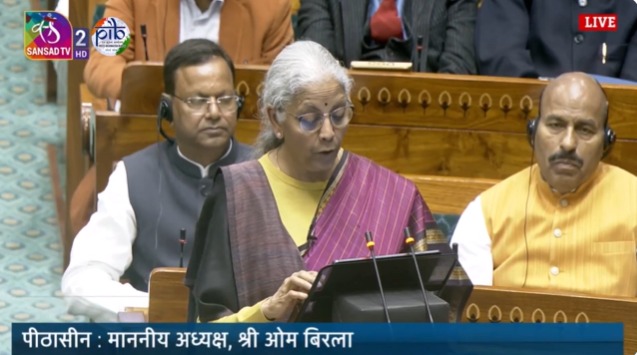
Budget 2026-27: FM Sitharaman Unveils Banking Reforms and Measures to Boost Investments

New Delhi, Feb 2026 : In her Union Budget 2026-27 speech, Finance Minister Nirmala Sitharaman presented a range of forward-looking measures aimed at strengthening India’s financial sector, enhancing ease of doing business, and supporting the nation’s vision of a Viksit Bharat. The proposals cover banking reforms, non-banking financial institutions, foreign investment, and bond market development.
A key announcement was the formation of a high-level committee on Banking for Viksit Bharat. The committee will conduct a comprehensive review of India’s banking ecosystem, including banks and non-banking financial companies (NBFCs). Its mandate is to recommend reforms that improve efficiency, scale, and preparedness for future challenges while ensuring financial stability, greater inclusion, and robust consumer protection. Sitharaman highlighted that India’s banking sector currently enjoys strong balance sheets, record profitability, and nearly universal access, with 98 per cent of villages covered.
To further strengthen public sector financial institutions in the power sector, the Finance Minister proposed the restructuring of the Power Finance Corporation and the Rural Electrification Corporation. This initiative aims to enhance operational efficiency and scale, supporting infrastructure financing and accelerating growth in the energy sector.
The Budget also included a review of the Foreign Exchange Management Act (FEMA) non-debt instruments rules. The goal is to simplify procedures and provide a more contemporary, investor-friendly framework, boosting foreign capital inflows and aligning regulations with India’s evolving economic priorities.
On bond markets, the government proposed measures to deepen corporate and municipal bond issuance. Incentives for municipal corporations are expected to foster alternative funding avenues for urban infrastructure projects, while supporting broader financial market development.
In a significant move to improve foreign participation and ease of doing business, non-resident individuals will now be allowed to invest in equity instruments of listed Indian companies through the Portfolio Investment Scheme. The individual investment limit will increase from five per cent to ten per cent, while the overall combined limit will rise from ten per cent to 24 per cent. This step is aimed at boosting liquidity in equity markets and attracting diversified global investment.
Market reactions were positive, with shares of related entities recording gains amid optimism about the reforms. The proposals underscore the government’s proactive approach to fortifying India’s financial architecture while preparing the economy to navigate global uncertainties and sustain robust growth.







End of an Era: Cristiano Ronaldo Bids Farewell to the FIFA World Cup After a Record-Breaking International Career
Dallas, July 2026 : One of football’s greatest chapters came to a close on Tuesday a…

End of an Era: Cristiano Ronaldo Bids Farewell to the FIFA World Cup After a Record-Breaking International Career
Dallas, July 2026 : One of football’s greatest chapters came to a close on …