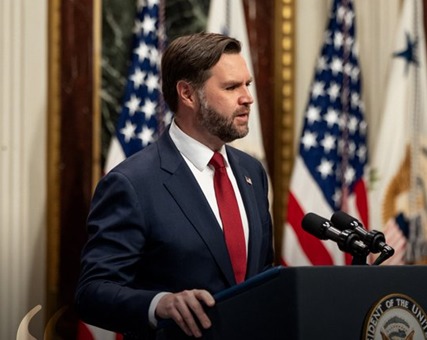
No Chance of Prolonged Middle East War, Says US Vice President JD Vance as Trump Weighs Iran Options

Washington, Feb 2026 : United States Vice President JD Vance has firmly rejected the notion that the US could be drawn into another long-running conflict in the Middle East, even as President Donald Trump considers fresh military and diplomatic options in dealing with Iran.
Speaking in an interview with The Washington Post while travelling aboard Air Force Two, Vance said there was “no chance” that Washington would repeat the mistakes of past decades by entering a war with no clear end. While he acknowledged that limited military strikes remain among the options on the table, he dismissed fears that such action would inevitably escalate into a prolonged regional conflict.
“The idea that we’re going to be in a Middle Eastern war for years with no end in sight — there is no chance that will happen,” Vance said, seeking to reassure both domestic and international audiences concerned about rising tensions.
The Vice President underlined that final decisions rest with President Trump, who continues to review a range of possibilities. These include targeted military measures designed to prevent Iran from acquiring a nuclear weapon, as well as diplomatic pathways aimed at resolving the dispute without resorting to force. Vance made clear that his own preference, and that of much of the administration, remains diplomacy—provided Tehran shows willingness to engage constructively.
“I think we all prefer the diplomatic option,” he said. “But it really depends on what the Iranians do and what they say.”
His remarks came as talks between the United States and Iran continued in Geneva, even amid a visible buildup of US military assets in and around the region. Negotiations on Thursday ended without a breakthrough, but mediators confirmed that discussions would resume next week, signalling that diplomatic channels remain open despite the heightened pressure.
At the same time, President Trump has openly floated the possibility of regime change in Iran. Earlier this month, he told reporters that removing Iran’s supreme leader, Ayatollah Ali Khamenei, “would be the best thing that could happen.” Those comments have fuelled speculation about Washington’s long-term intentions, even as officials stress that no final course has been chosen.
Vance, a 41-year-old Marine veteran who served during the Iraq War, has long described himself as sceptical of foreign military interventions. He reiterated that stance, arguing that his outlook aligns closely with Trump’s “America First” philosophy. According to Vance, this approach prioritises US national interests while remaining cautious about military entanglements abroad.
“Life has all kinds of crazy twists and turns,” he said. “But I think Donald Trump is an ‘America First’ president, and he pursues policies that work for the American people.”
At the same time, the Vice President warned against simplistic thinking shaped entirely by past failures. While emphasising the need to avoid repeating historical mistakes, he argued that the US should not rule out the use of force in all circumstances.
“Just because one president screwed up a military conflict doesn’t mean we can never engage in military conflict again,” Vance said. “We’ve got to be careful about it, but I think the president is being careful.”
The debate reflects deeper divisions within the conservative movement over America’s role in the Middle East and its relationship with Israel. While Vance has consistently described Israel as a strategic ally, he has also argued that voices critical of Israeli policy deserve a place in internal Republican discussions. He views this openness to debate as a strength rather than a weakness.
“I think it’s a really good conversation that’s going to be necessary for the right, not just for the next couple of years but for long into the future,” he said.
Pointing to the broad coalition that backed Trump in the 2024 election, Vance highlighted figures ranging from Joe Rogan and Mark Levin to Sean Hannity and Tucker Carlson. He argued that such a diverse alliance can only function if disagreement is tolerated and debate encouraged.
“To do that, you have to be willing to tolerate debate and disagreement,” he said. “And I just think that it’s a good thing.”
The United States has maintained a substantial military presence in the Middle East for more than two decades, particularly following the 2003 invasion of Iraq. Successive administrations have faced mounting public and political pressure to avoid becoming entangled in another prolonged regional war.
Tensions with Iran have ebbed and flowed over its nuclear programme and its influence across the region. Diplomatic efforts, including European-mediated talks, have repeatedly sought to rein in Tehran’s nuclear ambitions while preventing escalation in an already volatile geopolitical landscape. Vance’s comments signal that, for now, the Trump administration is intent on projecting firmness without committing to an open-ended conflict.
(The content of this article is sourced from a news agency and has not been edited by the Mavericknews30 team.)







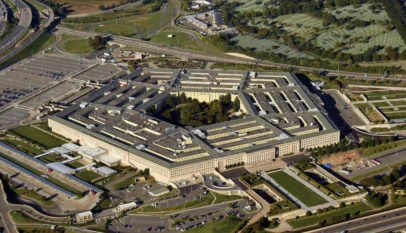
Pentagon Reportedly Raises Concerns Over Israeli Intelligence Activities in US
Washington, June 2026: The US Department of Defense has reportedly intensified its scrutin…
Pentagon Reportedly Raises Concerns Over Israeli Intelligence Activities in US
Washington, June 2026: The US Department of Defense has reportedly intensified its scrutiny of …