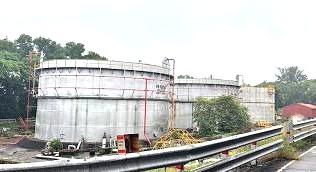
As Oil Crisis Looms, Indian Major MRPL Shuts Refining, Adani Hikes Tariff.

Mangalore/Bhuj; March 2026: India’s Mangalore Refinery and Petrochemicals has shut a crude unit and some secondary units at its 300,000-barrel-per-day refinery due to oil shortage, as per official sources today. Asian refiners are struggling to secure prompt replacement crude cargoes as Iranian threats to shipping through the Strait of Hormuz have disrupted crude oil flows.
MRPL has decided to shut from Wednesday evening the 100,000-barrel-per-day crude unit and secondary units, including a hydrocracker, at its complex in the southern state of Karnataka, two sources said. The refiner, which have stopped buying Russian oil late last year, is mostly dependent on the purchase of oil from the Middle East.
Meanwhile, India’s Adani Total Gas (ATGL) has sharply raised prices for supplies to industrial clients citing lower availability of gas due to conflict in the Middle East, according to official sources. The company is a joint venture of Adani Group and French oil major TotalEnergies.
As a result of the attacks on Iran and Tehran’s retaliatory strikes, transit through the Strait of Hormuz between Iran and Oman, which carries around one-fifth of oil consumed globally as well as large quantities of liquefied natural gas, has ground to a near-halt after some vessels in the area were hit.
“Due to recent geo‑political developments impacting LNG supply routes, ATGL has received upstream gas curtailment, leading to operational constraints”, the company said. It has raised prices from 03rd March on gas consumed over and above the 40% daily contract quantity to Rs. 119 ($1.30)/ standard cubic metre, the notice said. Earlier prices were around Rs. 40/ standard cubic metre, a source said.
Iraq, the second-largest crude producer in the Organization of Petroleum Exporting Countries (OPEC), has cut output by nearly 1.5 million barrels a day for lack of storage and an export route.
Meanwhile, Qatar declared force majeure on gas exports on Wednesday amid the U.S.-Israeli war on Iran, with sources saying it may take at least a month to return to normal production volumes. The move means global gas markets will experience shortages for weeks even in the unlikely scenario the conflict ends today, as Qatar supplies 20% of global liquefied natural gas. State energy giant Qatar Energy (QE), which stopped producing gas this week, will fully shut down gas liquefaction on Wednesday, two sources familiar with the matter said.
QE won’t restart the facility for at least two weeks, according to initial estimates of the situation in the region, the sources said. Once the restart decision is taken, it will take another two weeks to turn gas into a super-chilled fuel and reach full capacity, the sources added. The company did not respond to a request for comment.
Qatar accounts for about 20% of global LNG exports, all of which transit the Strait of Hormuz, where shipping has ground to a near-halt amid the U.S.-Israeli war on Iran and Tehran’s retaliation. Qatar supplies Europe and predominantly Asian markets, with over 80% of its customers in China, Japan, India, South Korea, Pakistan and other countries in the region.
Force majeure is a clause that frees parties from liability if any failure to meet supply obligations is due to events beyond their control.
QE has started contacting some of its clients in Asia and Europe, but has not told them how long the shutdown might last, sources told Reporters. The production halt has intensified competition between the Atlantic and Pacific basins for LNG cargoes, sending European and Asian gas prices and LNG freight rates to multi-year highs. “Nothing can replace Qatari LNG. If the shutdown is prolonged, it portends a larger gas market shock than in 2022 when Russian turned off pipeline gas to Europe. Gas prices could retest their record highs set in 2022”, said Saul Kavonic, head of energy research at MST Marquee.
The U.S., the world’s largest LNG producer, has little spare capacity to quickly lift LNG output and offset lost supply, according to Reuters calculations and industry analysts, as plants are already running near full capacity, and most cargoes are tied up in long‑term contracts.
Shipping curtailment around the Strait of Hormuz has meant export cargoes cannot leave Qatar, and therefore the liquefaction process, which turns gas into a liquid state by cooling it down to approximately 1620 C, cannot continue.
While QE has significant storage capacity at the Ras Laffan liquefaction plant, roughly 1,880,000 cubic metres, that buffer is limited in the context of continuous production at this scale. At full rate, it would take 04 days to fill up the tanks, said Mehdy Touil, lead LNG specialist and shareholder at Calypso Commodities, a tech company developing AI solutions for LNG.
The shutdown process is carried out gradually by first reducing production to minimum levels, lowering, stopping feed‑gas flows, and finally easing pressure back to upstream facilities to protect equipment, he said. To restart, the cooldown is the most critical step. It is intentionally slow to avoid thermal shock. Trains cannot all restart simultaneously; they must be sequenced, Touil added.
Team Maverick.







Taiwan Reaffirms South China Sea Claims After Philippines Submits Scarborough Shoal Chart to UN
Taipei, Aug 2026 : Taiwan on Sunday reaffirmed its sovereignty claims over islands in the …

Taiwan Reaffirms South China Sea Claims After Philippines Submits Scarborough Shoal Chart to UN
Taipei, Aug 2026 : Taiwan on Sunday reaffirmed its sovereignty claims over islands in …