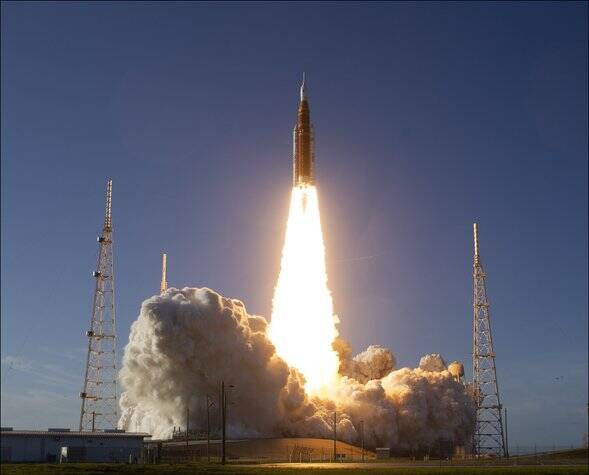
Artemis II Marks Historic Return to Crewed Lunar Missions After Five Decades

Washington, April 2026: The United States has successfully launched its first crewed mission around the Moon in more than 50 years, marking a major milestone in modern space exploration and signalling a renewed push in the global space race. The Artemis II mission, led by NASA, has drawn praise from political leaders and space officials alike, who view it as a defining moment for the future of human spaceflight.
US President Donald Trump congratulated NASA and the astronauts during a national address, calling the mission “amazing” and the crew “four unbelievable astronauts.” He highlighted the significance of the launch, describing it as a powerful symbol of American leadership in space.
The Space Launch System rocket lifted off from the Kennedy Space Center at 6:35 p.m. Eastern Time, carrying astronauts Reid Wiseman, Victor Glover, Christina Koch, and Canadian astronaut Jeremy Hansen aboard the Orion spacecraft. The crew has embarked on a 10-day mission that will take them around the Moon and safely back to Earth.
NASA Administrator Jared Isaacman described the launch as a turning point, emphasizing that Artemis II represents more than just a single mission. According to him, it is the beginning of a broader effort to expand human presence beyond Earth and lay the groundwork for sustained exploration of the Moon and beyond.
The primary objective of Artemis II is to test critical systems with a human crew on board. This includes evaluating life-support capabilities, spacecraft performance, and overall mission operations. The data gathered will play a crucial role in preparing for future missions that aim to land astronauts on the lunar surface and establish a long-term human presence there.
Shortly after liftoff, the Orion spacecraft successfully deployed its solar arrays and transitioned into flight operations. Engineers began monitoring its systems as it entered an elliptical orbit around Earth. NASA confirmed that the spacecraft completed key orbital maneuvers, including perigee and apogee burns, to refine its trajectory.
There were minor technical issues reported during the early phase of the mission. A brief communication dropout occurred after one of the orbital burns, but it was quickly resolved, with astronauts confirming they could still receive transmissions from ground control. Additionally, a blinking fault indicator was noticed during a routine system check, and engineers are currently assessing the situation.
As part of the mission, the crew will conduct a proximity operations test, manually guiding the Orion spacecraft close to the rocket’s upper stage. This exercise is designed to validate navigation and control systems, which will be critical for future missions involving docking and complex maneuvers in space.
US lawmakers also highlighted the broader strategic importance of the mission. Senate Commerce Committee Chairman Ted Cruz described Artemis II as a clear message that the United States intends to lead the next era of space exploration. He also pointed to increasing global competition, particularly from China, stressing the need for the US to maintain its leadership in space.
Congresswoman Zoe Lofgren praised the mission as an inspiring achievement that would capture the imagination of people worldwide. She noted that such milestones play a key role in encouraging future generations to pursue science and exploration.
NASA Associate Administrator Amit Kshatriya reiterated that Artemis II is fundamentally a test mission, with its success crucial for the safety and confidence of future crews. He emphasized that the current astronauts will push the spacecraft to its limits to ensure readiness for upcoming lunar landings.
If all systems perform as planned, Orion will execute a translunar injection burn to send the crew toward the Moon. The mission includes a flyby of the Moon’s far side before returning to Earth, where the spacecraft is expected to splash down in the Pacific Ocean.
With Artemis II now underway, the United States has taken a significant step toward re-establishing human presence in deep space, setting the stage for a new chapter in lunar exploration.
(The content of this article is sourced from a news agency and has not been edited by the Mavericknews30 team.)







FIFA Chief Infantino Hails Messi’s ‘Timeless Brilliance’ After Record-Equalling World Cup Feat
New Delhi, June 2026 : FIFA President Gianni Infantino has showered praise on Lionel Messi…

FIFA Chief Infantino Hails Messi’s ‘Timeless Brilliance’ After Record-Equalling World Cup Feat
New Delhi, June 2026 : FIFA President Gianni Infantino has showered praise on Lionel …