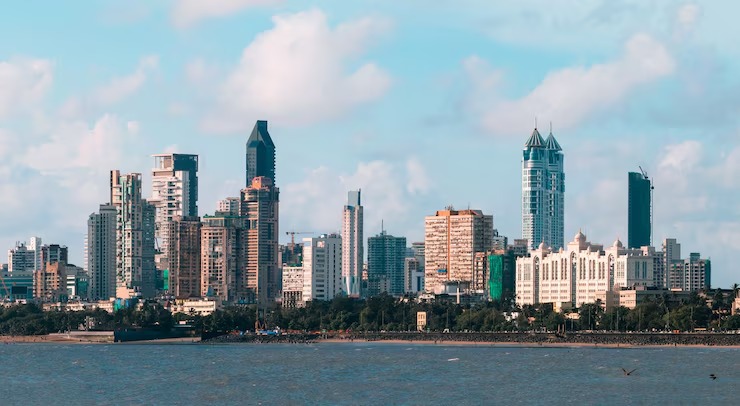
Maharashtra should have more satellite towns instead of extra FSI to get out of infrastructure ‘Chakravyuha’.

As mega urban centres like Mumbai and Pune are getting trapped in the ‘chakravyuha’ of flyovers and roads and reaching a saturation point, the government should stop giving additional floor space index (FSI) in these cities, senior Congress leader and urban planner Anant Gadgil has suggested.
He has also reiterated that since soil is increasingly getting replaced by concrete in urban areas, the space for water to percolate into the ground is shrinking and leading to rising instances of flooding after rains.
Talking to Press, Gadgil, who was earlier a member of the state legislative council, said instead of giving additional FSIs, the government should focus on creating satellite townships like Navi Mumbai in the Mumbai-Pune-Nashik triangle to reduce the burden on the existing infrastructure. FSI represents the maximum allowable floor area a developer can construct on a specific piece of land. Both Mumbai and Pune have seen their infrastructure crumbling in heavy rains recently, Gadgil said, and suggested that the government should build good schools, colleges, hospitals in these satellite townships.
The government can give land at a reasonable or lower rates to prominent companies to set up their offices with a restriction that at least 75% of the employees must live in these satellite townships so that the issue of traffic load will not crop up, he said. “This kind of policy will benefit companies, builders, citizens and the government. The more the FSI, the more the number of flats, leading to more cars. Subsequently, cities end up with a greater number of flyovers to overcome traffic jams. Crores of rupees have already been spent on these flyovers. Though the structural life of all these flyovers is more than 75 years, its functionality for all practical purposes is hardly 15 to 20 years” he said.
He has cited an example, saying when the Eastern Freeway connecting Chembur to D’Mello Road in south Mumbai was built over a decade ago, there was hardly any car on it. “Today, at peak hours, there is bumper-to-bumper traffic on it. In other words, we are getting trapped in the ‘chakravyuha’ of roads and flyovers” Gadgil said. Mumbai came to a standstill, not in the peak of the monsoon but only in the third week of May due to slashing unseasonal rains, he said.
“The moment the rain stops, Mumbaikars start blaming BMC, their favourite target. No one knows why flooding takes place when the authorities declare before monsoon that they have cleaned the drainage system well in advance“, he said.
In Mumbai, while constructing a new building, every architect / developer has to show sufficient parking spaces in the plan for approval, Gadgil said. Prior to 1991, only one car space per four to five 3-BHK flats was enough. Post-1991, when India began opening up its economy, the ratio went up to approximately 1 to 2 car spaces per 3-BHK flat. Today it is approximately 1 to 2 car spaces per 2-BHK and 2 to 3 spaces per 3-BHK flat. It is noteworthy, that three to four decades ago, Mumbai’s well planned areas like Khar-Bandra west, Sion-Chembur, Parsee Colony Dadar, Sewree – Wadala had at the most 3 to 4-storey buildings with garden/soil/plantation all around. Today, with 30 to 40-storey buildings built on these very plots, garden-plantation has vanished, replaced by concrete for parking, covering the entire ground floor in every new building.
But what people did not foresee is that soil is replaced by concrete, hence it is an imprudent act to expect water penetrating inside the soil. Mumbaikars have lost 10 lakh square feet and Punekars 2 lakh square feet of soil to concrete for parking. The previous environment minister had announced that 30% of the ground floor parking area in new buildings will remain non-concrete. But no such rule has been formulated by the government so far.
Mumbai being a linear city, with traffic only in south-north direction, he had suggested that east west of the metropolis be linked at regular intervals through elevated railway like metro or monorail. Gadgil said he had suggested that only 4 to 5-storey buildings on Mumbai’s sea front be allowed while on the other hand, skyscrapers can be built inside the city with sufficient open space between two buildings so that the sea breeze can freely flow in controlling the pollution. “But exactly the reverse of that has happened. Today, Mumbaikars have seen buildings rising from 5 storeys to 50 storeys and on the other hand they even saw some of the buildings collapsing”, he added.
Team Maverick




New Financial Year to Bring Tax, Labour and Travel Reforms from April 1
Mumbai, March 2026 : A host of major financial and regulatory changes will come into effec…

New Financial Year to Bring Tax, Labour and Travel Reforms from April 1
Mumbai, March 2026 : A host of major financial and regulatory changes will come …