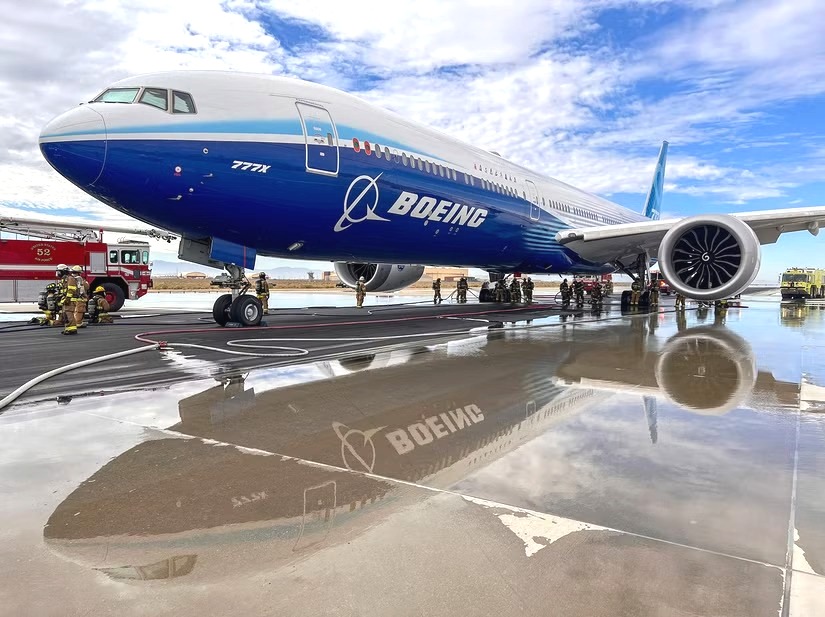
Boeing Successfully Conducts Critical Rejected Takeoff Test For Its New Boeing 777-9.

Edwards Air Force Base; April 2026: Boeing has successfully conducted a critical rejected takeoff (RTO) test for its new Boeing 777-9, demonstrating the aircraft’s braking performance under extreme conditions. The test took place in early 2026 at a dedicated high-speed runway facility and simulated a maximum-weight, high-speed abort scenario. During the procedure, the aircraft’s brakes reached temperatures of approximately 2,500°F (around 1,370°C). The test is a key certification requirement, ensuring the aircraft can safely stop even at decision speed (V1), the point at which a takeoff must either continue or be safely rejected.
The Boeing 777-9 is the largest variant of Boeing’s 777X family and is designed to carry up to 426 passengers in a typical two-class configuration. Rejected takeoff tests are among the most demanding evaluations, as they simulate a worst-case scenario with full fuel loads and a maximum takeoff weight of 775,000 lbs (351,550 kg). This milestone demonstrates compliance with strict certification standards set by regulators like the Federal Aviation Administration (FAA). It also provides a clearer picture of how the aircraft will perform in rare but critical emergencies.
During the test, the aircraft accelerates to just below rotation speed before pilots initiate maximum braking and deploy spoilers, but do not employ the use of thrust reversers. For the 777-9, this meant dissipating kinetic energy equivalent to several hundred megajoules entirely through its braking system. The aircraft uses advanced carbon brake discs, which are significantly lighter and more heat-resistant than traditional steel brakes. These components are specifically engineered to endure extreme temperatures without structural failure or loss of stopping performance.
The test also deliberately pushes tires to their limits, often resulting in deflation due to fuse plugs designed to release pressure safely under extreme heat. Engineers closely monitor brake energy absorption, stopping distance, and system redundancy throughout the process. Certification rules require the aircraft to come to a complete stop within runway limits without external assistance. Successfully achieving this confirms the aircraft can handle one of the most energy-intensive emergency procedures in aviation.
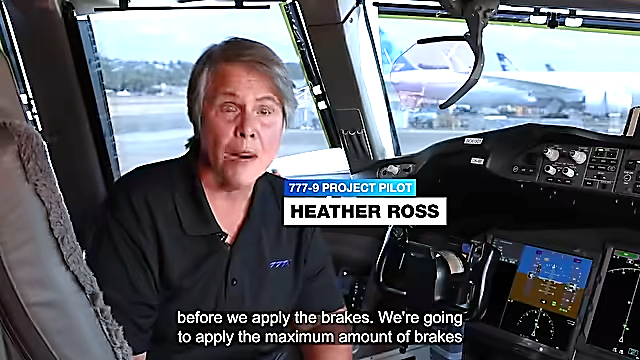
Captain Heather Ross, the 777-9 project pilot, said: “We’re optimising the conditions to make sure we put the most energy we possibly can into those brakes”.
Rejected takeoffs typically occur below or at V1 speed and are most often triggered by engine failures, fire warnings, or critical system alerts. Above V1, pilots are committed to taking off due to insufficient runway remaining to stop safely. This makes the RTO test particularly important, as it validates performance right at this decision threshold. The 777-9’s braking system is designed to handle these edge cases repeatedly over its operational life.
The 777X family introduces several new technologies, including folding wingtips and more efficient high-bypass engines developed by GE Aerospace. These improvements aim to reduce fuel burn by around 10% compared to previous-generation aircraft. However, the larger size and higher weight also mean greater braking energy during aborted takeoffs. This makes successful RTO testing even more critical for certification and operational approval.
In addition to braking performance, engineers evaluate how quickly the brakes cool after the stop and whether any fire risk exists. Aircraft are required to demonstrate that no hazardous conditions persist after the test, even with systems powered down. These factors are essential for ensuring passenger evacuation safety if required. The test, therefore, assesses both immediate stopping capability and post-stop safety conditions.
Why This Certification Significant For The 777X Program –
Brake temperatures of 2,500°F are high enough to cause visible glowing of the brake assemblies and can ignite residual rubber from tires. For this reason, airport fire crews are typically on standby during such tests, although intervention is rarely needed. After the test, the aircraft undergoes a detailed inspection, and many components, including tires and brake units, are replaced. This ensures accurate analysis of wear patterns and system durability.
Previous aircraft like the 777-300ER and 787 Dreamliner have undergone similar high-energy RTO tests as part of their certification campaigns. Advances in materials science, particularly carbon composites, have significantly improved brake performance over time. Looking ahead, further innovations may include enhanced cooling systems and predictive maintenance using real-time data monitoring. These developments aim to further increase safety margins and reduce operational costs.
Overall, the successful test reinforces confidence in the 777-9’s ability to meet stringent safety requirements under extreme conditions. It also highlights the scale of engineering required to safely manage the immense forces involved in modern aviation. As certification progresses, such milestones bring the aircraft closer to entry into service. The results will play a key role in final regulatory approval and airline acceptance.
Commercial aircrafts are using far superior carbon ceramic discs since a long time now, as they don’t warp under extreme conditions. Now the question remains as to how early it is approved and gets a certification.
Team Mavericks.








North Bastar Kanker: Savita Sahu Becomes a ‘Lakhpati Didi’ Through the Bihan Scheme
Entrepreneur Achieves Financial Independence Through Rice Milling and Mushroom Cultivation…
North Bastar Kanker: Savita Sahu Becomes a ‘Lakhpati Didi’ Through the Bihan Scheme
Entrepreneur Achieves Financial Independence Through Rice Milling and Mushroom Cultivation North Bastar Kanker, July …