Ukrainian Technological Adaptations, Drone Innovations Continue To Grant Ukraine Tactical And Operational Leverage.

Kyiv; April 2026: Colonel Pavlo Palisa, Deputy Head of the Office of the President of Ukraine, responsible for defense and security has informed the press reporters that Russian forces suffered 316 casualties per square kilometer of advance in Donetsk Oblast in the first quarter of 2026 (roughly from 01st January to March 31st, 2026). Palisa has further asserted that Russian forces suffered roughly 120 casualties per square kilometer of advance across the region in 2025 and roughly 160 casualties per square kilometer of advance in the Pokrovsk direction alone in 2025, while reiterating that the Ukrainian forces have broadly regained numerical drone superiority over Russian forces on the frontline and now have 1.3 strike drones to every one Russian strike drone.
Pavlo noted that Russian forces do maintain the quantitative advantage in some areas where they are concentrating offensive operations, however. Palisa added that 32 percent of Ukrainian drones are electronic warfare (EW)-resistant fiber-optic drones, compared to 24 percent of Russian drones. Palisa also noted that Ukraine’s mid-range strike campaign against Russian drone launch sites and infrastructure, including strikes against occupied Donetsk City Airport and drone repeaters in occupied Crimea, has prevented Russian forces from launching “up to 1,000 drones” simultaneously and has forced Russian forces to stagger drone launches throughout the day. Ukraine’s defensive successes, drone adaptations, and mid-range strike campaign are evidently creating compounding effects which are degrading both Russian frontline forces and Russia’s long-range strike campaign.
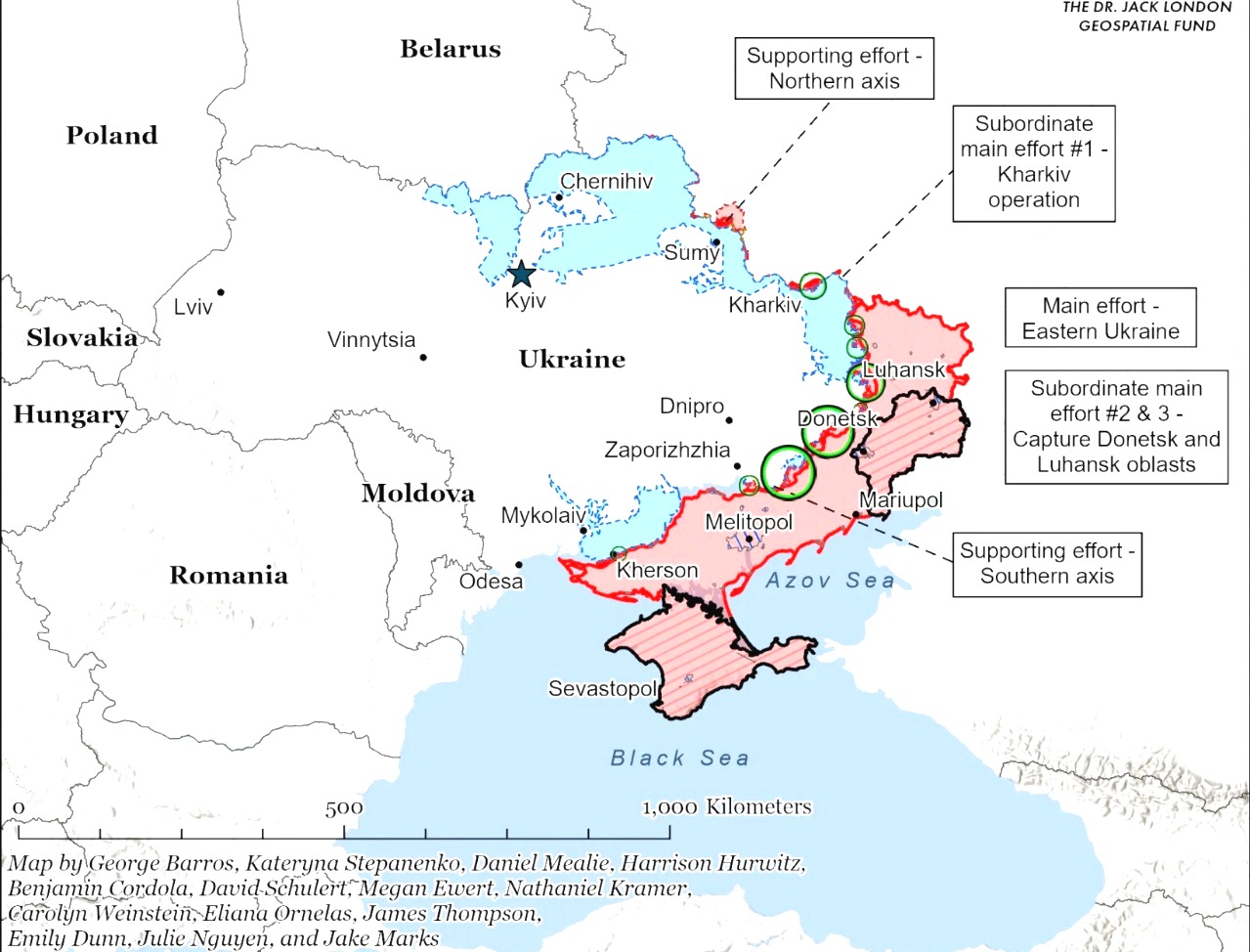
Recent Ukrainian advances in southern Ukraine since late January 2026 have also created cascading operational effects on the frontline that have forced Russian forces to choose between defending against Ukrainian counterattacks or allocating manpower and resources to other sectors of the frontline. Ukraine’s recent successes are accomplishing tactical, operational, and strategic battlespace effects that undermine the Russian narrative that the Ukrainian frontlines are on the verge of collapse.
Further, while addressing media outlets (a routine phenomena since Russia has attacked Ukraine), Pavlo has further said that Russian forces have ambitious battlefield plans for 2026 and beyond, but that Russian forces have not set preconditions for any operational-level frontlines changes and lack the strength to carry out such plans. Palisa reported that Russian forces will mainly focus on seizing the remainder of Donbas and intensify efforts in the Dnipropetrovsk-Zaporizhia Oblast border area in 2026.
The Ukrainian Deputy Head stated that Russia’s military objectives include creating a buffer zone along the northern Ukrainian-Russian border in Kharkiv, Sumy, and Chernihiv oblasts; setting conditions to seize the entirety of Zaporizhia and Kherson oblasts; and seizing Mykolaiv and Odesa oblasts in the long term. Palisa also noted that Russia is planning for the first time to create a buffer zone in Ukraine’s southwestern Vinnytsia Oblast from the territory of Transnistria — the pro-Russian Moldovan parastate.
Palisa emphasised that Russian forces currently lack the offensive capabilities to accomplish any of these goals, however. As it was earlier assessed in June 2025 that Russian forces aimed to seize an operationally significant area of Donetsk Oblast by September 1, 2025; the rest of Kherson Oblast and a buffer zone in northern and southern Ukraine by the end of 2025; and all land east of the Dnipro River in northern and eastern Ukraine and most of Mykolaiv and Odesa oblasts by the end of 2026. Russian forces have failed to complete any of these reported operational objectives as of April 2026 and have thus far been unable to restore operational maneuver to the battlefield, which would be a prerequisite for making the operationally-significant breakthroughs required to meet these objectives.
On the contrary Russia regularly claims that Russia “needs” to create a buffer zone in northern Ukraine, signaling broader territorial demands and setting conditions to later demand that Ukraine cede some or all of this territory, including in oblasts where Russian forces have minimal to no military presence. Kremlin officials routinely invoke the Kremlin’s concept of “Novorossiya” — an amorphous region in southern and eastern Ukraine that extends beyond Crimea and the four oblasts that Russia has illegally annexed, to justify the ever expanding Russian territorial ambitions in eastern and southern Ukraine.
Russian officials have also previously characterized Kharkiv and Odesa as “Russian” cities. Russia’s purported desire to extend a buffer zone to Vinnytsia Oblast aligns with the broader rhetorical pattern of Russian officials making claims to Ukrainian territory beyond Donbas and undermines the Russian narrative that negotiations over an end to the war are solely hinged on Ukraine ceding Donetsk Oblast.
The Russian Foreign Intelligence Service (SVR) claimed on April 8 that unspecified EU leaders are having discussions about developing EU nuclear weapons production capabilities. The SVR specifically claimed that Russia is bringing this accusation to the attention of the United States for help to prevent the EU from developing nuclear weapons. The SVR appears to be making these baseless accusations as part of the Kremlin’s continued effort to fracture US-EU relations to Russia’s benefit by portraying the EU as acting counter to US nuclear interests. The Kremlin frequently uses the SVR to bolster baseless claims about Ukraine’s alleged nuclear aspirations and to make nuclear threats against Ukraine, the UK, and France. The SVR similarly accused the UK and France in February 2026 without evidence of attempting to transfer a “dirty bomb” or nuclear weapon to Ukraine, likely to disrupt the ongoing discussions about Western security guarantees for Ukraine.
Suvro Sanyal – Team Maverick.





As Israel Drew First Blood; Hezbollah Retaliated Vowing To End The Israel-US Aggressions.
Beirut; April 2026: Lebanon’s Hezbollah resistance movement has unleashed a rocket b…

As Israel Drew First Blood; Hezbollah Retaliated Vowing To End The Israel-US Aggressions.
Beirut; April 2026: Lebanon’s Hezbollah resistance movement has unleashed a rocket barrage towards an …