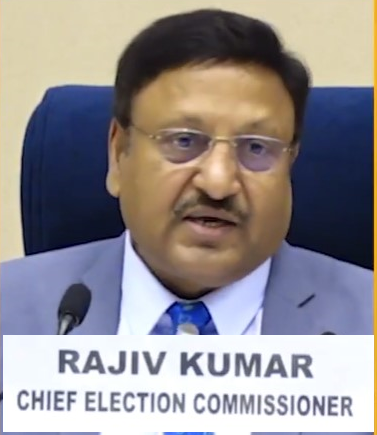
Delhi Assembly Elections on February 5, Counting on February 8: CEC Rajiv Kumar

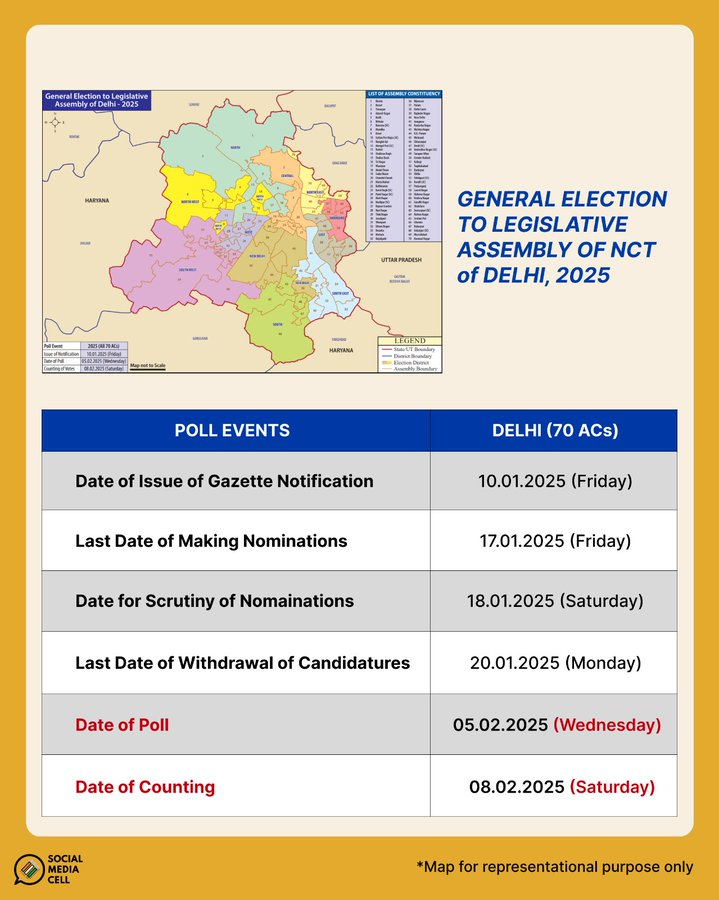
Chief Election Commissioner (CEC) Rajiv Kumar announced on Tuesday that the Delhi Assembly elections will be held on February 5, with the counting of votes scheduled for February 8. The last date for filing nominations is January 17, followed by the scrutiny of nominations on January 18. Candidates will have until January 20 to withdraw their nominations.
Addressing a press conference, Kumar stated, “This is a phased election. We deliberately scheduled voting for a Wednesday to encourage greater voter turnout, similar to our approach in Maharashtra.” Alongside the Delhi elections, by-elections for two assembly constituencies—Milkipur in Uttar Pradesh and Erode in Tamil Nadu—will also be held according to the same timeline.
CEC’s Warning Against Anti-Women Remarks
During the announcement, CEC Kumar emphasized the need for decency and restraint during election campaigns. He urged candidates and political leaders to avoid making derogatory comments about women or children. Referring indirectly to a recent controversy involving BJP candidate Bidhuri from Kalkaji, Kumar stated, “The Election Commission will ensure that no anti-women remarks are made during the implementation of the Model Code of Conduct.”
Kumar condemned such remarks, saying, “On the one hand, we are encouraging more women to participate in the electoral process, and on the other hand, such comments are disgraceful.” He warned candidates against bringing children into campaign rhetoric and affirmed the Commission’s strict stance on enforcing election norms.
VVPAT Integrity and Robust Electoral Machinery
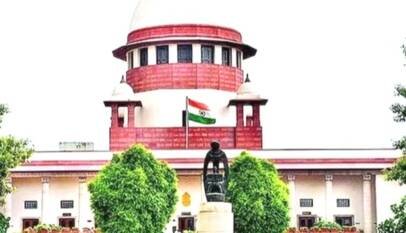
The Chief Election Commissioner also defended the integrity of India’s electoral process, particularly regarding the use of electronic voting machines (EVMs) and Voter Verifiable Paper Audit Trail (VVPAT) slips. Kumar revealed that since the Supreme Court mandated in 2019 to count VVPAT slips from five polling booths in every assembly constituency, over 67,000 VVPATs have been verified.
He explained, “More than 4.5 crore VVPAT slips have been checked since 2019, and no discrepancies have been found. This demonstrates the reliability of the system.” Kumar assured the public that any minor errors, such as technical glitches or isolated cases of mock poll data inconsistencies, are thoroughly investigated.
“Even in rare cases where machine data discrepancies could affect the margin of victory, the slips are recounted with utmost precision,” he added. He emphasized that the Election Commission follows strict guidelines for all aspects of the electoral process, from voter registration to machine handling.
Transparency and Accountability
Addressing allegations of vote tampering, Kumar reiterated the transparency and robustness of India’s electoral framework. “Our process is not only thorough but also transparent. Form 20, which contains accurate details of winners and losers, is provided to all candidates,” he said.
Despite criticism from opposition parties demanding greater accountability, including calls to count all VVPAT slips, Kumar affirmed that the current process ensures fairness and transparency in elections. The Election Commission remains committed to maintaining the trust and confidence of voters across the country.



Hockey Junior Men’s Nationals: Rajasthan, Telangana, Puducherry Shine in Coimbatore
Coimbatore, July 2026 : Hockey Rajasthan, Telangana Hockey and Le Puducherry Hockey regist…

Hockey Junior Men’s Nationals: Rajasthan, Telangana, Puducherry Shine in Coimbatore
Coimbatore, July 2026 : Hockey Rajasthan, Telangana Hockey and Le Puducherry Hockey registered impressive …