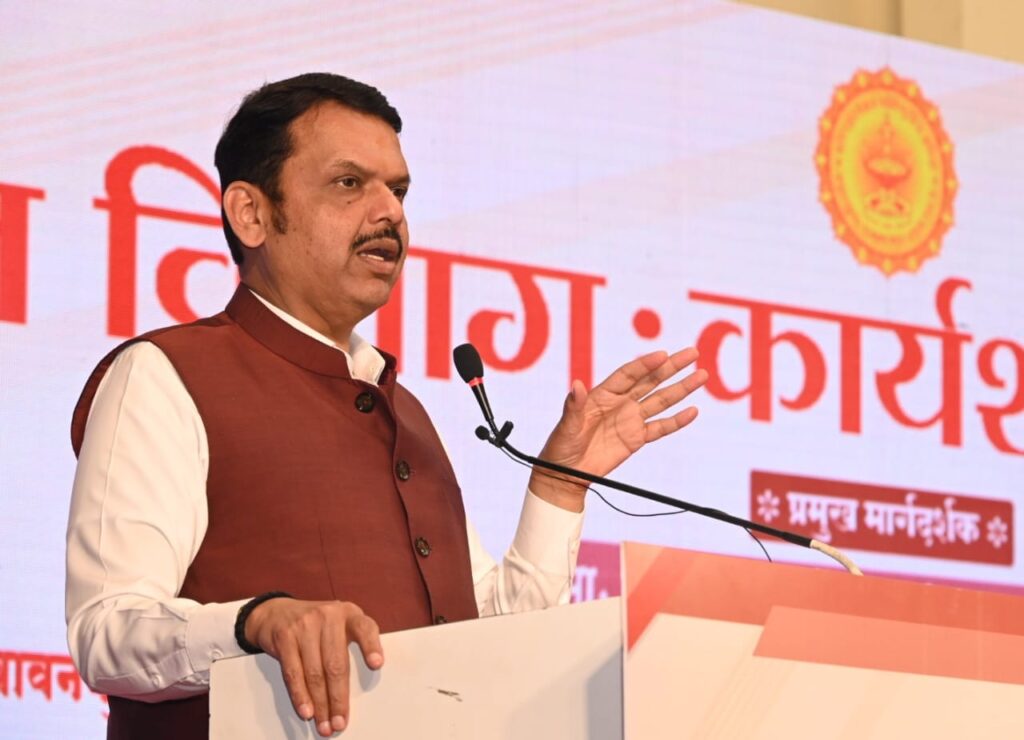
Implementation of Revised Revenue Procedures from August 15 – Chief Minister Devendra Fadnavis

Chief Minister’s Guidance at the Revenue Regional Officers’ Workshop
Pune : To study various aspects, structures, procedures, and revenue laws in the Revenue Department and suggest reforms, various study groups will be established under the chairmanship of Divisional Commissioners. After discussing their recommendations, efforts will be made to implement them practically from the upcoming August 15, said Chief Minister Devendra Fadnavis here today. He also instructed officers to work with a positive attitude, keeping in mind that “we are public servants.”
He was speaking at the two-day Revenue Regional Officers’ Workshop organized at Hotel Orchid here, in line with the Revenue Department’s Hundred-Day Action Program. On this occasion, Revenue Minister of State Yogesh Kadam, Additional Chief Secretary of Revenue Department Rajesh Kumar, Pune Divisional Commissioner Dr. Chandrakant Pulkundwar, Chhatrapati Sambhajinagar Divisional Commissioner Dilip Gawde, Nagpur Divisional Commissioner Vijayalakshmi Bidari, Konkan Divisional Commissioner Vijay Suryavanshi, Amravati Divisional Commissioner Shweta Singhal, State Settlement Commissioner and Director of Land Records Dr. Suhas Divase, Inspector General of Registration and Controller of Stamps Ravindra Binwade, and others were present.
The Chief Minister said that the Revenue Department is the face of the government. As it is the most connected with the citizens, the efficiency, transparency, and accountability of this department are considered as criteria to evaluate the government.
The Revenue Department has also been considered very important in ancient state systems. Even in Chanakya’s Arthashastra, written almost 1,750 years ago, the structure and importance of this department are mentioned. Chhatrapati Shivaji Maharaj also created a good structure for revenue. Through his royal edicts (Agnapatra), excellent orders were created for revenue collection, its management, and land record preservation. Later, the British rulers established a vast land revenue system, from which our current revenue system evolved. Of course, many elements of traditional systems are also seen in it.
Officers working in government should present their ground-level experiences collectively, as this leads to better performance. Because while doing so, we know the problems and their solutions. Various rules, smart documents, dashboards, and websites presented by the department during this workshop reflect this. The Chief Minister congratulated the officers for preparing them. In this manner, the department has used human and artificial intelligence to create a standardized ‘Gita’ (guide) for both ‘Ease of Doing Business’ and ‘Ease of Living.’
All departments have taken the hundred-day program seriously. To decide the future direction of work for the next five years, we adopted this program. Seeing how effectively and sincerely the Revenue Department and other departments have handled it, the Chief Minister expressed confidence that they would achieve their goals.
System should be such that citizens need not even apply for information
The department has updated its website. It should be citizen-friendly and have proactive disclosures. In the next four to six months, all frequently requested information should be made available on the website itself, so citizens need not request it under the Right to Information. He also stressed the need for website security.
Work is also being done for office cleanliness. Old records are being weeded out, and unnecessary ones are being destroyed, while important ones are preserved well. Old furniture, vehicles, and discarded items should be properly disposed of so offices appear neat. Those pending this task should complete it, he instructed.
Facilities like drinking water, toilets (especially for women), waiting rooms, and signboards are being developed. Some offices have already done good work. A good environment and facilities in the office give citizens a sense of having come to the right place. Grievance redressal systems should be in place. Visiting hours must be fixed and adhered to. Proper work should be done on complaints received through the ‘Aaple Sarkar’ portal and on Lokshahi Day, he said.
Field visits must be undertaken to understand the solutions to problems
Without directly visiting people on the ground and facing problems firsthand, one cannot truly understand or realize solutions, nor feel the sense of duty. Therefore, senior officers should conduct field visits at least twice a week. Such visits improve accountability and reduce any opacity in the functioning.
To promote investment, many district collector offices have established dedicated cells. These provide land-related information to investors. A good example of this is the acquisition of 90% government land near agricultural substations within nine months. Under the central government’s KUSUM scheme, solar projects are being set up on this land to supply 16,000 megawatts of solar power to agricultural pumps. Only Maharashtra has achieved this so far, and has submitted a ₹4,000 crore demand to the central government. In the next five years, power rates will reduce further. Acquiring land at more than 2,000 locations in just nine months has been possible due to new technology.
Appoint coordination officers to liaise with industries
Like relationship managers in large industries, a coordination officer should be appointed in the district collector’s office. This officer should keep track of MoUs signed between industries and the government and help resolve issues. This will help in actual implementation of MoUs. A dedicated setup must be established to promote investment, he added.
This 100-day program is being implemented in 12,436 offices across the state. Among these: 2,427 in Konkan, 2,379 in Chhatrapati Sambhajinagar, 1,984 in Pune, 1,945 in Nagpur, 1,925 in Nashik, and 1,776 in Amravati. These offices are undergoing transformation. Those lagging behind will be given a chance to improve. After the program ends on May 1, all offices will be assessed through the Quality Council of India. The best-performing Divisional Commissioners, Collectors, and junior-level officers will be honored.
By December 2025, all offices must be solar-powered, as per central government instructions. Funds from the District Planning Committee and reserved department funds should be used. In each district, at least two tourist places should be selected based on visitor numbers and importance, and facilities developed there to promote tourism. The best performers in this area will also be honored. Such programs can be scaled up to boost tourism.
Land acquisition is crucial for current development and must be transparent and fast. Use technology, satellites, drones, and satellite imagery for accurate valuation. The PM Gati Shakti portal should be used effectively. Divisional Commissioners and Collectors must review land acquisition cases monthly. This will prevent errors and curb malpractices.
Study groups to be set up under Divisional Commissioners
To study and make recommendations regarding various revenue-related issues, six study groups will be formed under the chairmanship of six Divisional Commissioners. The Chhatrapati Sambhajinagar group will suggest reforms in committees headed by Collectors. Amravati will develop Key Performance Indicators (KPIs) to evaluate officers. Nagpur will collect, assess, and standardize best practices for statewide implementation.
For suggestions on Ease of Living, Pune’s group will identify citizens’ difficulties and how to resolve them, as well as suggest changes to revenue laws, rules, and procedures. Konkan’s group will work on improving the effectiveness of District Planning Committees. Nashik’s group will study collector office structures, institutional development, capacity building, recruitment process simplification, and decentralization of powers. They will also identify how to simplify two citizen-centric services using modern technology.
Revised revenue procedures to be implemented from August 15
The goal is to reduce required documents from citizens, ensure uniform procedures everywhere, digitize all processes, and automate every step from application to final response. All study groups must submit their reports by June 30, so that discussions can be held and necessary recommendations implemented from August 15.
Even if mistakes occur with good intent, we will support you. But will not shield those who deliberately do wrong. The Revenue Department should launch a channel on its platforms to educate common people in simple language about land matters. Short videos and reels should be uploaded about 8A, 7/12, mutations, etc. Adopt more technology and best practices. Organize a hackathon to find good solutions. Work with a positive attitude as public servants.
The Minister of State for Revenue said that the Revenue Department is the backbone of the Maharashtra government. It bears the most stress and responsibility. Officers implement many initiatives. When the administration and government work together, departmental development is possible. To reduce workload, the minister emphasized use of technology from senior to junior level.





Australia Calls India a Top-Tier Security Partner, Unveils Landmark Defence and Energy Agreements
Canberra, July 2026 : Australia on Thursday described India as one of its most important s…

Australia Calls India a Top-Tier Security Partner, Unveils Landmark Defence and Energy Agreements
Canberra, July 2026 : Australia on Thursday described India as one of its most …