Super Weapons those races 2 Miles/Second would ravage targets to dust.

During the National Day Parade on 01st. October, 2019, in Beijing, the People’s Liberation Army (PLA) missiles moved slowly past the crowd on a fleet of giant camouflaged lorries. Needle-sharp in profile, measuring 11 metres long and weighing 15 tons, each bore the letters and numerals: “DF-17”.
China then had just unveiled its arsenal of Dongfeng hypersonic missiles. The US was already aware that these weapons were in development, but since then China has raced ahead with upgrading them.
Thanks to their speed and manoeuvrability – travelling at more than five times the speed of sound – they are a formidable weapon, so much so that they could change the way wars are fought. Which is why the global contest over developing them is heating up. Moreover, as per industry analysts it is just one component of the wider picture of the emerging geopolitical contest.
The Beijing ceremony raised speculation about a possible growing threat posed by China’s advancements in hypersonic technology. Today it leads the field in hypersonic missiles, followed by Russia. The experts have cited – China and Russia have excelled in this domain because both the country’s have invested in it much before.
Other nations are also racing ahead, with Israel has a hypersonic missile, the Arrow 3, designed to be an interceptor. Iran has claimed to have hypersonic weapons, and said it launched a hypersonic missile at Israel during their brief but violent 12-day war in June (The weapon did indeed travel at extremely high speed but it was not thought to be manoeuvrable enough in flight to class as a true hypersonic).
The United States appears to be strengthening its deterrence, and has debuted its “Dark Eagle” hypersonic weapon. According to the US Department of Defense, the Dark Eagle “brings to mind the power and determination of our country and its Army as it represents the spirit and lethality of the Army and Navy’s hypersonic weapon endeavours”. But China and Russia are currently far ahead – and according to some experts, this is a potential concern.
Hypersonic means something that travels at speeds of Mach 5 or faster. (That’s five times the speed of sound or 3,858 mph.) This puts them in a different league to something that is just supersonic, meaning travelling at above the speed of sound (767 mph). And their speed is partially the reason that hypersonic missiles are considered such a threat.
The fastest to date is Russian – the Avangard – claimed to be able to reach speeds of Mach 27 (roughly 20,700mph) – although the figure of around Mach 12 (9,200mph) is more often cited, which equates to two-miles-a-second.
Why Hypersonic Missiles are so mercurial?
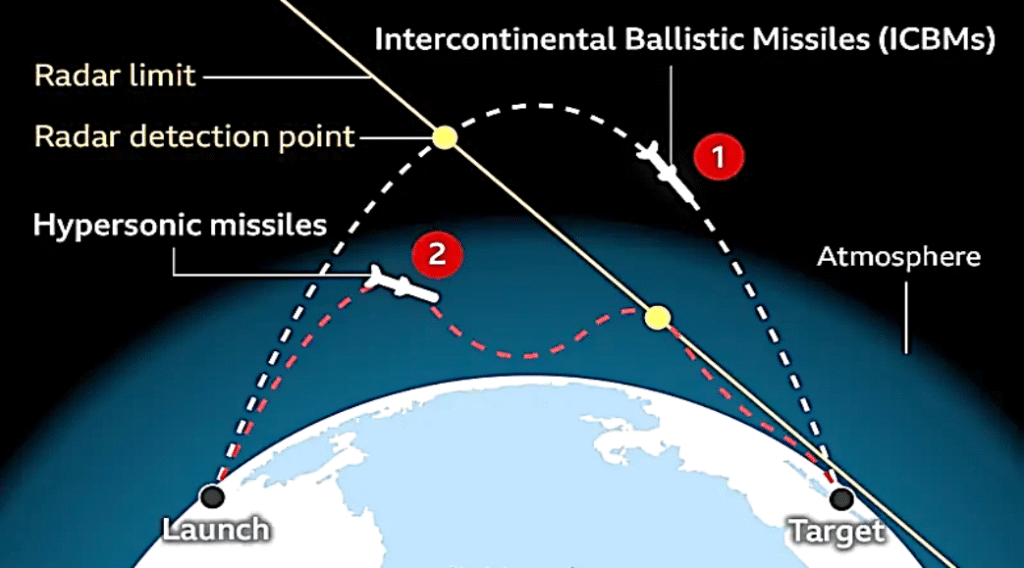
There are basically two kinds of hypersonic missile: boost-glide missiles rely on a rocket (like those DF-17 ones in China) to propel them towards and sometimes just above the Earth’s atmosphere, from where they then come hurtling down at these incredible speeds. Unlike the more common ballistic missiles, which travel in a fairly predictable arc – a parabolic curve – hypersonic glide vehicles can move in an erratic way, manoeuvred in final flight towards their target.
Then there are hypersonic cruise missiles, which hug terrain, trying to stay below radar to avoid detection. They are similarly launched and accelerated using a rocket booster, then once they reach hypersonic velocity, they then activate a system known as a “scramjet engine” that takes in air as it flies, propelling it to its target. These are “dual-use weapons”, meaning their warhead can be either nuclear or conventional high explosive. But there is more to these weapons than speed alone.
For a missile to be classed as truly “hypersonic” in military terms, it needs to be manoeuvrable in flight. In other words, the army that fired it needs it to be able to change course in sudden and unpredictable ways, even as it is hurtling towards its target at extreme speeds. This can make it extremely hard to intercept. Most terrestrial-based radars cannot be relied upon to detect hypersonic missiles until late in the weapon’s flight. By flying under the radar horizon, they can evade early detection and may only appear on sensors in their terminal flight phase, limiting interception opportunities.
The speed and manoeuvrability earn them a niche against high value targets and their kinetic energy on impact also makes them a useful means of engaging hardened and buried targets, which might have been difficult to destroy with most conventionally armed munitions previously. But though they travel at five times the speed of sound or more, there are measures to defend against them – some of which are “effective”.
The first is making tracking and detection more difficult. Ships can go to great lengths to protect their position. The grainy satellite picture available from commercial satellites only needs to be a few minutes out of date for it to be of no use for targeting. Getting satellite targeting solutions current and accurate enough to use for targeting is both difficult and expensive. However, artificial intelligence and other emerging technologies will likely change this over the period of time.
Team Maverick








Taiwan Reaffirms South China Sea Claims After Philippines Submits Scarborough Shoal Chart to UN
Taipei, Aug 2026 : Taiwan on Sunday reaffirmed its sovereignty claims over islands in the …
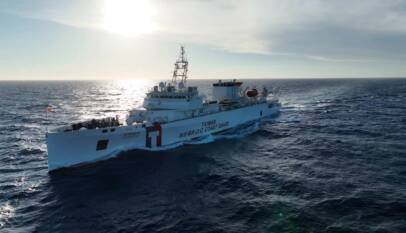
Taiwan Reaffirms South China Sea Claims After Philippines Submits Scarborough Shoal Chart to UN
Taipei, Aug 2026 : Taiwan on Sunday reaffirmed its sovereignty claims over islands in …