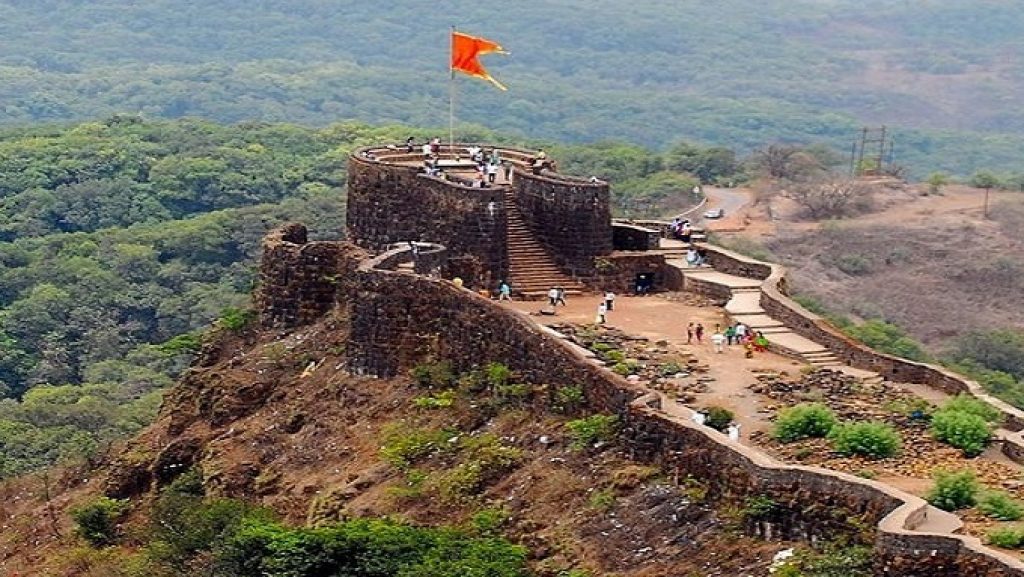
The Impregnable Fort in the Heart of the Sahyadris: Pratapgad

Sept 2025 : Nestled amidst the rugged ranges of the Sahyadris, hidden within dense forests, and overlooking winding mountain passes, Pratapgad stands proudly as a golden chapter in Maratha history. Its strategic importance lay not only in its elevated and rugged terrain but also in the control it commanded over the surrounding valleys, ghats, and passes. Recognized as one of Maharashtra’s famous hill forts, Pratapgad is situated in Javli Taluka of Satara district, about 13 km southwest of Mahabaleshwar, at an elevation of 1,092 meters above sea level. To its east lies a valley 340 meters deep, and to its west, a gorge 870 meters deep. After conquering the Javli Valley, Chhatrapati Shivaji Maharaj ordered Moropant Trimbak Pingale in 1656 to build this fort.
Pratapgad consists of two main sections – the citadel (Balekilla) at the summit and the lower fort spread across the southern and eastern slopes. The citadel housed significant structures like the royal palace, court (Sadar), the Kedareshwar temple, water reservoirs, and granaries. The lower section, with its massive fortifications and bastions, was designed to trap enemies in the surrounding ravines.
The fort is divided into three parts – the main fort, the machi (plateau), and the citadel. Both the main fort and citadel had water tanks, while strong ramparts and bastions offered defense. The citadel covers an area of 3,660 sq. meters, and the main fort 3,885 sq. meters, with southern bastions rising 10–15 meters high. Notable surviving bastions include Redka, Rajpahada, and Kedar. These were characteristically built on narrow mountain ridges, forming a “machi,” similar in style to those on Rajgad (Suvela, Sanjivani) and Torna (Zunzar) forts. In some places, the ramparts soar 40 feet high, making Pratapgad virtually impregnable. Built entirely in black stone, the fort allowed continuous surveillance of the Javli valley, enabling timely detection of enemy movements.
To enter the main fort, one had to pass through two gates adorned with images of mythical creatures called Sharabha. Beyond them lies the Tulja Bhavani temple, fronted by two tall lamp-pillars and the Nagarkhana (drum house). The original shrine of Goddess Bhavani had a stone sanctum, while in 1820, Chhatrapati Pratapsingh Maharaj of Satara added a wooden pavilion.
The fort’s approach is marked by narrow, zigzagging paths with concealed barriers, making a direct assault nearly impossible. The Maha Darwaza (main gate) is considered a masterpiece of defensive architecture, built in the Gomukhi style, designed to funnel enemies into a vulnerable spot where they could be attacked from both sides.
One of Pratapgad’s unique features is its well-planned water system. The fort has four main tanks – two in the citadel and two in the lower fort. Ingenious use of natural slopes ensured effective rainwater harvesting, providing ample water throughout the year. This reflects the Marathas’ advanced engineering and strategic planning skills.
Pratapgad’s historical fame is deeply tied to the 1659 encounter between Chhatrapati Shivaji Maharaj and Afzal Khan, which ended in Afzal Khan’s death. Later, Chhatrapati Rajaram Maharaj also halted here on his way to Jinji. In the post-independence period, a grand equestrian statue of Shivaji Maharaj was erected on the fort, inaugurated in November 1957 by then Prime Minister Pandit Jawaharlal Nehru.
Even today, thousands of people visit Pratapgad to connect with that historic moment. The fort hosts grand celebrations of Shiv Jayanti every year, including theatrical reenactments of the Afzal Khan episode, cultural programs, and activities celebrating Shivaji Maharaj’s life. These events make Pratapgad a symbol of Maharashtra’s pride and cultural unity.
Pratapgad remains a living witness to the bravery, strategy, and dream of Swarajya envisioned by the Marathas. Standing firm in the Sahyadris, it continues to serve as an unshakable link between the past and present.
Recognizing its significance, UNESCO has granted World Heritage status to 12 forts of Chhatrapati Shivaji Maharaj, with Pratapgad holding a special place among them. Thus, Pratapgad is not only a treasured legacy of Maharashtra but also a precious part of the world’s cultural heritage.






Portugal Part Ways with Roberto Martinez After World Cup Exit, Begin Search for New Head Coach
Lisbon, July 2026 : The Portuguese Football Federation (FPF) has officially confirmed the …

Portugal Part Ways with Roberto Martinez After World Cup Exit, Begin Search for New Head Coach
Lisbon, July 2026 : The Portuguese Football Federation (FPF) has officially confirmed the departure …