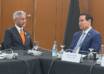
Global Turbulence, Shifting Alliances, and India’s Strategic Imperatives: EAM Jaishankar at Kautilya Economic Conference

New Delhi, Oct 2025 : External Affairs Minister S. Jaishankar on Sunday underscored a profound global shift in sentiment against globalization, noting that recent geopolitical conflicts and technological advancements are reshaping the nature of warfare, international relations, and economic competition. Speaking at the fourth Kautilya Economic Conference in the national capital, Jaishankar emphasized that the world is navigating “turbulent times,” with evolving dynamics that are affecting not only economic frameworks but also the way conflicts are conducted and understood.
“Today, the nature of weapons and the very nature of warfare has fundamentally changed,” Jaishankar said, pointing to the emergence of “contactless warfare” enabled by advanced technologies and sophisticated weaponry. Highlighting recent international conflicts such as Azerbaijan-Armenia, Ukraine-Russia, and Israel-Iran, he noted that modern conflicts increasingly rely on advanced, sometimes stalemated, weapon systems, which can prove decisive without direct engagement. These developments, he added, reflect deep shifts in global sentiment, with growing opposition to globalization emerging in many parts of the world.
Jaishankar drew attention to the increasing significance of natural resources in international competition. “Competition for rare earths and critical minerals has become a central factor in the rivalry between nations,” he said, emphasizing that the intensity of these developments is concentrating pressure on the global economy. “We are witnessing a paradoxical situation: on one hand, these factors encourage greater risk-taking; on the other, they prompt nations to de-risk every aspect of politics and economics,” he noted.
The Minister elaborated on the weakening and, in some cases, abandonment of international systems and rules. Economically, he observed, cost alone is no longer the defining consideration; ownership, security, reliability, and resilience are equally critical. Politically, alliances and agreements are being reconsidered, and even established powers are questioning the traditional balance of power. “Some states feel they no longer need the rest of the world as much as before,” Jaishankar said. “With even modest power, they are willing to dictate policies and actions, moving the global needle toward competition and away from cooperative agreements. Today, almost everything is susceptible to weaponization, and major powers are not hesitant to deploy available tools.”
Amid this global turbulence, Jaishankar emphasized that India’s strategic strength lies in internal capacity building. “For India, the solution to a more difficult world is not merely external. A large part of it is internal,” he said. He highlighted the importance of developing human resources, advancing infrastructure, deepening manufacturing capabilities, diversifying trade flows, and ensuring energy, food, and health security. By strengthening domestic capacities and mitigating risks through diversified sources, India can better navigate global uncertainty.
Echoing similar concerns, Finance Minister Nirmala Sitharaman, in her inaugural address at the Kautilya Economic Summit 2025, underscored India’s role as a stabilizing force in the global economy while cautioning against the risks posed by imbalances and instability. Speaking on the theme “Seeking Prosperity in Turbulent Times,” she noted that the foundations of the global order are undergoing structural changes, reshaping trade flows, alliances, and financial systems.
“The scale of the challenge is immense,” Sitharaman said. “To call the current times merely ‘turbulent’ would understate the extent of global transformation. Uncertainty has become pervasive, alliances are being tested, and investments are being redirected along geopolitical lines.” She further noted that multipolarity is replacing global dominance by a single power, with Asian nations increasingly emphasizing alternative development and governance models.
Highlighting the long-term nature of these changes, the Finance Minister stated, “What we are facing is not a temporary disruption, but a structural transformation. The pressing question is: what lies on the other side of this change? It could be a new global society shaped by resilience, adaptability, and shared prosperity.”
Together, the remarks of Jaishankar and Sitharaman provided a comprehensive overview of the complex interplay between geopolitics, technology, and economics in today’s world. While Jaishankar focused on the implications of contactless warfare, resource competition, and de-risking strategies, Sitharaman highlighted structural changes in global trade, financial flows, and alliances. Both emphasized the need for India to strengthen its domestic capacities and strategic positioning to remain resilient and proactive amid a rapidly evolving global environment.
The Kautilya Economic Conference 2025 thus served as a platform to discuss India’s approach to navigating global turbulence, emphasizing internal development, strategic resource management, and diversified trade engagement as key pillars for ensuring national security, economic stability, and sustainable growth in the decades ahead.


China Open: Lakshya, Sindhu and Ayush Shetty Advance to Second Round After Gritty Wins
Changzhou (China), July 2026 : India’s top badminton stars Lakshya Sen, P.V. Sindhu …

China Open: Lakshya, Sindhu and Ayush Shetty Advance to Second Round After Gritty Wins
Changzhou (China), July 2026 : India’s top badminton stars Lakshya Sen, P.V. Sindhu and …