European Union desperate in squaring up latest sanctions on Russia, but Austria and Slovakia are reluctant.

The European Union is edging closer to agreeing on new sanctions on Russia, the 19th round since the full-scale invasion of Ukraine three years ago, but two EU member states are still holding out before giving the green light. Surprisingly the perennial EU sanctions skeptics Hungary isn’t the one of them. Instead, it is Austria and Slovakia that are hesitant to endorse the package, and their issues aren’t related to the proposed measures against Moscow at all.
Bratislava has concerns about EU energy policy, as well as the future of Slovakia’s automotive industry. Vienna is fretting over one of its biggest banks Raiffeisen’s entanglement in the Russian market, meaning Austria is asking for the unfreezing of several already-agreed sanctions. In negotiations between EU ambassadors in Brussels, both Austria and Slovakia have so far refused to back down, with diplomats now expecting that this won’t be solved until leaders meet at an EU summit on October 23.
The reluctance of Austria and Slovakia is causing consternation in Brussels as there was hope that the sanctions would be quickly approved. Presented by the European Commission to the EU capitals in mid-September, the headline measure was a bid by the bloc to phase out completely Russian liquefied natural gas (LNG) imports by 2027, one year earlier than initially foreseen.
This move was surprisingly accepted quickly by all member states as was the proposal, first pushed by the Czech Republic, to limit the movement of Russian diplomats inside the bloc. Other measures also green-lighted include the listing of 121 Russian shadow fleet vessels; the sanctioning of banks both in Russia but also in Belarus, Kazakhstan, Kyrgyzstan, and Tajikistan; and the possibility of blacklisting ports and locks outside Russia that are suspected of being involved in aiding the Kremlin in arms imports and oil exports.
But what was surprising is, the proposal never touched Russian oil imports to the EU, even though there was plenty of talk around Brussels beforehand that the European Commission was keen to address this issue with either sanctions or tariffs. With only Hungary and Slovakia still importing Russian oil via pipelines, the EU executive likely refrained from including it in the proposal knowing very well that it would be vetoed.
But, this hasn’t, however, stopped Slovakia from objecting to these sanctions. Prime Minister Robert Fico has demanded that he first wants a real debate at the upcoming EU summit on how the EU’s restrictive measures on Moscow are driving up energy prices for European households. Most EU officials expect that he wants assurances that Russian oil imports won’t be touched in the future. But Fico is also dragging his feet on the sanctions so that he might be able to get concessions on the EU’s decision to ban new petrol and diesel car sales starting in 2035.
Brussels has included a review clause for that policy next year, but Slovakia, which has a considerably large automotive sector, has already positioned itself to loosen this strict deadline. And given that more EU member states, including Germany and the likely new Czech government are questioning the EU’s ambitious climate targets, known collectively as the Green Deal, it could be that Fico gets some support on this issue.
Austria is less likely to get much sympathy for its request, to remove sanctions on two Russian individuals and three Russian entities, in order not to complicate the work of its Raiffeisen bank in Russia. Yet Vienna has persistently pushed for this in recent days and has refused to provide consent to the new sanctions package until it gets its way. Austria’s proposed addition to the sanction proposal, looks rather innocuous. It simply notes that “the competent authorities of a Member State may, under such conditions as they deem appropriate, authorise the release of frozen funds, and attributable, directly or indirectly, to the entities listed under entry numbers 475, 476 and 477 under the heading ‘Entities’ in Annex I to this Regulation or to persons listed under entry numbers 929 and 1825 under the heading ‘Persons’ in that Annex”.
A detailed insight envisions the people and entities behind those clauses: Number 929 is the Russian oligarch Oleg Deripaska, blacklisted by the EU since 2022. And Number 1825 is his business partner Dmitry Beloglazov, who was sanctioned by Brussels last year for what the EU says is “a coordinated and complex evasion scheme” devised by Deripaska. Not surprisingly the entities are Deripaska’s company Rasperia and Beloglazov’s Titul and Iliadis.
All this is connected to 2 billion euros ($2.3 billion) worth of frozen assets in Strabag, an Austrian construction company that once was part-owned by Deripaska, which he has tried to channel through Rasperia to Titul and Iliadis.
In January, Rasperia and Deripaska won a case in a Russian court in which Austria’s Raiffeisen bank was forced to pay 2 billion euros in damages. While the Austrian lender then said that the Russian court’s verdict wasn’t binding, they now seemed to have changed their tune as Vienna’s proposed addition to the sanctions proposal would allow Raiffeisen to take ownership of the sanctioned shares and, by extension, comply with the Russian court decision.
According to officials and diplomats versed with the topic, all of the other 26 EU member states are unhappy about Austria’s proposal for several reasons. Firstly, they are peeved that the European Commission has allowed Austria to include the proposal in the latest sanctions draft, indicating that the EU executive has sympathy for Vienna’s position.
The other member states are also upset that Brussels is seemingly helping Raiffeisen, given that the bank is so deeply immersed in the Russian market with over 50% of its total revenues last year being generated there. This comes as many other European companies have left Russia or at least reduced their business presence there since the full-scale invasion of Ukraine in 2022.
Perhaps the biggest fear from the other EU member states is the precedent this would set if Austria got its way. It would imply that Russian court rulings indirectly apply to the EU and that other sanctioned Russian oligarchs could take legal aim at EU companies still working in Russia in a bid to have their assets unfrozen.
Team Maverick



Jaishankar, Rubio Push for Defence Pacts and Near-Final Trade Deal at Manila Meeting
Manila, July 2026 : India and the United States on Wednesday gave fresh momentum to their …
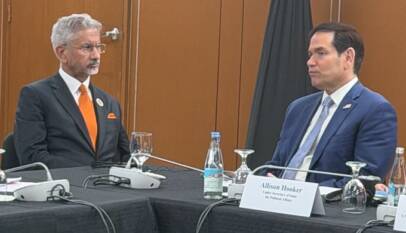
Jaishankar, Rubio Push for Defence Pacts and Near-Final Trade Deal at Manila Meeting
Manila, July 2026 : India and the United States on Wednesday gave fresh momentum …