Catholic Music Debate: Should Certain Hymns Be Banned?

“Hymns that are liked by the people are a good choice, but it’s also important
that they convey the Catholic faith”, said Archbishop Shawn McKnight.
Several hymns were temporarily banned last year in the Diocese of Jefferson City, Missouri, after being found “to be insufficient in sound doctrine”, with the action raising questions about what music is allowed at the Holy Mass. Archbishop Shawn McKnight, who implemented the brief ban, told Irons: “I would hope everybody else learns from my mistake”.
Archbishop McKnight, was the bishop of Jefferson City while implementing the ban, is now serving as the archbishop of Kansas City. The controversial ban in question encompassed 12 songs in total, including the popular hymns “I Am the Bread of Life and All Are Welcome”. Archbishop McKnight said the decree was implemented too quickly and without enough discussion among Catholics in the diocese.
Earlier, in a decree dated October 24th, 2025, Bishop W. Shawn McKnight listed a dozen commonly used but “doctrinally problematic” Catholic songs that were absolutely forbidden in the diocese after November 01st 2024. Most of the hymns were written in the 1980s or 1990s, with the oldest dating to the 1960s. The list included such songs as “All Are Welcome” by Marty Haugen; “God Has Chosen Me” by Bernadette Farrell; “Led By the Spirit” by Bob Hurd; and “Table of Plenty” by Dan Schutte.
The decree also forbidded the use of any music composed by David Haas, Cesaréo Gabarain, and Ed Conlin due to credible accusations of abuse against them. Haas music, in particular, were already been banned by a number of publishers and banned in his long time Archdiocese of Los Angeles since sexual harassment allegations against him surfaced in 2020. Gabarain, a deceased Spanish priest, has been accused of sexual abuse of minors.
According to the Catholic Missourian, McKnight issued the decree following a “thorough process of study and review” by the Diocesan Liturgical Commission as well as consultation with the diocesan Presbyteral Council, made up of priests who are ministering throughout the diocese. McKnight said his goal is to encourage “full, conscious, and active participation in the liturgy” through a common musical repertoire.
A set of 2020 guidelines from the U.S. bishops, “Catholic Hymnody at the Service of the Church”, lays out criteria for evaluating whether hymns sung at Mass are accurately conveying the truths that Catholics believe. These criteria’s are:
1. Is the hymn in conformity with Catholic doctrine?
2. Is the hymn expressed in image and vocabulary appropriately reflective of the usage of Scripture and the public liturgical prayer of the Church?
Currently, no particular hymns are excluded in the Diocese of Jefferson City, but parishes are required to evaluate Mass music using guidelines that were provided for archdioceses and dioceses across the nation by the U.S. Conference of Catholic Bishops (USCCB).
The USCCB’s 2020 – Catholic Hymnody at the Service of the Church: An Aid for Evaluating Hymn Lyrics was created to make sure Mass hymns are in conformity with Catholic doctrine. The bishops list a number of specific concerns regarding hymns, including ones with “deficiencies in the presentation of Eucharistic doctrine”, and those, “with a view of the Church that sees Her as essentially a human construction”, or songs with “an inadequate sense of a distinctively Christian anthropology”.
Kevin Callahan, who serves as the music director at Sacred Heart Parish in Glyndon, Maryland, told Irons: “We believe, the Body and Blood, Soul and Divinity of Christ is here at the Mass, in the Eucharist. The songs, of course, should reflect that”. He further explained that he understands why the bishops would create the aid. The bishops “want the right thing to be said in Church; they don’t want the wrong idea to get tossed around”, reiterating his disbelief that certain hymns could be misleading.
Callahan asserted that Gregorian chant has earned pride of place within the liturgy of the Mass. This was reflected in the Second Vatican Council document Sacrosanctum Concilium, which explains: “The Church acknowledges Gregorian chant as specially suited to the Roman liturgy”.
Sara Pecknold, a professor of liturgical music at Christendom College, noted that “Gregorian chant, beyond a shadow of a doubt, was developed with and for the liturgy. The Second Vatican Council teaches us that the more closely tied the music is to the liturgical action the more sacred it is”, she pointed out.
If Gregorian chant is unfamiliar to a parish, Pecknold recommends small steps that could be taken. She said: “I would first start with the very simplest chant melodies, for the ordinaries of the Mass”. Beyond Gregorian chant, the Second Vatican Council decided that the Church approves “of all forms of true art having the needed qualities and admits them into divine worship”.
Pecknold explained: “Liturgical music should glorify God, and it should sanctify and edify all of us who are present at this great sacrifice”.
It was Dave Moore, the music director at the 2024 U.S. National Eucharistic Congress, who was in charge of bringing together a wide variety of Catholic musicians from across the country for the event.
Moore said the musical goal of the congress was to create a unity rooted in Christ, through different styles of music. “I don’t know how you find unity without diversity,” Moore said. “There are a lot of people who do things differently than we are used to, but what we’re looking for is the heart, like: Are you pursuing the heart of God?”
Archbishop McKnight also noted the need for variety. “Catholicity means there is a universality to who we are, that we’re not of just one kind or one culture, but there is a diversity of charisms and a diversity of styles. The fact that there are different ways of entering into the mystery of Christ actually increases the unity we have; otherwise, we’re just a church of some, and not the Church of all”.
Music is “often associated with memories and emotions, too”, he said. “That is a part of our celebration of the Eucharist. It’s not just a thing of the mind. It is not just a doctrinal assent. It’s also a movement of the heart; and, ultimately, it’s active prayer. Hymns that are liked by the people are a good choice, but it’s also important that they convey the Catholic faith”, Archbishop McKnight said. “It’s about discernment of the will of God and what the Holy Spirit wants”.
Team Maverick


Amarnath Yatra Resumes After Six-Day Rain Halt, Pilgrims Hail Safety Arrangements and Renew Their Journey of Faith
Jammu, July 2026 : The annual Shri Amarnath Yatra resumed on Saturday after remaining susp…
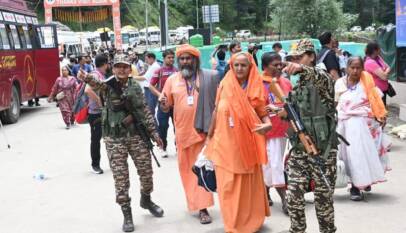
Amarnath Yatra Resumes After Six-Day Rain Halt, Pilgrims Hail Safety Arrangements and Renew Their Journey of Faith
Jammu, July 2026 : The annual Shri Amarnath Yatra resumed on Saturday after remaining …