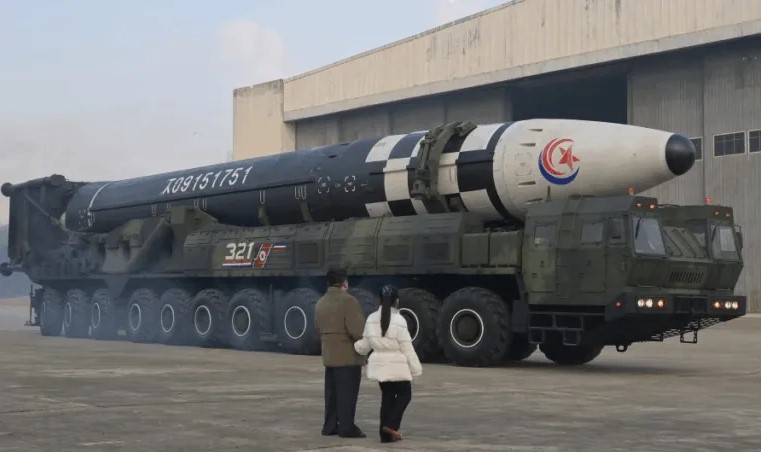
In the Politics of Illusion, North Korea miles away than the United States.

For years, while building castles in the air, the American intelligence agencies had asserted that North Korea would be requiring several more years, most likely 2020 or even 2022, before it could catapult a missile capable of striking the far distant United States. On July 4, 2017, Pyongyang had launched an intercontinental ballistic missile that reached deep space and re-entered at high velocity.
By 2017 September, North Korea had further detonated a hydrogen bomb, 15 times stronger than the bombs predecessor which was dropped at Hiroshima that had destroyed humanity for generations ahead. The Central Intelligence Agency and its sister agencies had anticipated that this day would eventually come. But their inability to predict the rapid pace of advancement remains one of the starkest intelligence failures of recent decades. It was not simply a matter of bad luck or faulty technical analysis. It was the result of two forces that intersect again and again in the history of US assessments of North Korea’s nuclear program: Pyongyang’s deliberate use of strategic deception, and the institutional inertia of the US intelligence community.
From the first suspicions of a clandestine weapons program in the 1980s through the collapse of the 1994 Agreed Framework, the inconclusive Six-Party Talks, and the dramatic summits of 2018–2019, a familiar cycle has emerged: Washington enters negotiations determined to halt or roll back North Korea’s program. North Korea agrees on paper but continues developing weapons in secret, denying violations and then unveiling new capabilities with a missile test or nuclear detonation. The agreement collapses, and Washington returns to the negotiating table with hopes of restoring momentum toward denuclearisation.
Each turn of this cycle reveals a recurring blind spot. American analysts focus on observable indicators and static assumptions, while North Korea manipulates visual evidence and creates ambiguity to gain time.
Defining intelligence –
To the public and political leaders, any unpleasant surprise is an intelligence failure. Scholars define it more precisely. Richard K. Betts, an American political scientist who is one of the leading thinkers on this issue, has argued that failures are not rare anomalies but inevitable outcomes of systemic, cognitive, and organisational barriers. Intelligence agencies must operate under conditions of uncertainty and ambiguous evidence. The greater the ambiguity, the greater the influence of preexisting beliefs.
In the case of North Korea, ambiguity is not simply an accident involving limited information. It is a condition carefully constructed by the regime. Strategic deception, deliberate manipulation of information to influence an adversary’s perceptions which has become a central component of North Korea’s nuclear armament strategy. American intelligence agencies have repeatedly struggled to adapt to this strategy, because they are weighed down by bureaucratic norms that prize continuity over change and reactivity over anticipation.
Strategic deception is most effective when the target already wants to believe a certain narrative. Intelligence analysts, like all humans, are vulnerable to cognitive shortcuts: anchoring to past estimates searching for information that confirms expectations, and discounting anomalies. North Korea exploits these tendencies. It has mastered the art of ambiguity management, controlling what is observable so analysts fill gaps with assumptions rather than evidence. It uses propaganda and signaling statements in the ruling party’s official newspaper Rodong Sinmun, broadcasts from the Korean Central News Agency to sometimes exaggerate capabilities and other times downplay them, always keeping opponents guessing.
Pyongyang has repeatedly manipulated the cycle of diplomacy itself, agreeing to freeze or dismantle programs while continuing clandestine development, thereby advancing its program while sowing confusion among US analysts and policy makers. This interplay has shaped almost every major episode in the US-North Korea nuclear saga. While experts such as Siegfried Hecker have argued that North Korea was often a willing diplomatic partner and the United States squandered opportunities to negotiate, a seeming willingness to negotiate can also be part of a broader strategy of deception.
Politics of illusion –
The 1994 Agreed Framework with the United States was intended to freeze North Korea’s plutonium production at Yongbyon in exchange for heavy fuel oil and the promise of light-water reactors. For several years, the deal appeared to hold, and intelligence analysts cautiously reduced their estimates of plutonium production. But while inspectors had limited access, Pyongyang pursued a parallel uranium enrichment effort in secret. By the early 2000s, evidence of this hidden program surfaced, shattering American assumptions and exposing how US agencies had been lulled into complacency by a formal agreement that North Korea never fully honored. The framework collapsed, but not before Pyongyang had gained years of breathing space.
The Six-Party Talks in the 2000s followed a similar trajectory. These negotiations involving China, Japan, Russia, South Korea, the United States, and North Korea, were designed to create a multilateral path toward denuclearisation. North Korea agreed in principle to abandon “all nuclear weapons and existing nuclear programs” in exchange for aid and normalization of relations. For a moment, optimism surged.
But Pyongyang simultaneously manoeuvred to maintain covert capabilities, exploiting gaps in verification and capitalising on disagreements among the negotiating parties. North Korea did dismantle Yongbyon’s cooling tower, which was a highly visible and symbolic measure, widely publicized to demonstrate commitment to denuclearisation. However, this action did not eliminate North Korea’s nuclear weapons program, nor did it address concerns over uranium enrichment, a critical pathway to nuclear weapons that remained largely outside the scope of verification.
Even as US intelligence raised warnings, Pyongyang denied enrichment altogether, declaring, “We do not currently have, nor will we ever have, a highly enriched uranium program”. In reality, work on enrichment had begun by the late 1990s. When evidence of enriched uranium traces emerged in 2007, the discovery reignited debate but produced no consensus within the intelligence community. Some analysts pointed to active enrichment inside North Korea, while others attributed the traces to contaminated equipment imported from abroad. The inability to establish a coherent judgment limited US options and eroded diplomatic leverage during the later stages of the Six-Party Talks. By turning ambiguity into a weapon, North Korea delayed scrutiny and divided analysts, ultimately securing valuable time to advance its program.
Institutional inertia –
Deception alone cannot explain repeated misjudgment. The other half of the equation lies within Washington itself. Institutional inertia is the resistance of established organisations to change, even when facing new challenges. The US intelligence community is vast, fragmented, and deeply rooted in practices that value continuity. Change tends to occur reactively, after scandal or failure, rather than proactively. Analysts are overburdened by the demands of immediate reporting, with reduced capacity for long-term strategic thinking. Bureaucratic rivalries between agencies encourage competition for influence, not experimentation in methodology.
This inertia shapes how new evidence is processed. Analysts struggle to reconcile emerging data with outdated frameworks. They lean on conservative estimates, preferring to be “wrong on the safe side”, underestimating adversaries rather than risking alarmist overstatement. But when dealing with a deceptive and fast-moving opponent like North Korea, this conservatism becomes self-defeating. It guarantees that estimates lag behind reality.
The consequences of this dynamic are not limited to intelligence assessments. They ripple outward into US policy. When policy makers are working with assessments that understate North Korea’s strengths, they make decisions that are misaligned with reality. When US intelligence agencies assured leaders in early 2017 that an operational intercontinental ballistic missile was still years away, the Trump administration initially assumed there was time for maximum pressure to work. Within months, North Korea shattered that assumption. The administration pivoted to high-stakes summitry with Kim Jong-un, but by then Pyongyang had already secured a new level of deterrent credibility.
Other scholars have traced US intelligence failures to politicisation, cultural bias, and bureaucratic rivalry. All of these play roles. Policy makers sometimes pressure analysts to produce conclusions that fit preferred policies. Analysts sometimes project American cultural assumptions onto adversaries.
Rethinking US intelligence on North Korea.
Absolute accuracy in intelligence is unattainable, but incremental improvement is possible. The patterns seen in previous US-North Korean relations suggest several possible reforms. First, intelligence organisations must build for adaptability, not stability. They must prioritise agility, encourage analysts to test assumptions, reward dissenting perspectives, and treat ambiguity as a strategic variable. Rather than forcing ambiguous evidence into existing frameworks, agencies must recognise that adversaries actively manipulate ambiguity.
Also, analysts need more than satellite imagery and signals intercepts. They need linguistic, cultural, and psychological expertise to decode the narratives that adversaries craft. Deception is a cognitive process, not just a technical one. Countering it requires cognitive tools. Intelligence that is accurate but ignored is still a failure.
Finally, agencies must improve communication with policy makers, making uncertainty clear and resisting the urge to present false precision. The goal is not to eliminate ambiguity but to help decision makers understand it and prepare for multiple scenarios.
These lessons extend beyond the Korean Peninsula. Other adversaries such as Iran, Russia, and China also employ deception to mask their capabilities and intentions. Non-state actors with access to emerging technologies can do the same. In an era defined by ambiguity and surprise, intelligence failure is not a matter of poor tradecraft alone. It is the predictable result of adversaries that weaponize deception against bureaucracies predisposed to inertia. Recognising this interaction is the first step toward breaking the cycle.
The failures of 2017 were not an aberration. North Korea will continue to advance its program, sometimes in secret, sometimes in plain sight. The United States will continue to watch, sometimes seeing clearly, often not. The challenge is to reform an intelligence system that is too reactive and too wedded to outdated frameworks.
Deception succeeds not only because adversaries conceal, but also because institutions resist recalibrating to what little is revealed. If US intelligence is to keep pace with adversaries who thrive in the shadows, it must embrace humility and adaptability. Deception is inevitable but failure does not have to be.
Team Maverick







India Aims to Build a World-Class Drone Ecosystem as Defence Reforms Accelerate Innovation
New Delhi, July 2026 : Defence Secretary Rajesh Kumar Singh has said that building a globa…

India Aims to Build a World-Class Drone Ecosystem as Defence Reforms Accelerate Innovation
New Delhi, July 2026 : Defence Secretary Rajesh Kumar Singh has said that building …