Chinese Investments finds Patronage in Ireland despite European Union and US Pressure.

Chinese investment still enjoys patronage in Ireland, the Dublin Chamber of Commerce CEO has reiterated, even as the wider European Union adopts a more cautious attitude and Dublin walks a tightrope to maintain ties with both the US and China amid a wide-ranging rivalry between the world’s two largest economies. “We’re firmly open for business within the EU rules, that is an unambiguous position”, Mary Rose Burke, CEO of the Dublin Chamber of Commerce, told the reporters in an interview last week.
“When we already have successful investors into Ireland, when we have Irish businesses investing in China, I don’t see anything that will completely upend that or stop it from being attractive for businesses to evaluate opportunities both ways”.
Chinese investment in Ireland has risen sharply in recent years, even as Beijing’s trade relations with both the EU and the United States have worsened. Direct Chinese investment in Ireland surged to US$ 380 million in 2023, up 265% year on year, and then surged another 172% last year to just under US$ 1.04 billion, according to data compiled by Beijing’s commerce ministry and other state agencies.
Burke said IDA Ireland, an autonomous statutory body that promotes foreign direct investment, had around 40 Chinese client companies that were investing across the Irish economy, including pillar industries such as technology and pharmaceuticals.
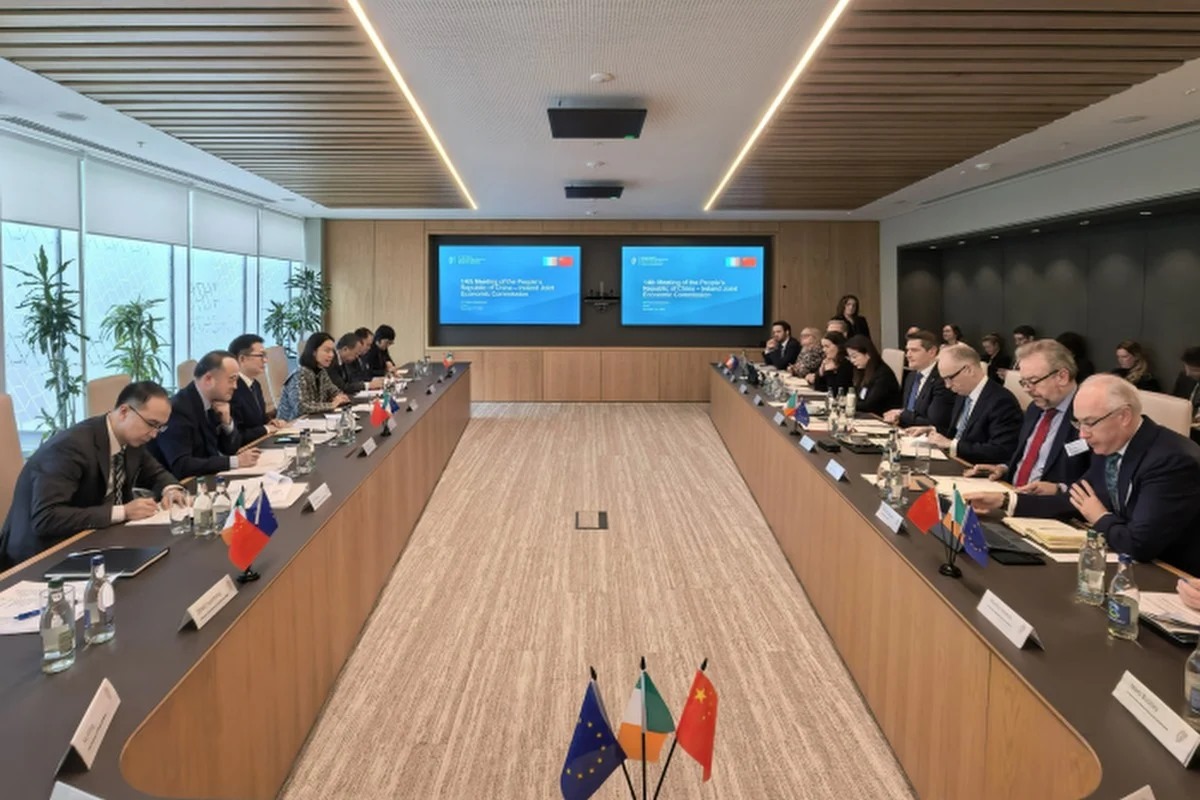
China is seeking further collaboration with Ireland in several sectors, including the digital economy, green energy, biopharmaceuticals, scientific and technological innovation and financial services, said Vice-Minister of Commerce Ling Ji last week during a visit to Dublin for a meeting of the China-Ireland Joint Economic and Trade Commission, according to a statement from the ministry. He also stressed that China would further open up its services sector over the next five years, creating new opportunities for investment by Irish companies.
Burke warned that increasing trade tensions and supply chain risks could become permanent, and Ireland would have to learn to adapt and try to find opportunities within them. Despite Ireland’s welcoming stance on Chinese business relative to the rest of Europe, its economy is heavily intertwined with that of the US. Among the many American multinationals that have built regional headquarters in the country, further incentivised by Dublin’s favourable tax policy, are tech giants Google, Meta and Apple. The US Chamber of Commerce business lobby warned Ireland last year of the national security risks associated with doing business with China, which it accused of engaging in “anticompetitive practices”.
Chinese tech firms have also established a footprint in Ireland. Telecommunications giant Huawei Technologies announced in 2022 that it would invest €150 million (US$172.9 million) in Dublin to set up the European hub of its cloud business.
On the other side, ByteDance, the owner of the TikTok short video platform, the US edition of which has been subject to a protracted divestment negotiation overseen by the White House, chose Ireland as the location for its first European data centre in 2023, in part to ease EU concerns about the protection of user data.
Ireland introduced a law in 2023 that allows the government to exclude vendors deemed to be high national security risks from taking part in the country’s communications network, but it has yet to introduce a formal ban or a gradual phasing out plan specifically targeting Huawei equipment in its 5G network, unlike other EU countries such as France and Germany.
Burke said that as a deeply integrated EU member, Ireland was unlikely to go against the bloc’s benchmark policies. As trade tensions mount, Brussels has been increasingly scrutinising China’s presence in the European market. Burke argued that Ireland could make its voice heard in trying to push for good and appropriate regulations. But exactly how much sway Dublin could have on decision-making in Brussels remains an open question.
“In a bloc of 27 countries, Ireland’s interests are very different from the others, and it has a limited amount of influence over that”, said Dan O’Brien, chief economist at the Dublin-based Institute of International and European Affairs. O’Brien noted that France threatened retaliation after recent EU-US trade talks while Ireland remained conciliatory, adding that Dublin’s strong dependency on US investment left it especially vulnerable to pressure from Washington.
While Ireland has long served as a gateway for US companies seeking to enter the European single market, Washington’s protectionist policies during Trump’s second term appear to have prompted some rethinking in Dublin, said Alexander Davey, an analyst at the Berlin-based Mercator Institute for China Studies. “Now there seems to be another economic engagement with China as rebalancing against Trump”, Davey said, naming the US president’s proposed reshoring of US pharmaceutical companies as one measure which would directly harm Ireland’s economic interests.
“The question is, how sustainable is this kind of balancing, moving from one side to the other and back again?”
Team Maverick




Iran Rejects US Peace Plan, Demands Permanent End to Conflict
Tehran, April 2026: Iran has rejected a US-proposed 15-point peace plan, instead putting f…

Iran Rejects US Peace Plan, Demands Permanent End to Conflict
Tehran, April 2026: Iran has rejected a US-proposed 15-point peace plan, instead putting forward …