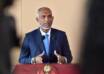
Chief Minister’s 4E Road Safety Model to Drive Statewide Campaign: Focus on Education, Enforcement, Engineering and Emergency Care

Statewide Road Safety Month to be observed from January 1 to January 31, 2026
Strict policy beyond challans: Licences to be seized and vehicles impounded for habitual offenders
Over 46,000 accidents and 24,000 deaths in 2025 a serious warning; even one death causes lifelong pain for an entire family: Chief Minister
Behaviour change at the core of awareness drive; publicity from tehsil to district level, real accident case studies and use of public address systems
Youth participation through NSS, NCC, Disaster Mitras, Scouts & Guides and Civil Defence to turn campaign into a people’s movement
Directions for black spot rectification, road safety audits, control on overspeeding and lane violations, enhanced expressway patrolling, cranes and ambulances
Golden Hour treatment paramount; linking private trauma centres, reducing response time of 108 and ALS ambulances, and fitness checks for school and heavy vehicles
Lucknow, December 2025 : Chief Minister Yogi Adityanath has directed that a statewide “Road Safety Month” be observed from January 1 to January 31, 2026, stating that the beginning of the new year should not be limited to formal events alone but must reflect firm resolve, mass participation and behavioural change on an extremely sensitive issue directly linked to public life—road safety.
Chairing a high-level review meeting on Saturday with senior government officials, divisional commissioners and district magistrates, the Chief Minister made it clear that the road safety campaign must not become a mere formality. Instead, it should evolve into a people-centric movement connected to the life and safety of every citizen.
The Chief Minister directed that the Road Safety Month be implemented strictly on the 4E model—Education, Enforcement, Engineering and Emergency Care, with equal emphasis and coordinated action on all four pillars. He said that merely informing people about traffic rules is not enough; it is essential to make them understand that adherence to these rules is directly linked to their own lives, their families and society at large. Education must instil correct road behaviour among children, youth and citizens; enforcement must ensure strict compliance; engineering must address black spots and critical points; and emergency care must guarantee prompt ambulance response and quality trauma treatment. Without balanced action on all four fronts, real reduction in road accidents is not possible, he stressed.
Referring to departmental data presented in the meeting, officials informed that 46,223 road accidents were recorded in the state till November 2025, resulting in 24,776 deaths. Calling these figures extremely alarming, the Chief Minister said road accidents are not just an administrative or technical issue but a major social challenge. Even a single death causes lifelong pain to an entire family, he said, emphasising that both sensitivity and tough decisions are essential to prevent such tragedies.
The Chief Minister instructed that special emphasis on awareness be placed during the first week of January and that all departments complete their preparations well in advance. Awareness material must be displayed compulsorily at every tehsil, block, district and major headquarters. He directed that real-life accident case studies be used to show how a moment’s negligence can change the course of an entire life. Extensive use of public address systems was also ordered to ensure the message reaches every citizen that road safety concerns their own lives and families.
To ensure mass participation, the Chief Minister directed active involvement of National Service Scheme (NSS), National Cadet Corps (NCC), Disaster Mitras, Scouts & Guides and Civil Defence. He said that only through youth and volunteer participation can the campaign truly become a public movement; government efforts alone are not sufficient without social responsibility.
Stating that challans alone are not a permanent solution, the Chief Minister ordered strict action against habitual traffic rule violators, including seizure of driving licences and impounding of vehicles. Clear guidelines must be framed and enforced rigorously, he said, adding that firmness is unavoidable in matters directly linked to human lives.
The Chief Minister also issued detailed directions for identification and permanent rectification of black spots and critical points. He pointed out that poor road engineering, faulty signage, unregulated cuts, blind curves and improper speed breakers contribute significantly to accidents. Road-owning agencies, including the Public Works Department, must ensure time-bound improvements. Only table-top speed breakers should be constructed, and regular road safety audits must be conducted.
Special instructions were issued for fitness checks of ambulances, school vehicles and heavy vehicles, ensuring that no unfit vehicle operates on roads. For long-distance passenger vehicles travelling over 300 km, deployment of two drivers was made mandatory to prevent fatigue-related accidents. The Chief Minister emphasised strict control on overspeeding, promotion of lane discipline, increased expressway patrolling, and augmentation of ambulances and cranes.
Strengthening emergency medical response, the Chief Minister underlined the importance of the Golden Hour, stating that faster medical assistance significantly reduces fatalities. He directed that private hospitals with trauma facilities be integrated into accident response systems. Departments of Home, Transport, PWD, Expressway Authority, Medical & Health and Medical Education must develop a coordinated network to ensure swift treatment. Response times of 108 and ALS ambulances must be further reduced.
Reiterating road discipline, the Chief Minister said roads are meant for movement, not parking. He ordered strict action against illegal roadside parking and directed that no tempo, bus or rickshaw stands be allowed along roads. He also instructed that construction material should not spill onto roads and that creation of vending zones is the responsibility of local bodies, which must be ensured without exception.
Highlighting risks posed by long-standing vehicles, illegal passenger vehicles and parked trucks along highways and expressways, the Chief Minister ordered immediate corrective action. He also directed zero tolerance against stunt riding, stating that it endangers not only the riders but all other road users.
The Chief Minister further instructed continued vigilance against illegal liquor activities, ensuring that liquor shops are not located near schools, colleges or religious places and that signage remains restricted to prescribed norms.
At the conclusion of the meeting, the Chief Minister interacted with district magistrates of Hardoi, Prayagraj, Agra, Kanpur Nagar and other high-accident districts, discussing major causative factors and directing formulation and strict implementation of special district-level action plans with both firmness and sensitivity to curb road accidents effectively.
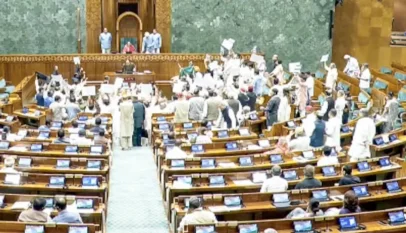
Parliament Paralysed for Second Day as Opposition Protests Over NEET Leak, Student Crackdown
New Delhi, July 2026 : Parliament remained deadlocked for the second consecutive day of th…
Parliament Paralysed for Second Day as Opposition Protests Over NEET Leak, Student Crackdown
New Delhi, July 2026 : Parliament remained deadlocked for the second consecutive day of …