India’s National Highway Network Expands by 61% in 11 Years, Becomes World’s Second-Largest

Dec 2025 : India’s road infrastructure has undergone a remarkable transformation over the past 11 years, with the country’s national highway network expanding rapidly to become the second-largest in the world. As of 2025, India’s national highways span a total length of 1,46,560 kilometres, reflecting a growth of nearly 61 per cent from 91,287 km in 2014, the Ministry of Road Transport and Highways (MoRTH) announced on Tuesday.
This expansion has been driven by a series of flagship government programmes, including the Bharatmala Pariyojana—under which the earlier National Highways Development Programme (NHDP) was subsumed—the Special Accelerated Road Development Programme for the North-East (SARDP-NE), the Left Wing Extremism (LWE) Road Development Programme, and several externally aided projects. Together, these initiatives have significantly strengthened road connectivity across regions, especially in border areas, aspirational districts, and economically strategic corridors.
One of the most striking developments has been the growth of high-speed, access-controlled corridors and expressways. From just 93 km in 2014, their operational length has surged to 3,052 km by the end of 2025. Similarly, the length of four-lane and above national highways—including expressways—has more than doubled, rising from 18,371 km to 43,512 km during the same period.
The Ministry has also made major strides in infrastructure financing. Through asset monetisation, MoRTH has raised Rs 1,52,028 crore till November 2025 using various models, and has set a target of Rs 30,000 crore for FY 2025–26. To further attract private investment, Model Concession Agreements (MCAs) have been updated, and the Build-Operate-Transfer (BOT) framework has been comprehensively revamped for the first time since 2007–08.
In a move to widen the investment base, the Ministry plans to introduce the Public Infrastructure Investment Trust, Raajmarg InvIT, for which SEBI clearance is currently under process. The issuance is expected in January 2026. In line with the Union Budget 2025–26, MoRTH has also identified a public-private partnership (PPP) project pipeline of 13,400 km, with an estimated investment of Rs 8.3 lakh crore to be developed over the next three years.
Logistics and freight movement have been another major focus. Under Bharatmala Pariyojana, 35 Multimodal Logistics Parks are planned with an investment of around Rs 46,000 crore. Once operational, these parks are expected to handle nearly 700 million metric tonnes of cargo, significantly reducing logistics costs and improving supply-chain efficiency.
For improved highway user experience, the Ministry has proposed modern wayside amenities at intervals of 40–60 km along national highways under the PPP model. Additionally, the Parvatmala Pariyojana aims to develop world-class ropeway infrastructure in hilly regions to enhance connectivity, decongest cities, and improve last-mile logistics.
Several landmark projects were completed or launched in 2025. The Prime Minister inaugurated the 12-km-long Sonamarg Tunnel in Jammu and Kashmir, built at a cost of over Rs 2,700 crore, and also inaugurated and laid foundation stones for multiple road projects in Katra, including the Rafiabad–Kupwara National Highway widening project worth over Rs 1,952 crore. Major urban decongestion projects such as the Dwarka Expressway and the Urban Extension Road-II (UER-II) in Delhi were also inaugurated.
Sustainability and safety remained central themes. India flagged off its first-ever trials of hydrogen-powered heavy-duty trucks in New Delhi as part of the clean energy push. The Cashless Treatment of Road Accident Victims Scheme, 2025 was rolled out nationwide, providing treatment cover of up to Rs 1.5 lakh per victim at designated hospitals.
Vehicle safety was further strengthened through mandatory High Security Registration Plates (HSRP), promotion of Advanced Driver Assistance Systems (ADAS), and expansion of vehicle scrapping infrastructure. As of November 2025, 123 registered vehicle scrapping facilities and 160 automated testing stations were operational, with 3.58 lakh vehicles scrapped.
Under the Rah-Veer Scheme, incentives for Good Samaritans were increased to Rs 25,000 per incident, alongside annual national awards. Digital reforms such as the BhoomiRashi portal streamlined land acquisition, while FASTag-based annual passes and pilot projects for barrier-free tolling using Automatic Number Plate Recognition cameras marked a push towards seamless mobility.
Together, these initiatives underscore a comprehensive transformation of India’s road transport ecosystem, aligning infrastructure growth with safety, sustainability, and economic development goals.
Team Maverick.
Chandrababu Naidu Reviews Preparations for PM Modi’s August 1 Inauguration of Bhogapuram International Airport
Amaravati, July 2026 : Andhra Pradesh Chief Minister N. Chandrababu Naidu on Monday conduc…
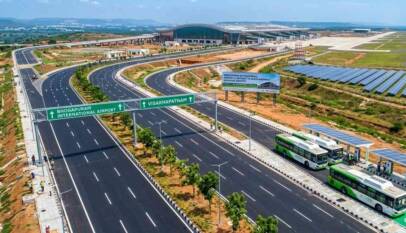
Chandrababu Naidu Reviews Preparations for PM Modi’s August 1 Inauguration of Bhogapuram International Airport
Amaravati, July 2026 : Andhra Pradesh Chief Minister N. Chandrababu Naidu on Monday conducted …