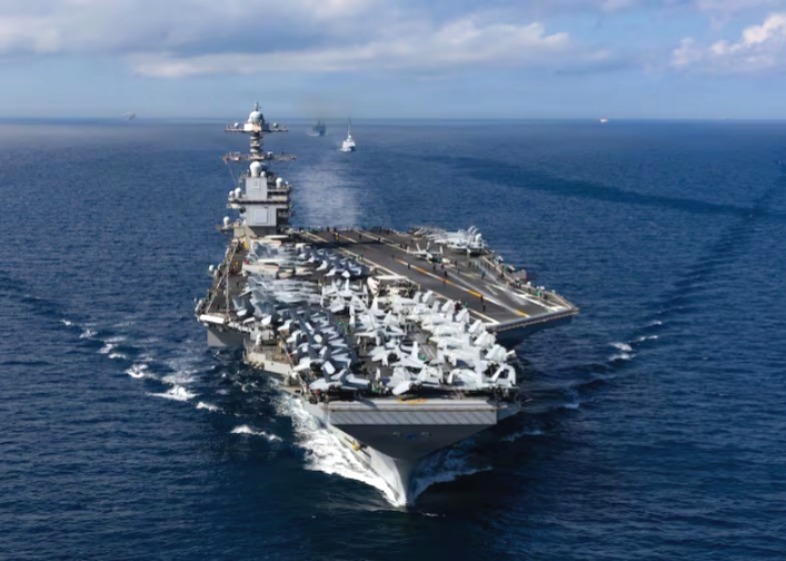
US Chief Naval Officer Cautions Against Extending USS Gerald R Ford In Greenland.

Washington; January 2026: The United States Navy’s top admiral said he would “push back” if President Trump tries to send a long-deployed aircraft carrier from the Caribbean to the Middle East as part of a U.S. military response to Iran’s crackdown on protestors. But Admiral Daryl Caudle said the Navy is prepared to discuss options, and that the USS Gerald R. Ford would be honoured to set sail if ordered.
On Tuesday, President Trump had posted on Truth Social that “Help is on the way” for protestors in Iran, as the Iranian government announced that police had killed 2,000 so far during violent clashes with demonstrators, the same day he was scheduled to receive a briefing on military options to respond.
The following day, Admiral Daryl Caudle said he hopes one of those options won’t be to send the Ford, which left its Virginia homeport for the Mediterranean Sea in June and is about to exceed its planned seven-month deployment, having been sent to U.S. Southern Command last fall in for what was described as counter-narcotics operations and possible military action against Venezuela.
“And so, if the president needs options in the Middle East, we can go build out what that looks like for him”, Caudle told reporters during a Surface Navy Association event. “I think the Ford, you know, from its capability perspective, would be an invaluable option for any military thing the President wants to do, but if it requires an extension, you know, it’s going to get some pushback from the office” of the CNO. “Regardless, the greatest honour you can have as a person in the Navy is to think you’re so valued that you need to be extended. So, the sailors will rise to that occasion”, if need be, he said.
The US Navy is trying to balance the wellbeing of sailors and the maintenance of its ships, and deployment extensions throw a wrench in both.
“People want to have some type of certainty that they’re going to do a seven-month deployment”, Caudle said. “When it goes past that, that disrupts lives…to the financial and readiness aspects, we have maintenance agreements and contracts that have been made with yards that are going to repair the ships that are in that strike group, including the carrier itself. And so, when those are tied to a specific time, the planning, the yard is expecting it to be there, all that is highly disrupted, okay?”
The service has been for years trying to get on top of these maintenance delays, even releasing a strategy a year ago that aimed to get 80 percent of ships deployable by 2027. Caudle warned that delaying that maintenance now could extend its funding into the next budget cycle, and with continuing resolutions so common, increased wear requiring increased repairs might not get the commensurate increased funding.
“The financial aspects of an extension can be quite disruptive when we burn the ships hotter”, he said. “When it goes eight, nine-plus months, those critical components that we weren’t expecting to repair are now on the table, so the work package grows. So that’s disruptive”.
Chief of Naval Operations Admiral Lisa Franchetti set a goal for the Navy last fall that she conceded might be a little aspirational: to have 80% of the Navy’s fleet ready to deploy at any given time by 2027.
On 12th January 2026, Naval Sea Systems Command released its strategy to support that effort: a five-part plan that includes getting new ships in the water on time while also creating more maintenance opportunities for existing ships. The second part will mean sticking to the schedule for maintenance periods, a continuous challenge for the service.
“Bonus points for early”, Vice Admiral Jim Downey, head of Naval Sea Systems Command, said Thursday during a panel at the Surface Navy Association’s annual symposium outside Washington, D.C. “That is possible”. Getting there will take better planning, he added, including shorter maintenance periods with tight schedules to make sure needed repairs and upgrades are done—and no time for lollygagging. That might look like 100 or 150 days in dry dock rather than a year, as data shows scheduled year-long availabilities are four times as likely to run over on time than shorter ones, Downey said.
There’s also a new policy that caps any added time to address surprises uncovered during the maintenance period to 12% of the original timeframe, Rear Admiral Bill Greene, who commands Navy Regional Maintenance Center in Norfolk, told the audience.
Which is to say, if you have 100 days scheduled, anything you add during the process can’t take more than 12 extra days. If it does, it needs approval from the first flag officer in that ship’s chain of command. Some of this will also necessitate better coordination with private partners.
“And that really comes down to planning what the work scope is, planning the material availability, and making sure the material is there ahead of time and ready to be used, and then making sure that the labor that we need is also ready”, George Whittier, the CEO of ship engine supplier Fairbanks Morse, said during the panel.
And then there’s the option to do computer repairs and upgrades independently, rather than in a shipyard. Rather than having to rip out and replace a destroyer’s computer system to upgrade its Aegis Weapon System, Program Executive Office Integrated Warfare Systems is making the updates virtual.
“This enables the rapid delivery of new capabilities, software updates early, making our ships more lethal just by delivering upgrades to a computer program even while they’re at sea”, said Captain Andy Biehn, a military deputy at PEO IWS. Several destroyers have received this update so far, he added, with 20 more scheduled to complete it this year.
Team Maverick.








Super-Sub Merino Delivers Again as Spain March into World Cup Semi-finals
Los Angeles, July 2026 : Mikel Merino has emerged as Spain’s ultimate impact player …

Super-Sub Merino Delivers Again as Spain March into World Cup Semi-finals
Los Angeles, July 2026 : Mikel Merino has emerged as Spain’s ultimate impact player …