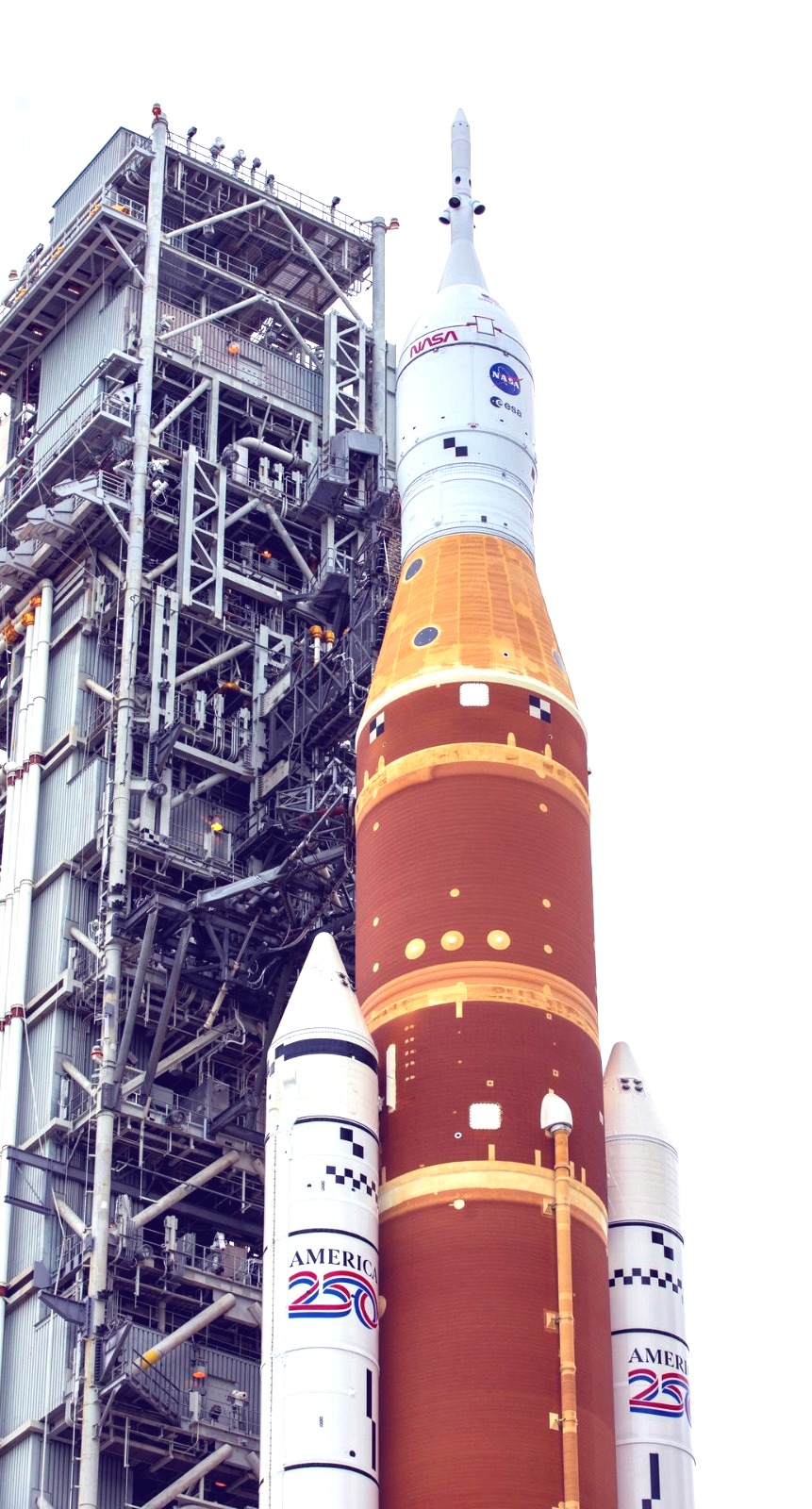
NASA To Discuss Early Results Of Artemis II Wet Dress Rehearsal.

Florida Space Centre; February 2026: Following a fuelling test of NASA’s SLS (Space Launch System) rocket at the launch pad for the Artemis II Moon mission, leaders will discuss initial results during a news conference at 12:00 hours (EST) which would be 22:30 hours (IST) tomorrow Tuesday, February 03rd.
The agency’s SLS rocket and Orion spacecraft arrived at Launch Pad 39B at NASA’s Kennedy Space Center in Florida on January 17th 2026. Since then, engineers have been conducting a variety of tests prior to launch. Underway now is a wet dress rehearsal, which requires filling the rocket with the 700,000 gallons of propellant.
Call to stations began on 31st January, and teams are counting down to a simulated launch window opening at 21:00 hours (EST) on Monday. If more work is needed, NASA may rollback SLS and Orion into the Vehicle Assembly Building after the wet dress rehearsal.
The agency will stream the news conference live on its YouTube channel. A 24/7 live stream of the rocket remains online, as well as a separate feed for coverage of the wet dress rehearsal.
Participants in the news conference include:
NASA Associate Administrator Amit Kshatriya; Lori Glaze, acting associate administrator for the Exploration Systems Development Mission Directorate; John Honeycutt, chair, Artemis II Mission Management Team Representative, Exploration Ground Systems Program
Following a successful wet dress rehearsal, NASA leaders will make a final call to send the Artemis II astronauts to Kennedy. The four crew members have been in quarantine in Houston since 21st January 2026. If teams need more time to work on Artemis II hardware, crew can remain in Houston or exit quarantine.
If the crew members are sent to Kennedy, they are expected to fly NASA’s T-38s to Florida, arriving on the centre about 15:00 hours (EST) on February 03rd. They will participate in a media gaggle immediately following landing. Their gaggle also will stream live on NASA’s YouTube channel.
Participants include all four Artemis II crew members:
- Reid Wiseman, commander, NASA astronaut.
- Victor Glover, pilot, NASA astronaut.
- Christina Koch, mission specialist, NASA astronaut.
- Jeremy Hansen, mission specialist, CSA (Canadian Space Agency) astronaut.
As part of a Golden Age of innovation and exploration, Artemis will pave the way for new U.S. crewed missions on the lunar surface in preparation to send the first astronauts to Mars.
Artemis II Wet Dress Rehearsal –
Following successful chill down of the liquid hydrogen and liquid oxygen lines, teams started slowly filling the SLS (Space Launch System) rocket’s core stage with super-cold liquid hydrogen, chilled to minus 423 degrees Fahrenheit, then with liquid oxygen chilled to minus 297 degrees. This marks the official start of propellant loading for the Artemis II wet dress rehearsal.
Slow fill is a deliberate process that allows the tanks and associated hardware to thermally condition before transitioning to fast fill. This step minimises thermal stress and ensures the integrity of the system as hundreds of thousands of gallons of cryogenic propellant flow into the core stage.
At approximately 11:25 hours (EST) which is 21:55 (IST), the Artemis launch director, in coordination with the mission management team chair, gave the “go” to begin loading cryogenic liquid propellant into the SLS (Space Launch System) rocket for wet dress rehearsal. While teams continue to monitor cold weather that would impact launch day, they are not tracking weather constraints to Monday’s tanking operations.
NASA teams have completed final preparations and closeouts of the umbilical’s connecting the mobile launcher to the SLS rocket and Orion spacecraft. The umbilical’s provide power, communications, and fuel to different parts of the rocket and spacecraft, while additional accessories provide stabilization. During launch, each umbilical releases from its connection point, allowing the rocket and spacecraft to lift off safely.
Teams will begin slowly filling cryogenic propellant into the rocket beginning at L-9 hours 25 minutes in the countdown. Liquid hydrogen and liquid oxygen will flow into the rocket’s core stage and interim cryogenic propulsion stage tanks, topped off and replenished as some cryogenic propellant boils off. The team will also conduct leak checks to ensure loading proceeds as expected.
Earlier, The Artemis II wet dress rehearsal countdown continued as teams at NASA’s Kennedy Space Center in Florida began configuring the SLS (Space Launch System) rocket and Orion spacecraft with gaseous nitrogen, an important step to mitigate fire hazards, protect spacecraft systems, and ensure mission safety.
Technicians had replaced the ambient air in the SLS and Orion crew module with gaseous nitrogen, which is an inert gas that does not support combustion. By replacing air – which contains highly-combustible oxygen – with nitrogen, engineers can remove the oxidiser needed to sustain fire and dramatically reduce flammability risks in a launch environment filled with high-energy systems and propellants.
The step also includes an inerting purge that removes oxygen and prevents contaminants like moisture or particulates from entering sensitive systems on SLS and Orion. This keeps propulsion and life-support hardware clean and stable and creates a non-reactive environment that protects hardware and minimizes chemical reactions during countdown and ascent.
While gaseous nitrogen is excellent for fire prevention, it is hazardous for humans to breathe because it displaces oxygen, so all personnel have cleared the area during operations.
Team Maverick.








Australia Calls India a Top-Tier Security Partner, Unveils Landmark Defence and Energy Agreements
Canberra, July 2026 : Australia on Thursday described India as one of its most important s…

Australia Calls India a Top-Tier Security Partner, Unveils Landmark Defence and Energy Agreements
Canberra, July 2026 : Australia on Thursday described India as one of its most …