MP Emerging as Leader in Tackling Climate Change: CM Dr. Yadav

Chief Minister Dr. Mohan Yadav stated that climate change is a serious global challenge, directly linked to human existence, economic stability, and the future of coming generations. He emphasised that sustainable development cannot be achieved by ignoring environmental concerns, and that balancing development with environmental protection is the true foundation of progress.
Chief Minister Dr. Yadav underlined the need for concrete and time-bound solutions to address climate change, adding that states play a crucial role in fulfilling India’s climate commitments. He said that Madhya Pradesh has emerged as a leader in renewable energy production and is playing a pioneering role in addressing climate change. The state is among the fastest-growing in the country, witnessing rapid development across sectors. Assuring full cooperation and security to investors interested in renewable energy, he stated that the government and investors together will make the nation self-reliant in renewable energy. Chief Minister Dr. Yadav also stated that Madhya Pradesh is moving swiftly toward ensuring 24-hour power supply and that partnerships with investors will take renewable energy enterprises to new heights.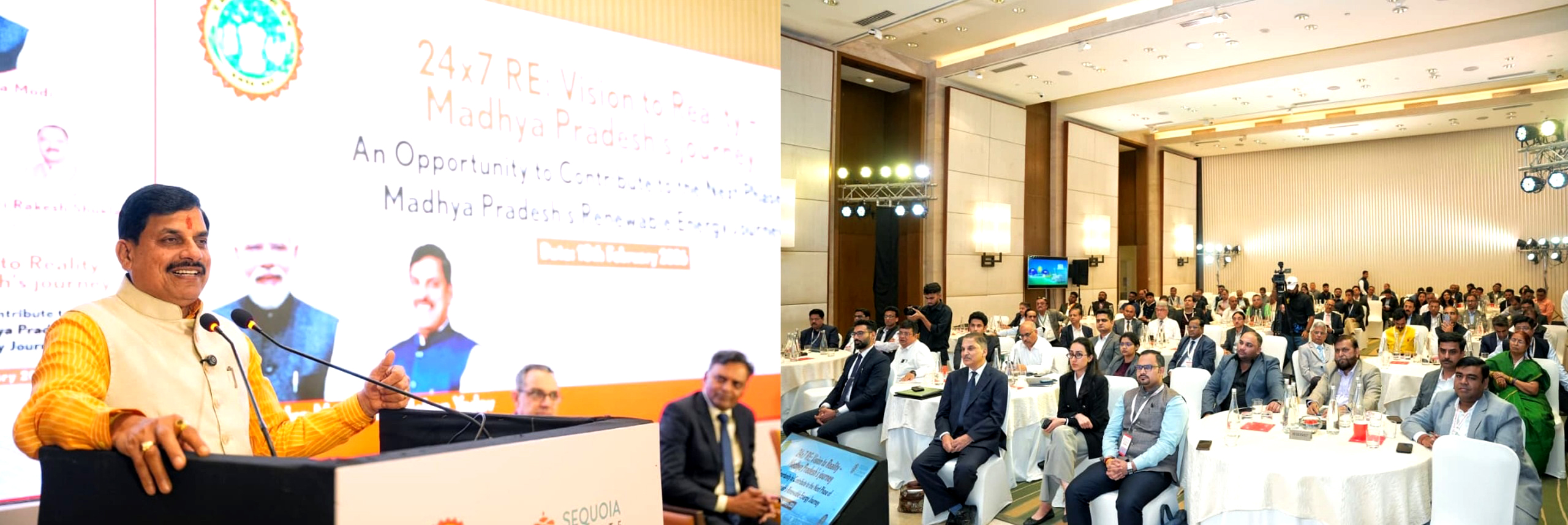
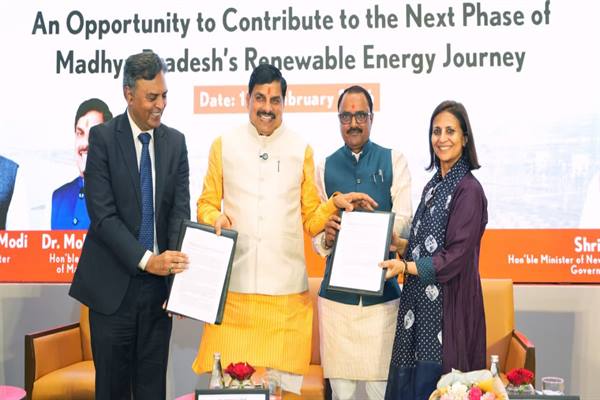
Chief Minister Dr. Yadav addressed the gathering at Mumbai Climate Week 2026 on Wednesday evening. On this occasion, an MoU was signed between the Department of New and Renewable Energy, Government of Madhya Pradesh, and the renowned Sequoia Climate Foundation for the development of renewable energy in the state, in his presence.
Chief Minister Dr. Yadav stated that the challenge of climate change cannot be resolved by one country, state, or government alone and requires strong national and international cooperation. He said that Mumbai Climate Week serves as an important platform for advancing energy transition, green growth, and climate solutions. The Chief Minister emphasised the urgent need for collective efforts to reduce carbon emissions, promote clean energy sources, adopt green technologies, and ensure balanced use of natural resources. He appealed for greater public participation in environmental protection and encouraged citizens to adopt behavioural changes under the ‘Lifestyle for Environment’ initiative.
Chief Minister Dr. Yadav said, highlighting innovations by the Madhya Pradesh Government in green energy production, that the state has established a distinct identity in the renewable energy sector. Madhya Pradesh was the first state to introduce an EV policy, marking a significant step toward combating climate change. The government is currently implementing a 300 MW 4-hour solar-plus energy storage project, a 300 MW 6-hour solar-plus energy project, and a 24×7 battery-based renewable energy storage project, a first-of-its-kind initiative in India.
Over the past 12 years, the state’s renewable energy capacity has grown remarkably, with solar energy registering 48 per cent annual growth and wind energy 19 per cent annual growth. After meeting its own energy needs through major renewable projects, Madhya Pradesh has begun supplying clean energy to neighbouring states and to Indian Railways.
Chief Minister further stated that the Omkareshwar Floating Solar Project is the world’s largest floating solar project, developed without displacing a single citizen, and energy generation has already commenced. Sanchi has become the country’s first Solar City, and the government is moving toward installing solar rooftops on all government buildings. The Chief Minister said the state is rapidly progressing toward becoming India’s renewable energy hub through partnerships with investors, the private sector and policymakers. Financial and policy incentives are being extended for solar, wind, energy storage, biofuel, and green hydrogen technologies. He invited investors to join Madhya Pradesh’s transformative journey, stating that it will not only help balance the climate but also elevate businesses and contribute significantly to the state’s development. He affirmed the government’s commitment to achieving energy security, environmental protection, and sustainable development goals for a brighter future.
Minister for New and Renewable Energy Shri Rakesh Shukla said that the state is advancing toward battery storage-based energy production to tackle climate challenges. Projects such as the Omkareshwar Floating Solar Power Project and Ultra Mega Solar Projects in Shajapur, Agar-Malwa, and Rewa are being implemented. He invited investors to explore opportunities in Madhya Pradesh.
Additional Chief Secretary, New and Renewable Energy, Shri Manu Srivastava, said that renewable energy is an efficient, affordable, and reliable alternative for electricity supply, and that the state is ensuring power at minimal rates. He added that the Chief Minister had committed at the World Economic Forum in Davos to provide 24×7 electricity supply, a commitment now being fulfilled.
Regional Director for South Asia at the International Finance Corporation (IFC), affiliated with the World Bank Group,Shri Imad N. Fakhoury, appreciated the state’s rapid progress in renewable energy and its investor-friendly 24×7 renewable energy design. He assured full cooperation in establishing the FDRE centres in the state.
India Director of Sequoia Climate Foundation, Sushri Seema Paul, said that Madhya Pradesh is a leader in renewable energy, with around 500 gigawatts of renewable capacity under development. She stated that the Foundation is both a partner and stakeholder in expanding renewable energy in the state and formalised this collaboration through the MoU.
Dr. Ashwini Kumar and Shri Amit Singh also addressed the gathering, highlighting renewable energy innovations in the state. Environmental experts, policymakers, and industry representatives from India and abroad participated in large numbers. Managing Director of Madhya Pradesh Energy Development Corporation, Shri Amanveer Singh Bains, was also present.
Yamini Maurya Wins Silver as India Enjoys Historic Judo Run at Commonwealth Games 2026
Glasgow, August 2026 : India’s impressive run in judo at the Commonwealth Games 2026 conti…
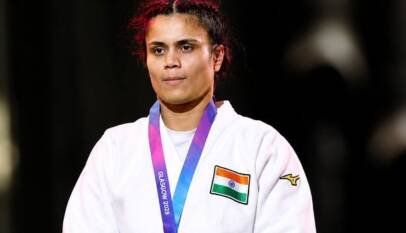
Yamini Maurya Wins Silver as India Enjoys Historic Judo Run at Commonwealth Games 2026
Glasgow, August 2026 : India’s impressive run in judo at the Commonwealth Games 2026 …